
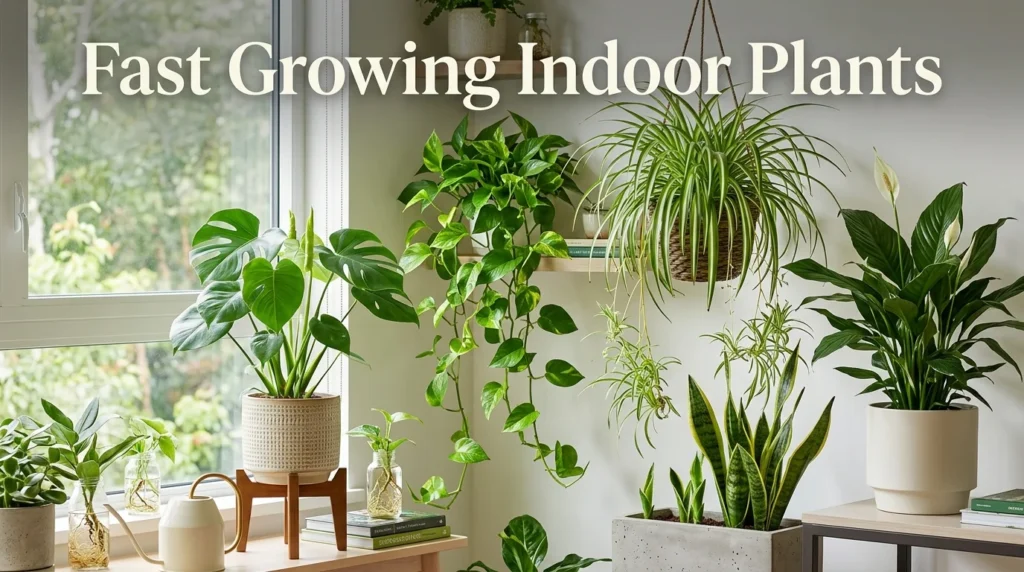
The best fast growing indoor plants are aggressive green growers like Golden Pothos, Heartleaf Philodendron, Spider Plant, Tradescantia Zebrina, and Syngonium. Under proper indoor conditions specifically bright indirect light, warm ambient room temperatures (68°F–80°F), and a consistent watering routine these species can produce anywhere from 6 to 24 inches of fresh vine or stem growth during a single spring and summer growing season.
Growing rapid producers inside your home provides instant gratification, quickly fills empty corners, and generates an abundance of healthy cuttings for propagation. However, fast growth demands careful management: rapid producers consume soil nutrients quickly, require frequent repotting upgrades to avoid root binding, and can quickly become leggy or floppy if light levels fall short of their metabolic needs.
Successfully cultivating fast growing indoor plants comes down to balancing three core factors: photosynthetic light intake, balanced fertilizing routines, and regular maintenance pruning. Without enough bright light, even the naturally fastest-growing species will stall out or stretch wildly, producing sparse leaves on thin, weak stems.
This comprehensive master guide covers top fast-growing species comparisons, maximum-growth environmental triggers, feeding and soil protocols, pruning techniques to maintain bushiness, propagation steps, and diagnostic troubleshooting for rapid indoor growers.
Top Fast Growing Indoor Plants Compared
Selecting species suited to your room’s natural lighting, humidity, and maintenance schedule ensures consistent, vigorous growth year-round. If you are new to fast growers, start with one forgiving beginner species and learn its rhythm before filling every corner. Choose plants to match your brightest available spots rather than trying to force a high-light vine into a dim hallway.
| Plant Species | Common Name | Growth Rate & Pattern | Light Requirement | Watering Interval | Skill Level |
| Epipremnum aureum | Golden Pothos | Trailing/Climbing vine (12–18 in/month) | Medium to bright indirect light | Top 50% dry | Beginner |
| Philodendron hederaceum | Heartleaf Philodendron | Trailing vine (12–20 in/month) | Medium to bright indirect light | Top 50% dry | Beginner |
| Chlorophytum comosum | Spider Plant | Clumping rosette with offshoots (10–15 in/season) | Bright indirect light | Top 50% dry | Beginner |
| Tradescantia zebrina | Inch Plant / Wandering Dude | Cascading colorful stems (18–24 in/season) | Bright indirect light to gentle sun | Top 25–50% dry | Beginner |
| Syngonium podophyllum | Arrowhead Vine | Bushy to vining habit (12–16 in/season) | Medium to bright indirect light | Top 50% dry | Beginner |
| Pilea peperomioides | Chinese Money Plant | Upright stem with basal pups (8–12 in/season) | Bright indirect light | Top 75% dry | Intermediate |
| Ficus elastica | Rubber Tree | Upright tree specimen (12–24 in/year) | Bright indirect to direct morning sun | Top 50% dry | Intermediate |
Environmental Triggers That Accelerate Indoor Growth
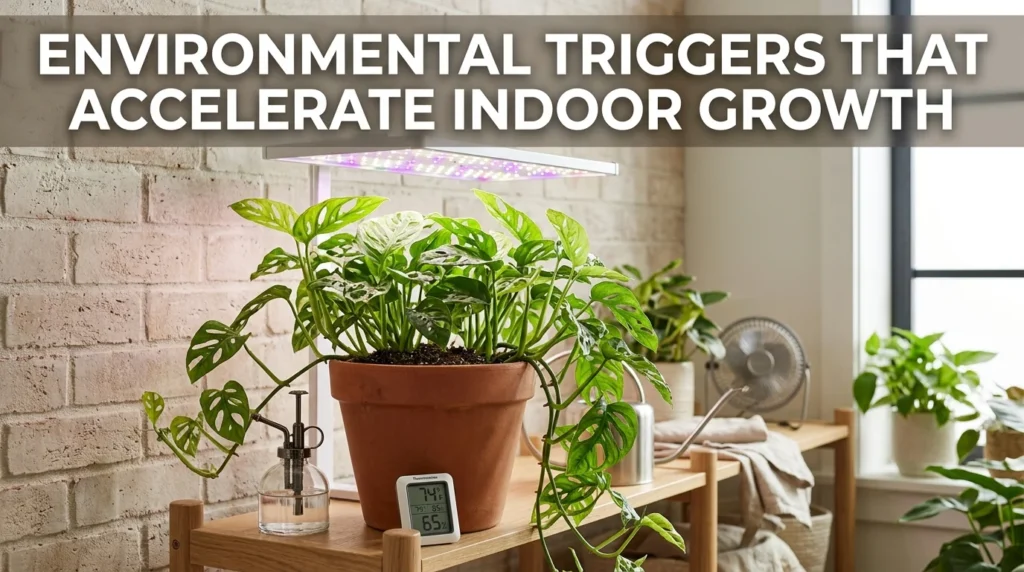
A plant’s genetic capability for fast growth is only unlocked when key environmental inputs light, temperature, and atmospheric moisture are optimized.
1. Light: Fueling Rapid Photosynthesis
Light is the fundamental metabolic driver of plant growth. Plants synthesize sugars from light energy; if light intake is insufficient, cellular division slows down regardless of how much water or fertilizer is applied. Rotate pots regularly so all sides grow evenly, and wipe dust from the leaves so they capture as much light as possible. Tall, stretched stems with wide gaps between leaves are the classic signal that a plant is reaching for more light.
- Ideal Light Levels: Position rapid growers in areas receiving bright, indirect sunlight for 6 to 8 hours daily (near East-, West-, or set-back South-facing windows).
- Light Intensity Targets: Aim for 200 to 400 foot-candles (approx. $20 – 40 \ \mu\text{mol/m}^2/\text{s}$ PPFD) for foliage vining plants, and up to 600 foot-candles for variegated species.
- Low-Light Consequences: In dark rooms, plants stall or stretch (etiolation), producing long gaps between nodes and small, pale leaves.
- Supplemental Lighting: If natural window light is limited, install full-spectrum LED grow lamps 12 to 18 inches above the foliage, running for 12 to 14 hours per day.
2. Temperature and Thermal Energy
- Optimal Temperature Range: Keep indoor temperatures between 68°F and 82°F (20°C to 28°C). Warm ambient air accelerates cellular chemical reactions, driving faster leaf unfolding.
- Cold Stunting: Temperatures below 60°F (15°C) force tropical plants into survival mode, stalling new growth. Avoid placing pots near chilly window drafts or air conditioning units.
3. Humidity and Stomatal Opening
- Relative Humidity Goal: Maintain ambient humidity between 50% and 65%.
- Why Humidity Matters: High humidity allows leaf pores (stomata) to remain open longer during daytime light hours without risking moisture loss. This maximizes carbon dioxide intake, accelerating growth rate.
Substrates, Nutrient Management, and Potting Protocols
Because fast growing indoor plants develop extensive root systems rapidly, their substrate and nutrient requirements differ from slow-growing cacti or succulents.
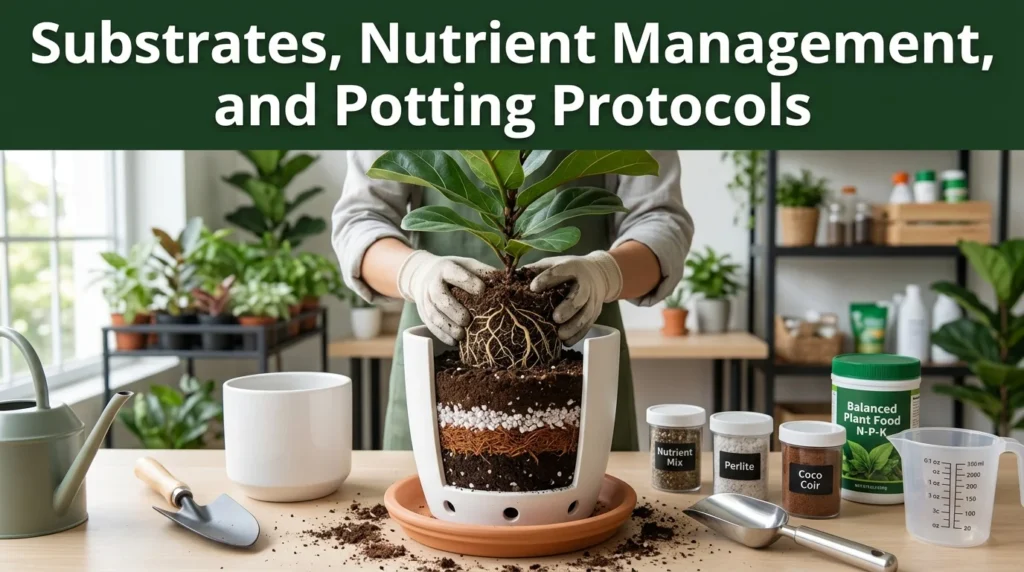
High-Aeration Rich Soil Mix Recipe
Rapid roots require a substrate that holds balanced moisture while delivering continuous oxygen to root tips:
- 40% High-Quality Peat Moss or Coco Coir (Moisture retention and structure)
- 30% Coarse Perlite or Pumice (Aeration and preventing compaction)
- 20% Fine Orchid Bark or Rice Hulls (Root zone porosity)
- 10% Aged Worm Castings (Organic micro-nutrients)
Feeding Schedule for Peak Growth
Fast foliage expansion exhausts soil nutrients quickly. Unfed plants develop small, pale leaves and leggy stems. Always apply fertilizer to already-moist soil rather than a dry root ball, and flush with plain water every month or two to prevent salt buildup. Brown, scorched leaf tips are a common sign that feeding has been too heavy-handed.
- Spring and Summer Routine: Apply a balanced, water-soluble liquid fertilizer (such as 10-10-10 or 20-20-20) diluted to half-strength every 2 weeks during active spring and summer growth.
- Foliar and Organic Boosts: Supplement monthly with liquid seaweed or diluted fish emulsion for trace minerals.
- Autumn & Winter Pause: Reduce fertilizer applications to once every 6 to 8 weeks, or halt entirely if plant growth pauses during short winter days.
Pruning, Pinching, and Shaping for Maximum Bushiness
Unchecked fast growth can lead to long, sparse vines or top-heavy stems. Regular pruning is essential to keep rapid growers full, bushy, and structurally sound.
1.Locate Leggy Stems:Identify long, thin stems with wide spaces between nodes.
Inspect the plant for thin stems where leaves are spaced far apart due to rapid stretching.
2.Pinch Back Growing Tips:Make clean cuts 1/4 inch above a leaf node using sharp, sterile shears.
Snip off the leading growth tips of trailing or bushy stems. Pruning breaks apical dominance, forcing dormant lateral buds along the stem to activate and branch out.
3.Propagate Trimmings:Select healthy 4- to 6-inch cuttings containing 2 to 3 leaf nodes.
Do not throw away pruned stems. Strip the lowest leaves and place cuttings into clean water or moist substrate to grow new roots within 2 to 3 weeks.
4.Re-plant Cuttings to Fill the Base:Plant rooted cuttings back into the base of the mother pot.
Tuck rooted cuttings into empty spots around the soil crown to create a dense, bushy appearance.
Repotting and Root Management for Fast Growers
Rapid growers quickly fill containers with root masses. If left root-bound, growth stops, and leaves yellow due to nutrient depletion.
Signs Your Fast Grower Needs Repotting
- Roots escaping through bottom drainage holes.
- Soil drying out rapidly within 1 to 2 days of a thorough watering.
- Water running straight through the sides of the pot without soaking in.
- Stalled top growth during mid-summer despite proper light and feeding.
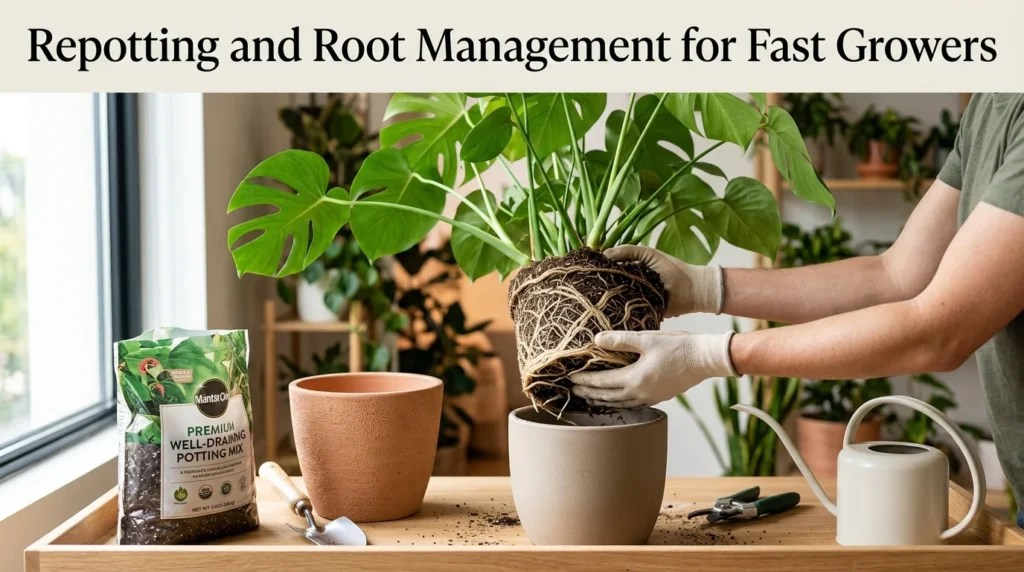
Step-by-Step Repotting Process
- Choose the Right Pot Size: Select a fresh pot that is 1 to 2 inches larger in diameter than the current container. Avoid oversized pots, which hold excess soil that remains wet too long.
- Unpot and Inspect: Gently loosen the plant from its container. Tease apart tightly coiled roots around the base to encourage outward root expansion.
- Fresh Substrate Base: Add fresh, high-aeration soil mix to the bottom of the new pot so the top of the root ball sits 1 inch below the rim.
- Fill and Settle: Place the plant inside, fill around the root mass with soil mix, press gently to remove air pockets, and water thoroughly until it drains out the bottom.
Troubleshooting Issues in Fast Growing Indoor Plants
Rapid metabolic rates mean problems happen quickly. Use this diagnostic table to address health issues before they damage the plant:
| Problem | Cause | What to Check | Solution |
| Long, thin stems with tiny, sparse leaves | Insufficient light (etiolation) | Distance from window; daily light hours | Move plant closer to a bright window or install a dedicated LED grow lamp |
| Yellowing lower leaves and soft stems | Overwatering; lack of soil oxygen | Soil moisture depth; pot drainage holes | Allow top 50% of soil to dry out; switch to an airy perlite-rich potting media |
| Crispy, brown leaf tips and edge curling | Low ambient humidity; high fertilizer salts | Room humidity levels (<40% RH); fertilizer dose | Raise humidity above 50%; flush soil thoroughly with clean water to clear salts |
| Pale, washed-out foliage with slowed growth | Nutrient deficiency (Nitrogen/Iron) | Feeding schedule frequency; soil age | Apply half-strength balanced liquid fertilizer every 2 weeks during active growth |
| Wilting foliage despite wet potting soil | Root rot from standing water | Root mass firmness and color (mushy vs. firm) | Unpot plant, trim away soft black rotted roots, and repot into fresh dry airy media |
Conclusion
Cultivating fast growing indoor plants is one of the most rewarding ways to transform your living space into a lush, vibrant green sanctuary in a short period. By providing bright indirect light, using an airy, nutrient-dense soil mix, and maintaining a balanced feeding schedule during active growing seasons, you unlock the maximum genetic potential of species like Pothos, Philodendrons, and Tradescantias.
Remember that rapid top growth requires active root management and routine maintenance. Regular pruning not only keeps long vines bushy and prevents legginess, but it also supplies an endless stream of fresh cuttings for water propagation. Keep an eye out for root-bound pots, adjust your watering as seasons change, and enjoy watching your indoor garden expand month after month.
Knowledge Check: Fast Growing Plants Quiz
Question 1
What is the single most critical environmental factor needed to maintain fast plant growth indoors?
- A) Keeping soil waterlogged 24/7.
- B) Adequate bright indirect light to power photosynthesis.
- C) Keeping room temperatures near freezing.
- D) High nitrogen feeding in pitch darkness.
Question 2
What horticultural effect does pinching back stem tips have on fast-growing trailing plants?
- A) It kills the entire root system instantly.
- B) It breaks apical dominance, forcing lateral buds to grow and making the plant bushier.
- C) It turns green leaves into flowers immediately.
- D) It halts growth permanently.
Question 3
How much larger should a new pot be when repotting a root-bound fast-growing houseplant?
- A) 8 to 10 inches larger.
- B) Exactly the same size.
- C) 1 to 2 inches larger in diameter.
- D) 5 times deeper than wide.
Question 4
Why do fast-growing indoor plants require more frequent fertilizing during spring and summer?
- A) They lose leaves if unfed for two days.
- B) Rapid cell expansion quickly consumes available soil minerals like nitrogen and potassium.
- C) Fertilizer acts as a replacement for sunlight.
- D) Soil turns into water without fertilizer.
Question 5
Which of the following is a classic sign that a fast-growing plant is receiving insufficient light?
- A) Thick, dark green, tightly spaced leaves.
- B) Stems stretching with wide gaps between small, pale leaves (etiolation).
- C) Massive root growth pushing out of the pot.
- D) Immediate flower production.
(Answer Key: 1-B, 2-B, 3-C, 4-B, 5-B)
Common Mistakes to Avoid with Fast Growing Indoor Plants
Most fast-grower frustrations come from a few avoidable habits. Watch out for these:
- Chasing growth with extra fertilizer while light is too dim for the plant to use it.
- Repotting into a far oversized pot that stays wet and stalls growth instead of speeding it.
- Letting vines grow unchecked until they turn leggy, then cutting everything back at once.
- Watering on a fixed schedule instead of checking how quickly the soil actually dries.
- Ignoring root-bound warning signs until top growth stalls completely.
Frequently Asked Questions
What indoor plant grows the fastest?
Tradescantia zebrina, Golden Pothos, and Heartleaf Philodendron are among the fastest-growing indoor plants. Under bright indirect light and warm room temperatures, individual vines can grow 1 to 2 feet per month during the active growing season.
How can I make my indoor plants grow faster?
To maximize indoor growth rates: move plants into bright indirect light, keep room temperatures warm (70°F–80°F), maintain humidity above 50%, feed with half-strength liquid fertilizer every two weeks in spring/summer, and prune stem tips regularly to encourage dense growth.
Do fast growing indoor plants need bigger pots?
Yes. Rapid foliage growth is supported by an equally fast-growing root system. Check pots every spring; if roots are tightly bound or growing through bottom drainage holes, repot into a container 1 to 2 inches larger.
Why is my fast-growing plant turning leggy?
Legginess occurs when light levels are too low. Stems stretch out toward the nearest light source, resulting in wide gaps between nodes and smaller leaves. Relocate the plant to a brighter window or add a grow light.
Should I feed fast-growing plants during winter?
No. Growth slows down significantly during autumn and winter due to shorter daylight hours. Reduce fertilizer applications to once every 6 to 8 weeks, or stop entirely until new spring growth appears.
Are fast growing plants good for beginners?
Yes. Fast-growing species like Pothos, Spider Plant, and Heartleaf Philodendron are extremely resilient, adapt easily to typical home environments, and respond quickly to proper care.
Can I propagate cuttings from fast growing indoor plants in water?
Yes. Cuttings from fast-growing vining plants like Pothos, Tradescantia, and Philodendron root easily in clean water. Place stem cuttings in a sunny spot; roots will typically emerge within 7 to 14 days.
Bright, indirect sunlight for 6 to 8 hours daily. In dark rooms, plants stall or stretch (etiolation), producing long gaps between nodes and small, pale leaves.
Keep indoor temperatures between 68°F and 82°F (20°C to 28°C). Temperatures below 60°F (15°C) force tropical plants into survival mode, stalling new growth.
Select a fresh pot that is 1 to 2 inches larger in diameter than the current container. Avoid oversized pots, which hold excess soil that remains wet too long.

Megan Foster is the founder and lead writer of GrowIndoorly.com, where she shares practical, easy-to-follow advice for growing healthy indoor plants. She is passionate about helping beginners and experienced plant lovers build thriving indoor gardens with confidence. Megan writes about houseplants, indoor herbs, succulents, hydroponics, grow lights, plant propagation, watering, soil care, and everyday plant maintenance.
She enjoys researching trusted gardening techniques and transforming them into simple, actionable guides that readers can easily apply at home. Her goal is to make indoor gardening more enjoyable and accessible by providing clear, reliable information that helps people keep their plants healthy throughout the year. Whether you’re caring for your first houseplant or expanding your indoor plant collection, Megan’s practical tips are designed to help you grow with confidence.


