
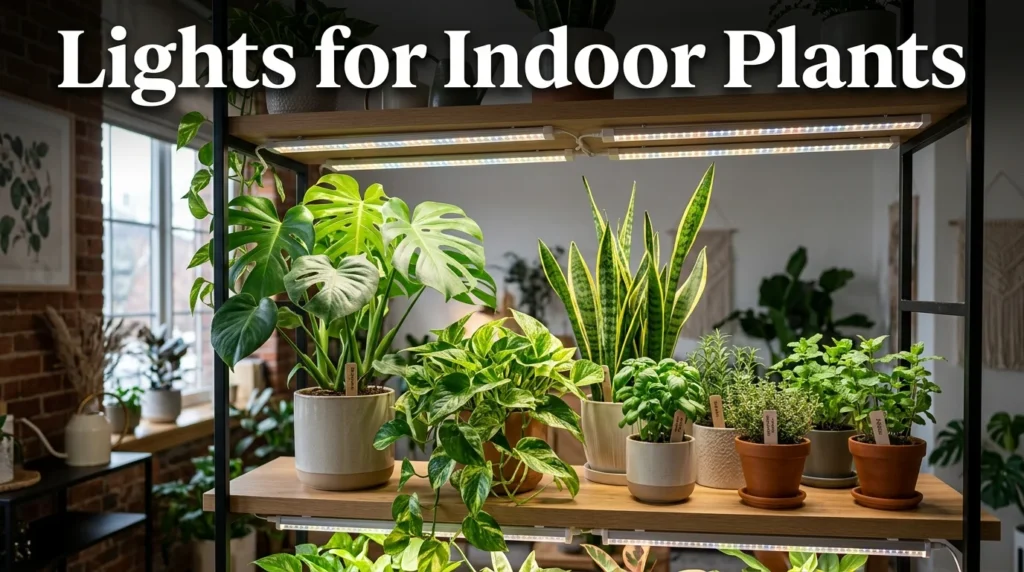
Selecting the right lights for indoor plants bridges the gap between natural sunlight and dark indoor living spaces, ensuring houseplants photosynthesize efficiently regardless of season or window orientation. Whether maintaining low-light tropicals, accelerating leafy vine growth, or wintering Mediterranean herbs, supplemental artificial lighting replaces or enhances solar energy. Modern full-spectrum LED fixtures deliver exact light wave frequencies required for chlorophyll absorption while consuming minimal electricity and producing low ambient heat.
Choosing effective lights for indoor plants requires understanding light spectrums, intensity metrics like PPFD (Photosynthetic Photon Flux Density), hanging distances, and daily photoperiod durations. Household ambient incandescent or soft white LED lamps lack the necessary Photosynthetically Active Radiation (PAR) bandwidths to sustain plant health over time. Investing in targeted grow light fixtures prevents leggy stem stretching, pale leaf foliage, slow growth rates, and flower drop.
Proper environmental balance ensures that supplemental lights for indoor plants yield maximum growth without causing thermal or light stress to your collection. Placing fixtures at the correct height above the canopy and pairing them with automated timers ensures consistent daily illumination. Combining proper light levels with well-aerated soil mixes and regular air circulation allows your indoor garden to thrive year-round.
This master guide breaks down light science, compares LED, fluorescent, and HID technologies, provides installation positioning rules, and outlines exact light requirements for common indoor plant groups.
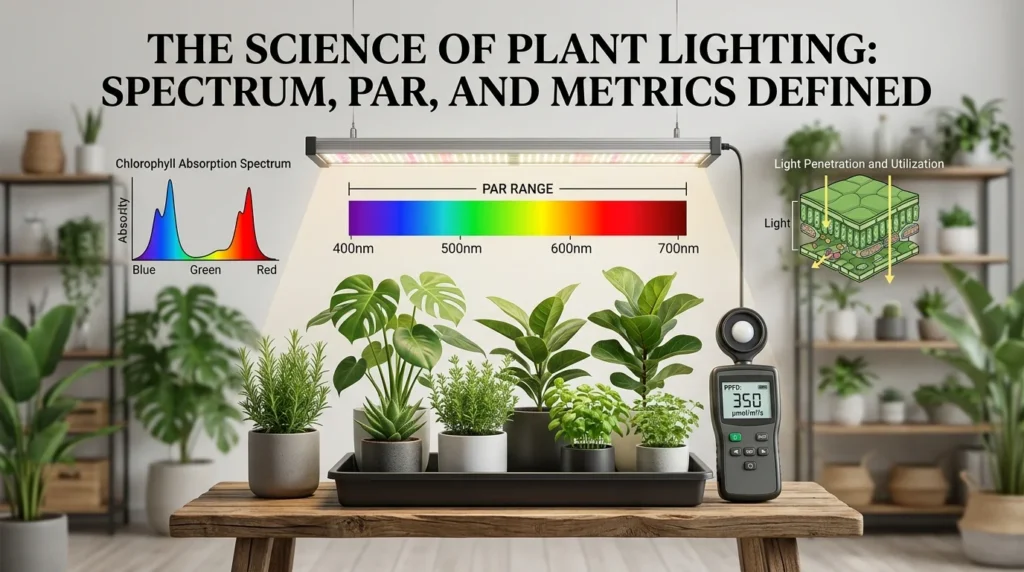
The Science of Plant Lighting: Spectrum, PAR, and Metrics Defined
To choose the best lights for indoor plants, growers must evaluate technical metrics rather than rely on human visual brightness (lumens or lux):
1. Photosynthetically Active Radiation (PAR)
PAR represents the waveband of solar radiation from 400 to 700 nanometers (nm) that photosynthetic organisms use to convert light into chemical energy. Humans perceive yellow and green light as bright, whereas plants primarily absorb blue and red light spectrums within the PAR range.
2. Photosynthetic Photon Flux Density (PPFD)
PPFD measures the actual number of PAR photons falling on a specific square meter of plant canopy per second, expressed as $\mu\text{mol/m}^2/\text{s}$.
- Low Light Plants (Ferns, ZZ Plants, Snake Plants): $50 – 150 \ \mu\text{mol/m}^2/\text{s}$
- Medium Light Plants (Monsteras, Pothos, Philodendrons): $150 – 300 \ \mu\text{mol/m}^2/\text{s}$
- High Light Plants (Ficus Trees, Succulents, Citrus, Herbs): $300 – 600+ \ \mu\text{mol/m}^2/\text{s}$
3. Light Spectrum (Kelvin Color Temperature & Nanometers)
- Blue Spectrum (400–500 nm / 5000K–6500K): Drives vegetative foliage growth, structural stem density, and dark green leaf pigment.
- Red Spectrum (600–700 nm / 2700K–3000K): Triggers flowering, fruit production, seed germination, and root extension.
- Full-Spectrum (3000K–4000K White LED): Combines blue, red, green, and far-red spectrums to closely mimic natural sunlight. It appears pleasantly white to human eyes while satisfying all plant growth stages.
Types of Lights for Indoor Plants Compared
Different lighting technologies offer unique trade-offs in energy efficiency, heat output, coverage area, and initial cost.
| Grow Light Technology | Energy Efficiency | Heat Output | Lifespan (Hours) | Best Use Cases | Pros & Limitations |
| Full-Spectrum LED Panels | Very High | Low to Moderate | 50,000+ | Plant shelves, grow tents, large indoor collections | Pros: Maximum energy savings, custom spectrums, cool running. Cons: Higher upfront purchase price. |
| LED Screw-in Bulbs (E26) | High | Very Low | 25,000–50,000 | Single accent plants, floor lamps, spotlight fixtures | Pros: Fits standard lamps, inexpensive, highly versatile. Cons: Limited beam coverage angle. |
| T5 High-Output Fluorescent | Moderate | Moderate | 10,000–20,000 | Seedling propagation, microgreens, shallow plant shelves | Pros: Even linear coverage, soft diffuse light. Cons: Contains mercury, higher power draw, bulky tubes. |
| Incandescent / Halogen | Extremely Low | High to Severe | 1,000–2,000 | Not Recommended for plant growth | Pros: Cheap upfront. Cons: Wastes 90% energy as heat, scorches foliage, lacks PAR output. |
| High-Intensity Discharge (HID) | Low to Moderate | Extremely High | 10,000–15,000 | Large commercial greenhouses or high-canopy fruit trees | Pros: Deep light penetration. Cons: Requires heavy ballasts, high power bills, intense heat generation. |
Hanging Distance, Coverage, and Photoperiod Duration
Proper placement ensures plants receive sufficient photon density without thermal stress or light burn.
       [ Grow Light Fixture ]
                 │
                 │  ← 12" - 24" Clearance
                 ▼
       ┌──────────────────┐
       │   Top Leaves     │  ← Highest PPFD Zone
       ├──────────────────┤
       │ Mid Canopy Leaves│  ← Moderate PPFD Zone
       ├──────────────────┤
       │   Lower Base     │  ← Low PPFD Zone
       └──────────────────┘
1. Distance Placement Rules
- High-Output LED Panels (100W+): Position 18 to 24 inches above the upper leaf canopy to avoid light bleaching or leaf crisping.
- Standard Low-Wattage LED Bulbs (15W–36W): Position 6 to 12 inches above the plant top for maximum effective photon transfer.
- T5 Fluorescent Tubes: Position 4 to 8 inches directly above seedlings or foliage.
2. Daily Photoperiod (Duration)
Plants require a consistent daily photoperiod followed by uninterrupted dark periods for respiration:
- General Houseplants: 12 to 14 hours ON / 10 to 12 hours OFF daily.
- High-Light Herbs & Flowering Plants: 14 to 16 hours ON / 8 to 10 hours OFF daily.
- Automation Tip: Always pair artificial grow lights with a digital grounded timer or smart plug to ensure consistent daily light cycles.
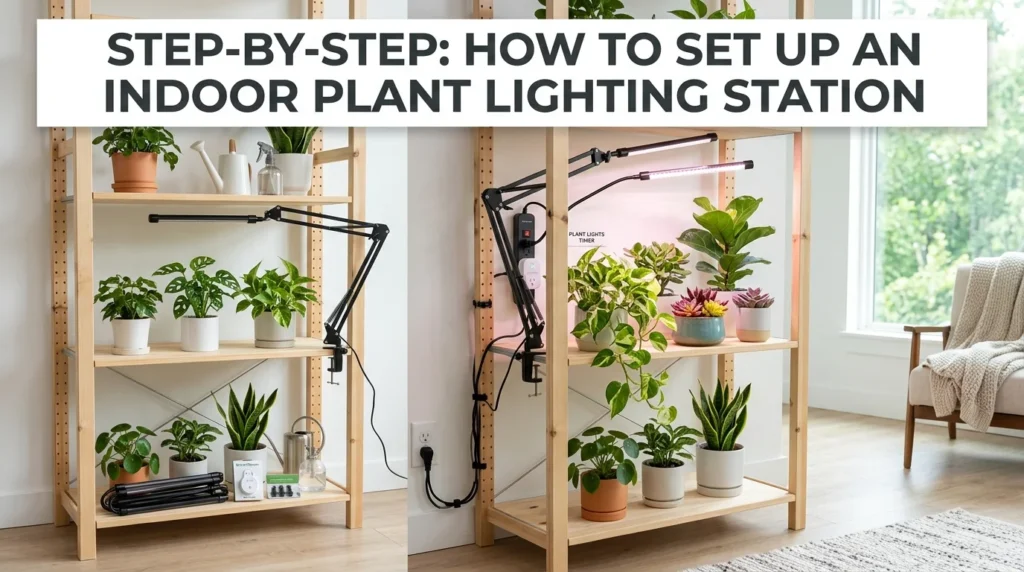
Step-by-Step: How to Set Up an Indoor Plant Lighting Station
Setting up an efficient plant shelf or light stand takes minimal time with the proper components:
1.Select a Sturdy Shelf or Hanging Framework:Match shelf height to plant mature size and light clearance.
Assemble a wire rack, wooden bookshelf, or ceiling hook system capable of supporting light fixtures and weighted plant pots safely.
2.Mount Full-Spectrum LED Fixtures:Select fixtures that match your shelf width for uniform coverage.
Attach linear LED bars or flat panels to the underside of shelves using adjustable pulley carabiners, zip ties, or mounting screws.
3.Connect Lights to a Digital Timer or Smart Plug:Set automated photoperiod cycles based on plant requirements.
Plug your light fixtures into an automated plug timer set for 12 to 14 hours of continuous operation daily, eliminating manual switches.
4.Position Plants and Measure Canopy Distance:Ensure leaves sit within the target PPFD intensity band.
Arrange plants under the fixture according to light needs—place high-light succulents directly under the light center and shade-tolerant ferns near outer edges.
5.Monitor Foliage Response for 14 Days:Watch for signs of light stress or stretched leggy stems.
Observe new growth. Adjust hanging height upward if upper leaves scorch, or lower the fixture if stems stretch toward the light source.
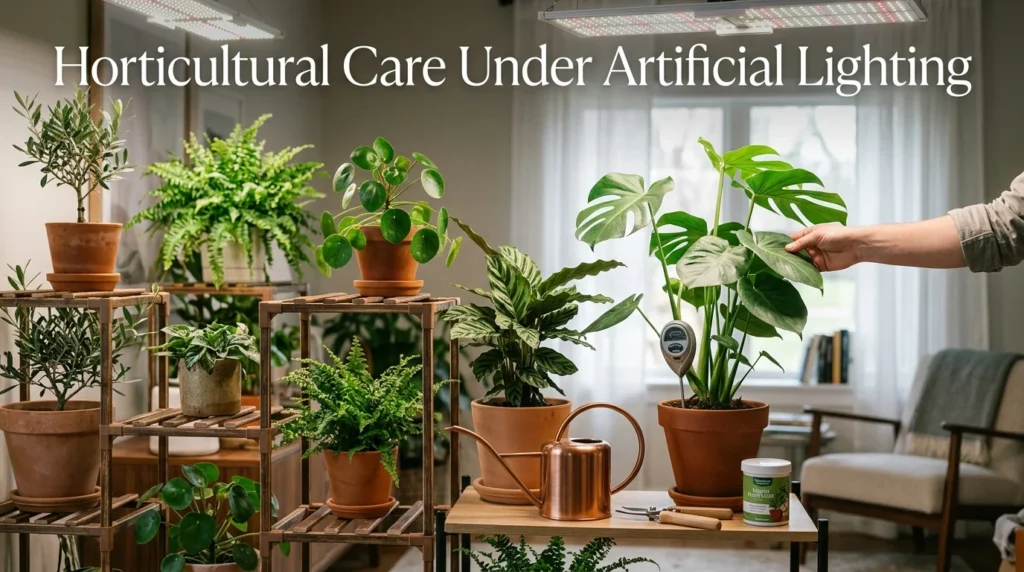
Horticultural Care Under Artificial Lighting
Artificial grow lights increase plant metabolic rates, altering watering, feeding, and humidity needs:
1. Watering and Soil Moisture Cycles
- Increased Transpiration: Plants under steady artificial grow lights photosynthesize faster and consume soil water more quickly than those in dim corners. Check soil dryness regularly.
- Aerated Potting Substrate: Combine 50% quality potting soil, 30% coarse perlite, and 20% orchid bark to ensure roots receive ample oxygen during rapid growth phases.
2. Nutrient Demands
- Active photosynthesis creates higher demand for essential macronutrients (Nitrogen, Phosphorus, Potassium) and micronutrients (Magnesium, Iron).
- Feeding Schedule: Apply a balanced, water-soluble fertilizer diluted to half-strength every 2 to 4 weeks during active lighting cycles. Reduce feeding if photoperiods are shortened during winter.
3. Thermal and Humidity Management
- LED lights release low forward heat, but drivers can raise room temperatures slightly over time. Maintain room temperatures between 65°F and 78°F (18°C to 26°C).
- Maintain relative humidity between 45% and 60% RH. Use pebble trays or a room humidifier if artificial light heat lowers ambient room humidity.
The GrowIndoorly Microclimate Setup for Plant Lighting
To maximize efficiency and protect your home, integrate these microclimate safeguards:
- Reflective Backdrops: Place white walls or mylar reflective sheets behind plant shelves. Reflection redirects scattered light back into lower foliage, increasing efficiency by up to 20% without adding electrical power.
- Gentle Air Circulation: Position a small USB fan near illuminated plant shelves. Air circulation dissipates warmth from light drivers, strengthens plant stems through micro-movement, and prevents fungal powdery mildew.
- Cable Management & Thermal Spacing: Keep power cords secured with cable ties away from water drainage trays. Leave a 2-inch air gap between light heat sinks and upper shelf boards to prevent heat buildup.
Troubleshooting Indoor Plant Lighting Issues
Diagnose common artificial lighting challenges with this quick reference table:
| Problem | Cause | What to Check | Solution |
| Leaves turning pale, bleached white, or crisping at tips | Light fixture is hanging too close; excess PPFD / thermal stress | Distance from fixture to top leaves; leaf temperature | Raise the grow light fixture 4–6 inches higher or dim light intensity |
| Stems getting tall, leggy, and leaning unnaturally | Light intensity is too low or fixture is positioned too far away | Measure light distance; check bulb PAR rating | Lower the light closer to the canopy or upgrade to a higher-wattage LED fixture |
| Lower leaves dropping while upper leaves look healthy | Poor light penetration to lower canopy branches | Canopy density; side-lighting coverage | Prune dense upper foliage or add side-mounted LED light strips |
| Algae growing on soil surface under grow lights | Continuous soil moisture combined with intense surface light | Topsoil dryness depth; watering frequency | Top-dress soil with 1/2 inch of coarse perlite or gravel; let topsoil dry between waterings |
| Fixture feels extremely hot to touch; dimming output | Inadequate airflow around LED heat sinks or driver | Dust buildup on heat sink fins; room air circulation | Clean dust off fixture fins; install a small circulating fan to dissipate heat |
Conclusion
Choosing the right lights for indoor plants transforms dim living quarters into thriving green sanctuaries by delivering the precise spectral energy houseplants need to photosynthesize. Transitioning from generic household bulbs to full-spectrum LED fixtures provides your indoor jungle with natural sunlight spectrums, preventing leggy growth, pale leaves, and stalled development across all seasons.
Optimizing your lighting setup comes down to balancing PPFD intensity, hanging distance, and photoperiod duration. Positioning full-spectrum LED panels or screw-in bulbs at the correct canopy height ensures maximum photon absorption without leaf scorch, while automated timers provide the essential dark periods required for cellular respiration.
At GrowIndoorly.com, we view artificial lighting as an essential foundation for successful indoor horticulture. By pairing high-efficiency LED grow lights with well-draining soil media, consistent airflow, and a disciplined watering routine, you can cultivate vibrant foliage, robust root systems, and year-round blooms in any room.
Test Your Knowledge:
Question 1
Which light spectrum color is primarily responsible for driving compact vegetative foliage growth and strong stems in indoor plants?
- A) Yellow light.
- B) Blue light (400–500 nm / 5000K–6500K).
- C) Infrared heat waves.
- D) Pure green light.
Question 2
What does PPFD (Photosynthetic Photon Flux Density) measure in indoor horticulture?
- A) How heavy a light bulb is.
- B) The total cost of electricity per month.
- C) The actual number of PAR light photons hitting a specific plant surface area per second.
- D) How bright a light looks to human eyes.
Question 3
Why are standard incandescent household light bulbs unsuitable as lights for indoor plants?
- A) They produce too much blue light.
- B) They waste 90% of their energy as heat, scorch leaves, and lack adequate PAR spectrums.
- C) They make plants turn purple.
- D) They draw zero electricity.
Question 4
What is the recommended daily photoperiod duration for most general indoor houseplants under artificial grow lights?
- A) 2 to 4 hours daily.
- B) 6 hours daily.
- C) 12 to 14 hours daily with an automated timer.
- D) 24 hours continuously without dark periods.
Question 5
What simple addition can increase light efficiency on a plant shelf by up to 20% without using more electricity?
- A) Painting the room black.
- B) Placing reflective white or mylar backdrops behind the plant shelves.
- C) Watering plants with hot water.
- D) Covering the lights with paper.
(Answer Key: 1-B, 2-C, 3-B, 4-C, 5-B)
Frequently Asked Questions
Can normal LED household lights be used as lights for indoor plants?
Standard daylight white LED household bulbs (4000K–5000K) can provide basic supplemental light for low-light plants if placed close. However, dedicated full-spectrum LED grow lights offer higher PAR output and optimized red/blue wavelength ratios for faster growth and flowering.
How long should I keep grow lights on for my houseplants?
Most indoor houseplants thrive with 12 to 14 hours of artificial light daily. High-light plants like succulents, citrus, or flowering herbs benefit from 14 to 16 hours. Always provide 8 to 10 hours of complete darkness every night for natural plant respiration.
How far should LED grow lights be placed from indoor plants?
Place high-output LED panels (100W+) 18 to 24 inches above the plant canopy. Screw-in LED bulbs (15W–36W) should be placed 6 to 12 inches above foliage. Adjust distance if leaves show signs of light burn (bleaching) or light deficiency (stretching).
Do grow lights consume a lot of electricity?
Modern LED grow lights are exceptionally energy-efficient. A typical 30-watt LED bulb running 12 hours a day consumes less than 0.36 kWh daily, costing only a few cents per day on average utility rates.
Can grow lights burn plant leaves?
Yes. Placing fixtures too close to foliage can cause light bleaching or thermal scorch, turning leaf tips dry, white, or brown. If upper leaves show crisping, raise the light fixture or dim the output.
Do indoor plants need dark periods at night?
Yes. Plants require a dark period to complete cellular respiration, process synthesized sugars, and rest. Leaving grow lights on 24/7 stresses plants and disrupts natural physiological cycles.
What is the difference between Lumens and PAR?
Lumens measure light brightness as perceived by human eyes, focusing heavily on green and yellow wavelengths. PAR measures the specific spectrum wavelengths (400–700 nm) that plants absorb for photosynthesis. Always select plant lights based on PAR and PPFD rather than lumens.

Megan Foster is the founder and lead writer of GrowIndoorly.com, where she shares practical, easy-to-follow advice for growing healthy indoor plants. She is passionate about helping beginners and experienced plant lovers build thriving indoor gardens with confidence. Megan writes about houseplants, indoor herbs, succulents, hydroponics, grow lights, plant propagation, watering, soil care, and everyday plant maintenance.
She enjoys researching trusted gardening techniques and transforming them into simple, actionable guides that readers can easily apply at home. Her goal is to make indoor gardening more enjoyable and accessible by providing clear, reliable information that helps people keep their plants healthy throughout the year. Whether you’re caring for your first houseplant or expanding your indoor plant collection, Megan’s practical tips are designed to help you grow with confidence.


