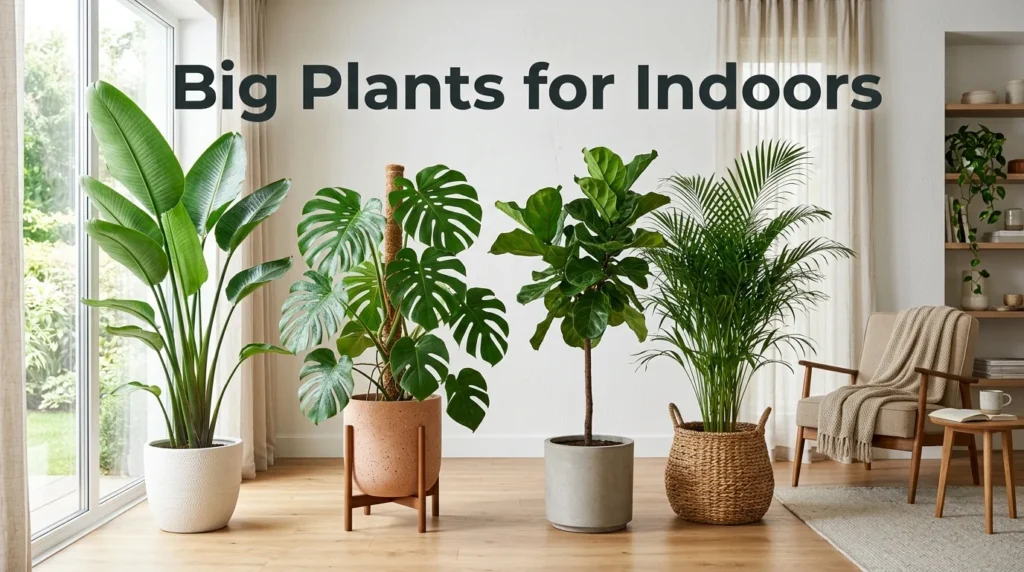
Beyond aesthetics, bringing big plants for indoors into your living space creates a natural canopy that enhances daily wellness and indoor air quality. Larger leaf surface areas process light and transpiration more efficiently, helping to regulate indoor humidity levels while filtering common household airborne toxins.
However, growing floor-scale foliage successfully requires understanding the physical needs of oversized root systems, container drainage, and ambient light placement. Large pots hold water much longer at the bottom, making proper soil aeration and watering mechanics vital to prevent root rot issues.
Choosing the ideal big plants for indoors comes down to balancing your available natural light with your lifestyle and maintenance preferences. Options range from low-light tolerant varieties like Snake Plants to high-light focal pieces like Birds of Paradise and Fiddle-Leaf Figs.
Understanding the Big Plants for Indoors
Large indoor plants transform a living space faster than almost any other design choice. A single mature Fiddle-Leaf Fig or a broad Monstera Deliciosa introduces architectural height, softens hard interior lines, and brings the restorative feel of a natural canopy into your home.
However, growing floor-scale houseplants requires a clear understanding of light physics, pot dimensions, watering mechanics, and root space. Big plants represent a higher financial and physical investment than small desk succulents; when one drops leaves or shows signs of distress, the issue is hard to miss.
This guide breaks down the ten best large indoor plants for every light level and skill tier, followed by precise horticultural care protocols to keep your oversized foliage thriving for years.
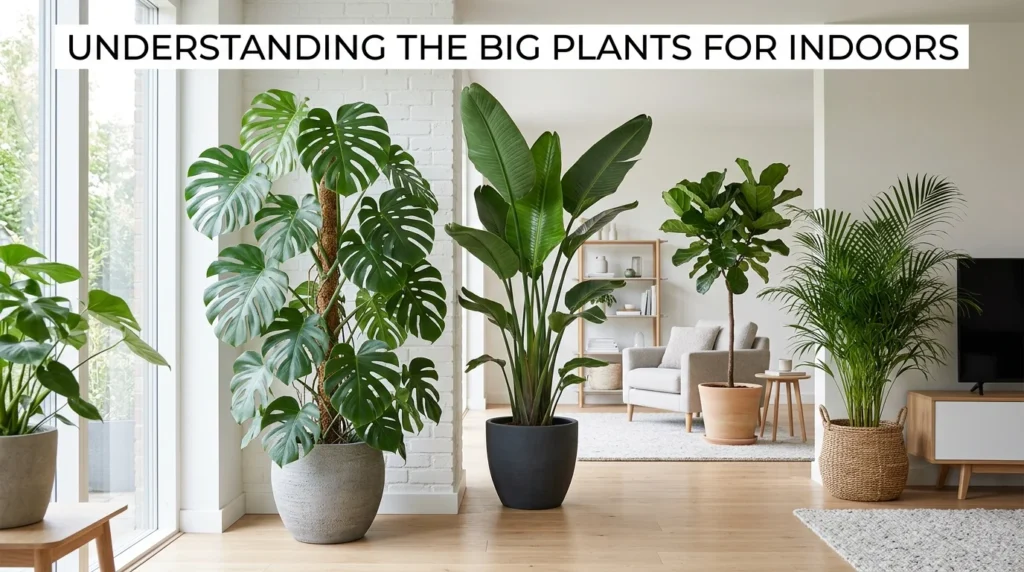
What Makes a Houseplant a “Big Plant”?
In indoor horticulture, a plant moves into the “large” or “statement” category when it meets three criteria:
- Height: It stands between 4 to 8 feet tall (or has a canopy spread exceeding 3 feet).
- Container Size: It requires a pot diameter of 12 inches or larger to support its root architecture and balance its center of gravity.
- Architectural Presence: It anchors the spatial layout of a room, acting as a focal point rather than an accent piece.
The 10 Best Big Indoor Plants for Home & Office
The table below outlines the top oversized houseplants based on lighting needs, maintenance difficulty, and canopy style.
| Plant Name | Light Requirement | Growth Habit / Structure | Maintenance Level | Best For |
| Monstera Deliciosa | Bright, Indirect | Vining / Spreading Bush | Easy to Moderate | Living rooms with high ambient light |
| Fiddle-Leaf Fig (Ficus lyrata) | Bright, Consistent Direct/Indirect | Tree-like Single/Multi-trunk | Intermediate to Advanced | High-light focal corners, tall ceilings |
| Rubber Tree (Ficus elastica) | Bright, Indirect (Tolerates medium) | Upright Tree / Column | Easy | First-time large plant owners |
| Bird of Paradise (Strelitzia nicolai) | Direct to High Indirect | Upright Fan-like Leaves | Moderate | Bright sunrooms, south-facing windows |
| Snake Plant (Sansevieria / Dracaena) | Low to Bright Indirect | Structural Vertical Leaves | Very Easy | Low-light corridors, bedrooms, offices |
| Dragon Tree (Dracaena marginata) | Medium to Bright Indirect | Slender Trunk with Tufted Crown | Easy | Narrow spaces requiring vertical height |
| Kentia Palm (Howea forsteriana) | Medium to Low Indirect | Arching Feather-like Fronds | Easy to Moderate | Elegant interior decor, low-light corners |
| ZZ Plant (Zamioculcas zamiifolia) | Low to Bright Indirect | Upright Arching Stems | Extremely Easy | Frequent travelers, dark living spaces |
| Peace Lily ‘Sensation’ (Spathiphyllum) | Low to Medium Indirect | Dense Bushy Broad Foliage | Easy | Spaces needing immediate volume and lushness |
| Swiss Cheese Vine (Monstera adansonii) | Medium to Bright Indirect | Climbing / Trellised Column | Moderate | Vertical moss poles, narrow bright spots |
1. Monstera Deliciosa (Swiss Cheese Plant)
Known for its broad, split leaves (fenestrations), Monstera Deliciosa is one of the most adaptable large plants for indoor environments.
       [ Wide Leaf Canopy ]
         /       |       \
    [ Stem ]  [ Stem ]  [ Stem ]
        \        |        /
       [ Moss Pole / Trellis ]
                 |
         [ Root System ]
- Light Needs: Thrives in bright, indirect sunlight. Low light causes smaller leaves without fenestrations and long, leggy stems.
- Watering Strategy: Allow the top 2 to 3 inches of soil to dry out completely before watering thoroughly.
- Support: Requires a sturdy moss pole or wooden trellis as it matures to support its heavy climbing stems and aerial roots.
2. Fiddle-Leaf Fig (Ficus lyrata)
A classic interior design centerpiece, the Fiddle-Leaf Fig features massive, violin-shaped leaves that grow along a central woody trunk.
- Light Needs: High light is non-negotiable. Place within 3 to 5 feet of an unobstructed south- or east-facing window.
- Watering Strategy: Water deeply only when the top 50% of the soil mixture feels dry to the touch. Never allow the pot to sit in standing drainage water.
- Sensitivity: Highly sensitive to drafty windows, sudden relocation, and overwatering. Dropping green leaves is a classic sign of environmental shock or root stress.
3. Rubber Tree (Ficus elastica)
Featuring glossy, leather-like leaves in deep green, burgundy, or variegated patterns, Ficus elastica offers a bold structural silhouette with lower maintenance needs than the Fiddle-Leaf Fig.
- Light Needs: Medium to bright indirect light. Red and variegated varieties maintain richer colors in brighter light.
- Watering Strategy: Keep moderately moist during active growth (spring and summer), allowing the top 2 inches of soil to dry. Reduce watering significantly in winter.
- Care Tip: Wipe the large leaves with a damp microfiber cloth monthly to remove dust and maintain photosynthetic efficiency.
4. White Bird of Paradise (Strelitzia nicolai)
If you want to bring an instant tropical atmosphere into a room, the White Bird of Paradise delivers with massive, paddle-shaped leaves that can reach 6 to 8 feet indoors.
- Light Needs: High light to direct sunlight. Requires the brightest spot in your home to sustain large leaf production.
- Watering Strategy: Prefers consistently moist (but not waterlogged) soil during warm months. Allow the top inch to dry between waterings.
- Leaf Tearing: Natural splitting along the leaf veins is completely normal; it is an evolutionary adaptation that prevents wind from snapping the large stalks in nature.
5. Snake Plant ‘Laurentii’ or ‘Zeylanica’ (Dracaena trifasciata)
While often sold in small pots, large specimens grown in 12-to-14-inch containers can reach heights of 4 to 5 feet, creating a striking vertical architectural element.
- Light Needs: Extremely adaptable. Tolerates low light levels up to direct sun.
- Watering Strategy: Drought-tolerant succulent. Allow the soil mixture to dry completely throughout the entire pot before watering. In winter, watering may only be needed once every 4 to 6 weeks.
- Ideal Use: Perfect for low-light corners, bedroom nooks, or offices where regular plant maintenance is difficult.
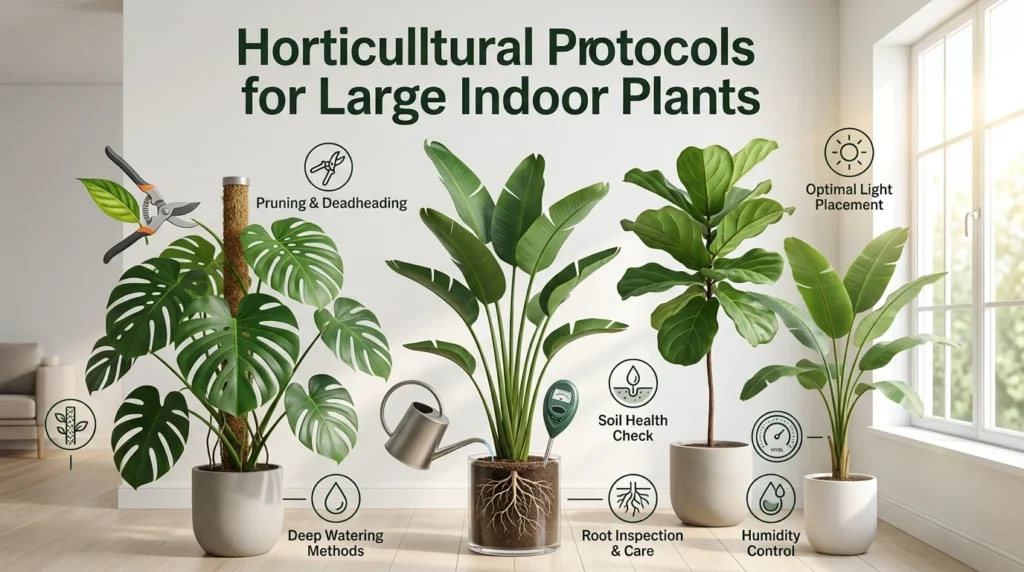
Horticultural Protocols for Large Indoor Plants
Sustaining a large plant indoors requires managing soil dynamics, light placement, container physics, and nutrient delivery.
+-------------------------------------------------------------------+
|                     LARGE PLANT CARE FRAMEWORK                     |
+-------------------+-------------------+---------------------------+
| LIGHT PLACEMENT   | WATER MECHANICS   | SOIL & DRAINAGE           |
| - Foot-candle target| - Pot weight test | - Coarse chunk substrate  |
| - Window distance | - Deep saturation | - Pot-in-pot setups       |
+-------------------+-------------------+---------------------------+
Light Requirements: Natural & Artificial Rules
Big plants possess large leaf surface areas. If light levels fall below their compensation point (where photosynthesis equals respiration), the plant will consume internal energy stores, leading to lower leaf drop and branch dieback.
Understanding Foot-Candles (FC)
- High Light (1,000–2,500 FC): Within 3 feet of South or West windows. Essential for Ficus lyrata, Strelitzia nicolai.
- Medium Light (250–1,000 FC): 4 to 8 feet from East or West windows. Ideal for Monstera, Ficus elastica, Dracaena.
- Low Light (50–250 FC): 8+ feet from windows or near North windows. Suitable for Sansevieria, ZZ Plant, Kentia Palm.
Supplemental Grow Lights for Big Plants
Standard clip-on grow lights are rarely effective for 6-foot trees because their light beam angle is too narrow.
- Use a high-draw LED grow bulb (36W–50W LED) installed in a tall floor lamp directed at the canopy.
- Position grow lights 18 to 36 inches above or angled toward the top canopy, keeping them on for 12 to 14 hours daily to supplement weak indoor light.
Soil Mixes, Potting, and Container Physics
The biggest structural mistake indoor gardeners make with large plants is using dense, pre-bagged potting soil without added aeration amendments. In large containers (12 to 18 inches in diameter), dense soil stays wet for weeks at the bottom of the pot, suffocating roots due to lack of oxygen (hypoxia).
| Substrate Component | Volume Ratio | Primary Horticultural Purpose |
|---|---|---|
| Quality Base Soil (Coco Coir or Peat Moss) | 40% | Retains moisture and holds essential plant nutrients. |
| Perlite or Pumice | 30% | Creates vital pore space and ensures strong air circulation around roots. |
| Coarse Orchid Bark | 20% | Adds structural support to prevent soil compaction in deep containers. |
| Compost or Worm Castings | 10% | Supplies organic nutrients and beneficial microorganisms. |
The Pot-in-Pot Method
Large ceramic or terracotta pots are heavy and difficult to move when filled with wet soil and a 7-foot tree.
- Keep the plant in its heavy-duty plastic nursery pot with ample drainage holes.
- Place a saucer or drainage tray inside your decorative outer pot (decorative planter).
- Set the nursery pot directly inside the decorative container, using structural foam blocks underneath if you need to raise its height.
- This setup allows you to easily lift the plant to inspect roots, remove excess water, or relocate it for cleaning.
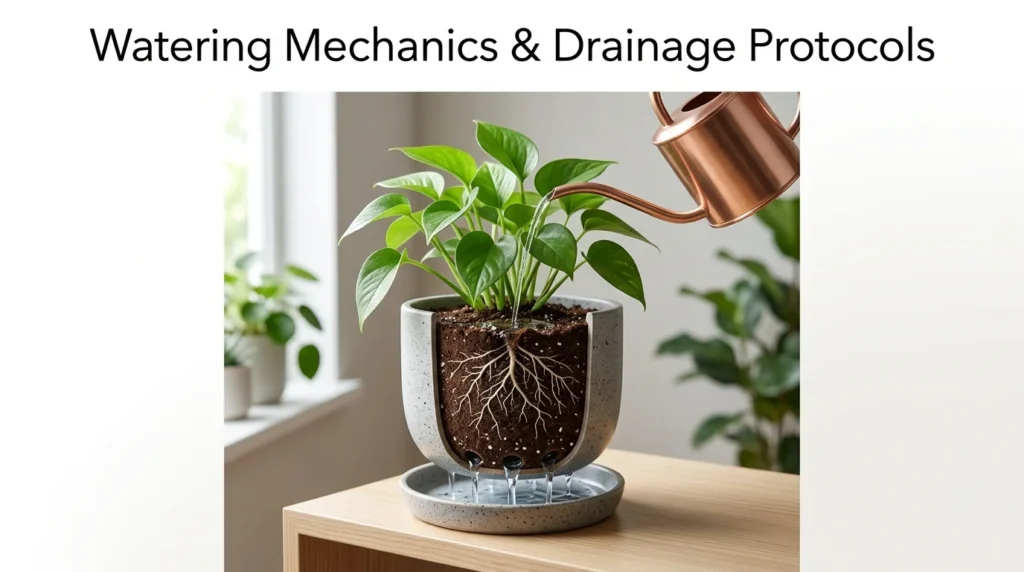
Watering Mechanics & Drainage Protocols
Watering a large pot requires a different approach than watering a small tabletop plant.
The Deep Drenching Rule
Never give a large plant small “sips” of water every few days. This causes salt buildup at the top of the root ball while leaving the lower roots bone dry.
- Application: Apply water evenly over the entire soil surface until water drains freely into the tray below.
- Evacuation: Allow the plant to drain for 20 to 30 minutes, then pump out or wipe up any standing water from the saucer. Large roots sitting in standing water will quickly rot.
How to Gauge Moisture in Deep Pots
Finger tests only measure the top 2 inches of soil, which dries far faster than the bottom 10 inches of a large container.
- Wooden Dowel Method: Insert a long wooden dowel (12 to 18 inches) deep into the root ball. Pull it out after 30 seconds. If it comes out clean and light-colored, the deep soil is dry. If dark wood particles stick to it, the root zone retains moisture.
- Lift/Tilt Test: Tilt the pot slightly to sense its total weight. Wet soil is substantially heavier than dry substrate.
Humidity, Temperature, and Seasonal Care
| Environmental Factor | Target Range | Low-Threshold Stress Sign | High-Threshold Stress Sign |
| Relative Humidity | 45% – 65% | Brown, crispy leaf edges/tips | Mold or fungal spots on leaves |
| Day Temperature | 68°F – 82°F (20°C – 28°C) | Stunted growth, yellowing | Leaf scorch, wilting foliage |
| Night Temperature | 60°F – 68°F (15°C – 20°C) | Leaf drop, root dormancy | Rapid moisture loss |
Winter Adjustments
- Drafts: Keep big plants away from cold exterior doors, drafty window seals, and direct output from heating vents.
- Water Frequency: Reduce watering frequency by 30% to 50% during winter months when natural sunlight drops and plants enter semi-dormancy.
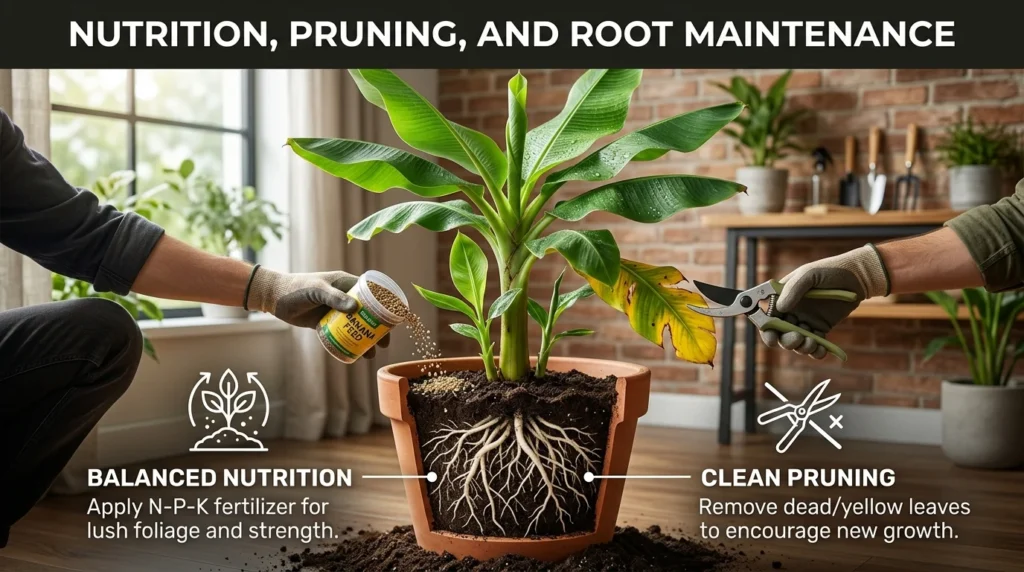
Nutrition, Pruning, and Root Maintenance
Fertilization
Large plants growing in synthetic indoor potting media need regular nutrient inputs during their active growing season (spring through early autumn).
- Use a balanced liquid houseplant fertilizer with a 3-1-2 or 2-1-2 N-P-K ratio diluted to half-strength every 2 to 4 weeks.
- Avoid fertilizing during late autumn and winter when plant growth naturally slows down.
Pruning and Structural Support
- Pruning: Cut back dead, yellowing, or crossing stems using sterilized pruning shears. Pruning the growing tip of trees like Ficus elastica encourages branching and a fuller canopy.
- Staking: Heavy plants like Monstera require moss poles, coir poles, or hardwood stakes driven deep into the root ball to anchor vertical growth.
       Incorrect Staking                   Correct Staking
      ------------------                  -----------------
       [ Weak Thin Stick ]                 [ Heavy-Duty Moss Pole ]
             \   /                                  |
            [ Plant ]                       [ Plant Stem Bound ]
             /   \                                  |
       (Leaning / Unstable)                [ Deep Root Anchor ]
Troubleshooting Common Large Plant Issues
Use this quick reference framework to diagnose and treat problems before they cause significant leaf loss.
Problem: Lower leaves turning yellow and dropping rapidly
- Cause: Overwatering and root hypoxia (lack of oxygen in the root zone).
- Check: Insert a wooden dowel deep into the pot to check for soggy soil at the bottom.
- Solution: Allow the pot to dry out completely. Ensure the drainage tray is dry. If soil remains waterlogged, repot into a coarser, well-aerated mix.
Problem: Brown, dry, crispy leaf tips and edges
- Cause: Low ambient humidity or tap water mineral accumulation (chlorine, fluorides, salts).
- Check: Measure ambient humidity with a digital hygrometer. Check if soil surface shows white mineral crusting.
- Solution: Run a cool-mist humidifier nearby. Flush the soil thoroughly with distilled or filtered water until excess mineral salts wash through the bottom.
Stems growing long, thin, leggy, and leaning dramatically toward window light sources
- Cause: Insufficient light intensity (etiolation).
- Check: Measure light levels using a light meter app or evaluate window distance.
- Solution: Move the plant closer to a bright light source or add a supplemental grow light overhead. Rotate the pot 90 degrees weekly to encourage balanced, symmetrical growth.
Conclusion
Incorporating floor-scale houseplants into your home is one of the most rewarding ways to elevate your interior design while bringing the restorative benefits of nature indoors. Success relies on getting the core fundamentals right: providing adequate light, planting in a well-aerated soil mix, using proper drainage protocols, and matching the plant’s care requirements to your lifestyle. By treating your large houseplants as long-term living features rather than temporary decor, you can enjoy a vibrant, lush indoor canopy that thrives season after season.
Educational Self-Assessment
Test your practical knowledge of large indoor plant care with these continuous learning questions:
1. Why is standard potting soil risky for large plants in 14-inch containers?
- A) It lacks initial nitrogen fertilizer.
- B) It compacts easily, holding water at the bottom and suffocating deeper roots.
- C) It causes the plant to outgrow its container too quickly.
- D) It prevents aerial roots from forming on monsteras.
2. What is the most reliable way to check moisture levels in a deep pot?
- A) Inspecting the top half-inch of soil visually.
- B) Relying on a set weekly calendar schedule.
- C) Using a deep wooden dowel or testing the pot’s total weight.
- D) Misting the leaves and observing water absorption.
3. What is the main benefit of the “pot-in-pot” method for large indoor plants?
- A) It eliminates the need for fertilizer.
- B) It doubles the rate of top foliage growth.
- C) It makes handling easier and prevents roots from sitting in stagnant drainage water inside decorative pots.
- D) It allows cold outdoor air to reach the roots safely.
4. If a Fiddle-Leaf Fig drops green leaves after being moved to a new spot, what is the primary cause?
- A) Rapid nitrogen toxicity.
- B) Environmental shock due to sudden changes in light levels or temperature drafts.
- C) Normal seasonal pruning cycles.
- D) Low humidity in the surrounding soil.
5. How should grow lights be positioned above tall indoor plants like Bird of Paradise?
- A) Mounted on the floor pointing up under the leaves.
- B) Positioned 18–36 inches above or angled directly toward the top canopy.
- C) Placed 10 feet away across the room.
- D) Taped directly against the main trunk.
(Answer Key: 1-B, 2-C, 3-C, 4-B, 5-B)
Frequently Asked Questions
Which large indoor plant is best for absolute beginners?
The Rubber Tree (Ficus elastica) and Snake Plant (Dracaena trifasciata) are the easiest large plants for beginners. They adapt well to varying humidity levels, tolerate occasional missed waterings, and are less sensitive to movement than the Fiddle-Leaf Fig.
How do I stop my large indoor tree from outgrowing my ceiling?
You can manage a plant’s height through pruning and root management. Trim the top central growing stem (apical meristem) during spring to stop vertical growth and encourage side branches. Avoid repotting the plant into larger containers once it reaches your desired size.
How often should I clean the leaves of my large houseplants?
Wipe down leaves with a soft, damp microfiber cloth every 3 to 4 weeks. Dust blocks light penetration, reducing photosynthesis and providing a hiding spot for common pests like spider mites and scale insects.
Can I leave my large indoor plants outside during the summer?
Yes, but you must transition them gradually. Place plants in full shade outdoors for 7 to 10 days before exposing them to partial sun. Direct, unaccustomed sunlight will burn indoor-adapted leaves within hours. Bring them back indoors before night temperatures drop below 55°F (13°C).
What should I do if my heavy plant is rootbound, but I don’t want a bigger pot?
Perform a root pruning:
- Remove the plant from its container during early spring.
- Cut away up to 20% of the outer and bottom roots using sharp, sterile shears.
- Repot the plant back into the same container using fresh, well-draining soil mix.
- Prune back the top foliage by a similar proportion to balance the root-to-shoot ratio.
How do I prevent large potted plants from tipping over?
Use a heavy ceramic, terracotta, or concrete outer pot (cachepot) as a base. Place heavy river rocks or brick pieces at the bottom of the outer pot below the nursery liner to lower the overall center of gravity.
Why are the leaves on my Monstera drooping even though the soil is wet?
Drooping foliage in wet soil usually indicates root rot. When roots die from lack of oxygen (hypoxia), they can no longer absorb water or transport it to the foliage, causing the leaves to wilt as if dehydrated. Check roots immediately for dark, mushy tissue.

Megan Foster is the founder and lead writer of GrowIndoorly.com, where she shares practical, easy-to-follow advice for growing healthy indoor plants. She is passionate about helping beginners and experienced plant lovers build thriving indoor gardens with confidence. Megan writes about houseplants, indoor herbs, succulents, hydroponics, grow lights, plant propagation, watering, soil care, and everyday plant maintenance.
She enjoys researching trusted gardening techniques and transforming them into simple, actionable guides that readers can easily apply at home. Her goal is to make indoor gardening more enjoyable and accessible by providing clear, reliable information that helps people keep their plants healthy throughout the year. Whether you’re caring for your first houseplant or expanding your indoor plant collection, Megan’s practical tips are designed to help you grow with confidence.