
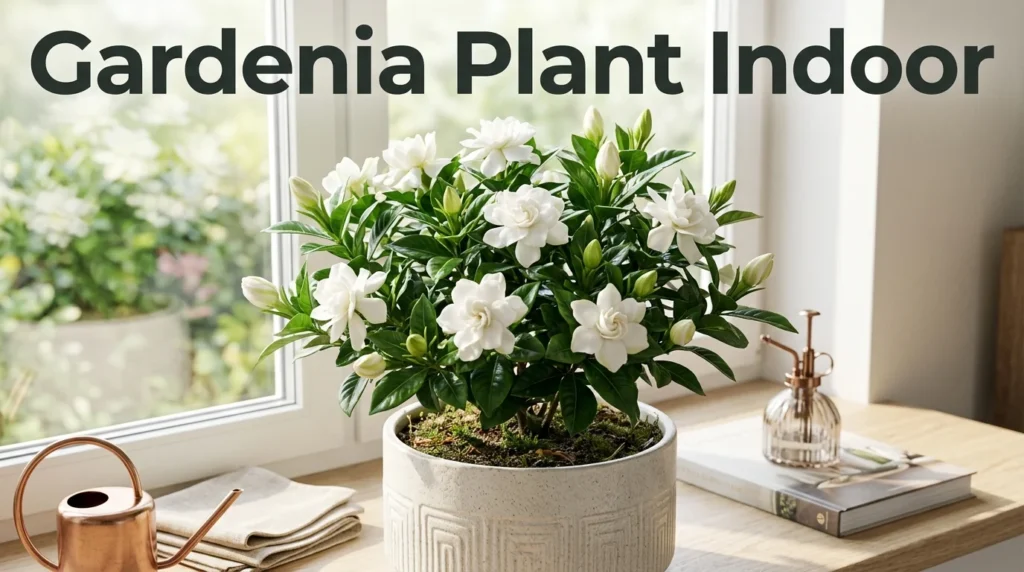
Growing a gardenia plant indoor space is one of the most rewarding challenges in houseplant horticulture. Famous for waxy, intoxicatingly fragrant white blooms and glossy evergreen leaves, Gardenia jasminoides (commonly known as Cape Jasmine) has earned a reputation as a demanding houseplant. Unlike forgiving foliage plants, an indoor gardenia requires precise care: high light intensity, acidic soil pH, consistent root moisture, and elevated ambient humidity.
To keep an indoor gardenia thriving and setting continuous flower buds, you must mimic its native subtropical habitat. The core secrets to success are providing 6 to 8 hours of bright, indirect sunlight or grow light exposure, maintaining acidic soil (pH 5.0 to 6.0), ensuring night temperatures drop slightly below day levels, and keeping atmospheric humidity around 50% to 60%.
When indoor gardenias fail, the issue is almost always traceable to environmental stress, such as sudden temperature swings, alkaline soil locking out iron nutrients, dry air, or improper watering that triggers immediate bud drop (bud blast).
Key Environmental Requirements for Indoor Gardenias
To achieve long-term success with an indoor gardenia, match its four non-negotiable cultural conditions:
| Care Factor | Target Specification | Consequence of Improper Conditions |
| Light | 6–8 hours bright indirect sunlight or 10–14 hours LED grow light | Yellowing foliage, sparse growth, zero bud formation |
| Soil pH | Acidic ($pH\ 5.0 – 6.0$), peaty, highly draining | Chlorosis (yellow leaves with green veins) due to iron lock |
| Humidity | 50% – 60% relative humidity | Bud drop, brittle leaves, spider mite infestations |
| Temperature | Daytime: 65°F–75°F (18°C–24°C) / Night: 55°F–62°F (13°C–17°C) | Temperatures above 65°F at night cause bud drop |
Best Gardenia Cultivars for Growing Indoors
While standard outdoor gardenia shrubs grow up to 6 feet tall, compact or dwarf cultivars are specifically suited for container culture indoors.
- Gardenia jasminoides ‘Radicans’: A dwarf, prostrate shrub growing 1 to 2 feet tall with small, dense foliage and highly fragrant double blooms. It thrives on indoor windowsills.
- Gardenia jasminoides ‘Kleim’s Hardy’: Reaches 2 to 3 feet in containers. It produces starry single, 6-petaled flowers that tolerate slight environmental shifts better than double-flowered types.
- Gardenia jasminoides ‘August Beauty’: A heavier bloomer featuring large double white flowers. Requires regular pruning to maintain a 3-foot indoor height.
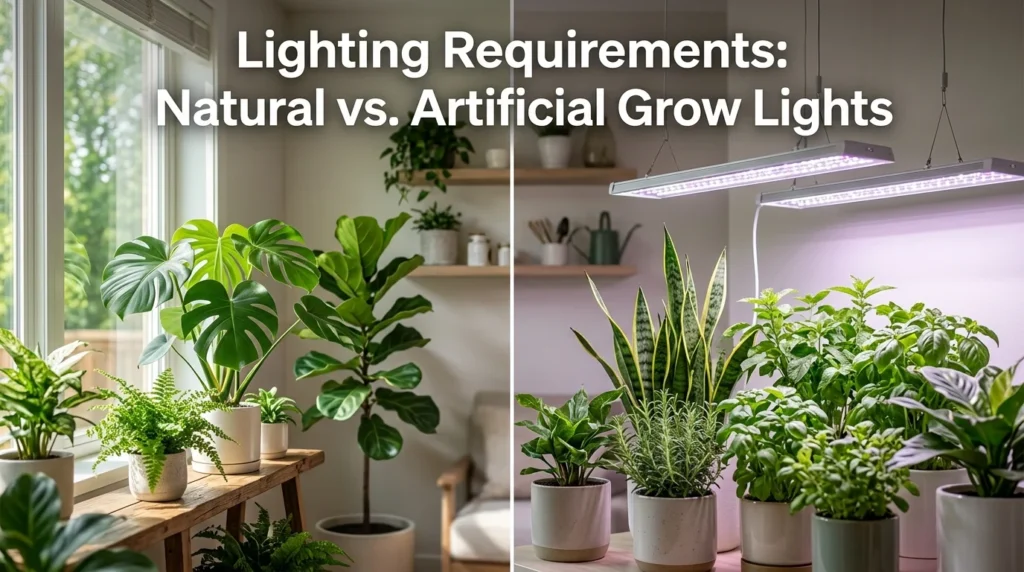
Lighting Requirements: Natural vs. Artificial Grow Lights
Light energy fuels gardenia flower bud production. Inadequate light results in leggy stems, dark drop-prone buds, and weak foliage. Rotate the pot a quarter turn each week so all sides receive even light, and wipe dust from the glossy leaves regularly so they can capture as much light as possible. Once flower buds begin to form, avoid moving or turning the plant, since gardenias resent disturbance at that stage.
Natural Light Placement
- East Windows: Ideal for morning sun without scorching tender leaves. Place the pot right along the window glass.
- South or West Windows: Provide excellent intensity, but during mid-summer peak hours, filter the light through a sheer curtain to avoid leaf bleaching or sunburn.
- North Windows: Inadequate for indoor gardenias; light levels here will not trigger blooming.
Using LED Grow Lights
Because indoor window light drops drastically during winter, supplemental lighting is frequently required. Put the fixture on a timer so the plant receives the same daily light schedule without fail, and keep that schedule steady rather than shifting it around. Raise the fixture as the plant grows to maintain the recommended distance from the top foliage.
- Intensity: Provide $300 – 500 \ \mu\text{mol/m}^2/\text{s}$ PPFD at canopy level.
- Duration: Run full-spectrum LED fixtures for 12 to 14 hours daily. Position fixtures 10 to 12 inches above the top foliage.
Soil Formulation and Acidic pH Management
Gardenias are acid-loving plants (acidophiles). In alkaline soil ($pH > 6.5$), gardenia roots cannot absorb micronutrientsspecifically iron and mangane seeven if these nutrients are present in the soil.
Acidic Soil Mix (pH 5.0 - 6.0):
┌─────────────────────────┬─────────────────────────┬─────────────────────────┐
│  40% Sphagnum Peat Moss │   30% Acidic Potting    │    30% Perlite or       │
│    (Provides Acid Basis)│          Soil           │     Coarse Pumice       │
└─────────────────────────┴─────────────────────────┴─────────────────────────┘
Custom Indoor Soil Blend
- 40% Sphagnum Peat Moss or Coco Coir: Naturally lowers soil pH and retains moisture.
- 30% Commercial Acidic Plant Soil / Azalea Mix: Provides structural body and base organic nutrients.
- 30% Perlite or Coarse Pumice: Ensures oxygenation around feeder roots and rapid excess water drainage.
Pro Tip: Test your potting soil pH twice a year using a digital pH probe. If the pH rises above 6.0, top-dress the soil with soil sulfur or water with an acidifying fertilizer solution formulated for azaleas, camellias, and rhododendrons.
Watering Protocols and Humidity Control
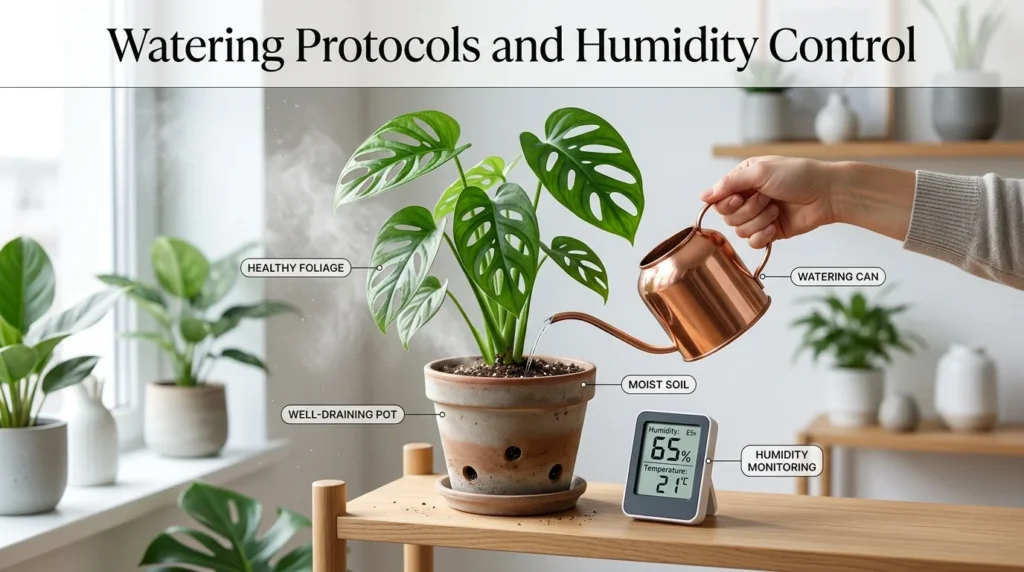
Irrigation and humidity management require strict consistency. Gardenia roots dislike both drought shock and standing water.
How to Water an Indoor Gardenia
- Soil Check: Check the top 1 inch of soil daily. Water thoroughly when the surface feels barely dry to the touch, but before the root ball dries out completely.
- Method: Pour water evenly across the soil until liquid drains freely from the pot bottom. Discard drainage saucer water immediately after 15 minutes; never leave the pot sitting in water.
- Water Type: Tap water high in minerals or dissolved carbonates (hard water) gradually raises soil pH. Use distilled, reverse osmosis, or stored rainwater whenever possible.
Raising Ambient Humidity
Standard home heating and air conditioning drop indoor humidity to 20%–30%, triggering immediate flower bud drop. To keep humidity between 50% and 60%:
- Humidifiers: Place a cool-mist ultrasonic humidifier 3 to 4 feet from the plant.
- Pebble Trays: Set the pot on a broad tray filled with pebbles and water. Ensure the pot base sits on the pebbles above the water line.
- Avoid Mist on Blooms: Never spray water directly on opening gardenia flower petals. Water droplets on petals cause brown fungal spotting (Botrytis).
Fertilization, Iron Deficiencies & Bloom Boosters
Because indoor gardenias require sustained energy for flowering, they are moderate to heavy feeders during active growth periods (spring through early autumn). Always apply fertilizer to already-moist soil rather than a dry root ball, and water with plain water every few weeks to flush out accumulated salts. Brown, scorched leaf tips are a common sign that feeding has been too heavy-handed.
- Fertilizer Choice: Use a liquid acid-formulated fertilizer with an NPK ratio like 30-10-10 or 20-20-20 enriched with iron, zinc, and manganese.
- Frequency: Feed every 2 to 3 weeks at half-strength from April through September. Suspend fertilization during late autumn and winter when growth naturally slows.
- Correcting Iron Chlorosis: If young upper leaves develop dark green veins with pale yellow backgrounds, the plant suffers from iron deficiency caused by high soil pH or root damage. Apply chelated iron ($Fe\text{-EDDHA}$ or $Fe\text{-EDTA}$) as a soil drench according to package directions.
Step-by-Step: Pruning, Shaping and Post-Bloom Care
Pruning controls shrub shape and stimulates new lateral stems, which yield the following season’s floral buds.
1.Time Your Pruning:Wait for current bloom cycle to complete in mid-to-late summer.
Prune gardenias immediately after flowering stops in late summer. Avoid pruning in late fall or winter, as gardenias set flower buds on mature wood for the next cycle.
2.Sterilize Tools:Clean bypass pruners with 70% isopropyl alcohol.
Disinfect blade edges to avoid introducing bacterial stem canker or fungal spores into fresh wood cuts.
3.Shape the Bush:Trim leggy growth back to a leaf node.
Cut back overgrown or straggly stems by one-third of their length, slicing at a 45-degree angle just above an outward-facing leaf node or stem junction.
4.Thin the Center:Remove dead, diseased, or crossing branches.
Snip away weak internal branches that block light and restrict airflow through the inner leaf canopy.
5.Encourage Branching:Shift pot location to bright light and feed lightly.
Return the plant to bright indirect light and apply a half-strength acidic liquid fertilizer to trigger fresh branch growth.
Troubleshooting Indoor Gardenia Problems
Use this diagnostic table to address leaf yellowing, bud drop, and pest problems promptly:
| Problem | Likely Cause | Diagnostic Check | Corrective Action |
| Buds turn black/brown and drop before opening (Bud Blast) | Low humidity, dry soil, or temperature fluctuation | Check humidity level (<50%); inspect night temps (>65°F) | Use a cool-mist humidifier; move away from drafty HVAC vents; maintain steady night temperatures (55–62°F). |
| New leaves are yellow with bright green veins (Interveinal Chlorosis) | High soil pH blocking iron absorption | Test soil pH ($>6.0$); examine tap water hardness | Drench soil with chelated iron ($Fe\text{-EDDHA}$); top-dress with peat moss; switch to acidifying fertilizer. |
| Older lower leaves turn solid yellow and drop | Overwatering, root rot, or nitrogen deficiency | Check lower soil moisture depth; inspect root tips | Allow top inch of soil to dry slightly between waterings; verify pot has functional drainage; feed with acid fertilizer. |
| Sticky clear residue on leaves and black soot | Scale insects (Coccidae) or Mealybugs | Inspect leaf undersides and stem joints for brown bumps | Wipe stems with cotton swabs dipped in 70% rubbing alcohol; apply neem oil or insecticidal soap sprays weekly. |
| Fine webbing on stem tips and dusty, bronzed leaves | Two-spotted Spider Mites (Tetranychus urticae) | Check leaf undersides using a magnifying glass | Boost ambient humidity immediately; shower leaf undersides with warm water; treat with insecticidal soap. |
Conclusion
Growing an indoor gardenia requires precision, but matching its natural subtropical needs makes keeping this fragrant houseplant entirely achievable. By providing bright indirect light or LED supplemental grow lights, keeping potting mix acidic with a pH between 5.0 and 6.0, maintaining relative humidity near 50% to 60%, and avoiding sudden temperature swings, you can easily prevent bud drop and leaf yellowing. Stick to consistent watering with low-mineral water and prune right after flowering to keep your gardenia lush, healthy, and filled with intoxicating white blooms year after year.
Knowledge Check: Indoor Gardenia Care Quiz
Question 1
What soil pH range is essential for an indoor gardenia to absorb iron and maintain deep green leaves?
- A) 7.5 to 8.5 (Alkaline)
- B) 6.5 to 7.2 (Neutral)
- C) 5.0 to 6.0 (Acidic)
- D) 3.0 to 4.0 (Extremely Acidic)
Question 2
What environmental factor most commonly causes gardenia flower buds to turn black and drop off (bud blast)?
- A) Atmospheric humidity dropping below 50% combined with sudden temperature shifts.
- B) Using plastic pots instead of terracotta.
- C) Pruning stems during early spring.
- D) Giving the plant 12 hours of full-spectrum LED light.
Question 3
Which window exposure provides the best balance of morning sunlight without scorching indoor gardenia foliage?
- A) North-facing window
- B) East-facing window
- C) Windowless interior hallway
- D) Unshaded South-facing window in July peak afternoon
Question 4
How can you correct interveinal chlorosis (yellow leaves with green veins) on an indoor gardenia?
- A) Increase watering to twice daily.
- B) Apply chelated iron and verify soil pH is below 6.0.
- C) Move the plant into complete darkness for 3 days.
- D) Repot into 100% builders sand.
Question 5
When is the best time of year to prune an indoor gardenia to avoid cutting off future bloom buds?
- A) In late winter just before new spring growth begins.
- B) Immediately after the summer bloom cycle finishes.
- C) In mid-autumn during peak bud development.
- D) Every month regardless of blooming status.
(Answer Key: 1-C, 2-A, 3-B, 4-B, 5-B)
Common Mistakes to Avoid with Indoor Gardenias
Most indoor gardenia failures trace back to a few avoidable habits. Watch out for these:
- Moving or turning the plant after buds form, which triggers bud drop.
- Watering with hard tap water that gradually raises soil pH and locks out iron.
- Misting open blooms, which causes brown fungal spotting on the petals.
- Placing the pot near heating vents or cold drafts that swing temperatures.
- Pruning or repotting while buds are developing, sacrificing the coming bloom.
Frequently Asked Questions
Why does my indoor gardenia smell so strong?
Gardenias release volatile organic floral compounds (predominantly linalool, jasmonate, and methyl benzoate) designed to attract pollinators across long outdoor distances. Indoors, these fragrance compounds concentrate within small spaces, creating an intense perfume.
Can I grow an indoor gardenia in regular potting soil?
Standard multi-purpose potting soils are often formulated with lime, pushing the pH close to neutral ($6.5 – 7.0$). Over time, this leads to iron chlorosis. Always mix standard soil with 40% sphagnum peat moss or use an acid-loving plant mix (such as an azalea/camellia soil blend).
Why are the flower buds on my gardenia turning brown and falling off before opening?
This common condition, called bud blast, is triggered by atmospheric shock: dry air (under 50% humidity), uneven soil moisture, dark conditions, or warm drafty night temperatures exceeding 65°F (18°C). Maintain steady moisture and humidity to resolve it.
How often should I fertilize my indoor gardenia plant?
Feed your gardenia every 2 to 3 weeks during its active growing season (spring through summer) using a water-soluble acidic plant food at half strength. Cease feeding completely during winter months when the plant enters seasonal rest.
Are gardenia plants safe for dogs and cats?
No. Gardenia plants contain toxic iridoid glycosides and geniposide. If ingested by pets, gardenias can cause mild to moderate gastrointestinal distress, including vomiting and diarrhea. Keep plants safely elevated away from pets.
Why are the leaves on my indoor gardenia turning black?
Black foliage usually indicates sooty mold, a secondary fungal growth that develops on sticky honeydew excreted by sap-sucking pests like scale, aphids, or whiteflies. Treat the underlying insect pest with insecticidal soap and wipe leaves down with a damp cloth.
Can an indoor gardenia be moved outside for the summer?
Yes. Moving gardenias outdoors during warm summer months helps rejuvenate foliage under higher natural humidity and light. Move the plant gradually into bright shade over 10 days to prevent sunscald before placing it in filtered sun. Bring it back indoors before night temperatures drop below 50°F (10°C).
Gardenias are acid-loving plants. They need acidic soil with a pH of 5.0–6.0; in alkaline soil (pH above 6.5), gardenia roots cannot absorb iron properly, causing chlorosis.
This condition, called bud blast, is triggered by dry air (under 50% humidity), uneven soil moisture, and temperature fluctuations — including night temperatures above 65°F (18°C).
No. Gardenia plants contain toxic iridoid glycosides and geniposide that can harm pets if ingested.

Megan Foster is the founder and lead writer of GrowIndoorly.com, where she shares practical, easy-to-follow advice for growing healthy indoor plants. She is passionate about helping beginners and experienced plant lovers build thriving indoor gardens with confidence. Megan writes about houseplants, indoor herbs, succulents, hydroponics, grow lights, plant propagation, watering, soil care, and everyday plant maintenance.
She enjoys researching trusted gardening techniques and transforming them into simple, actionable guides that readers can easily apply at home. Her goal is to make indoor gardening more enjoyable and accessible by providing clear, reliable information that helps people keep their plants healthy throughout the year. Whether you’re caring for your first houseplant or expanding your indoor plant collection, Megan’s practical tips are designed to help you grow with confidence.


