
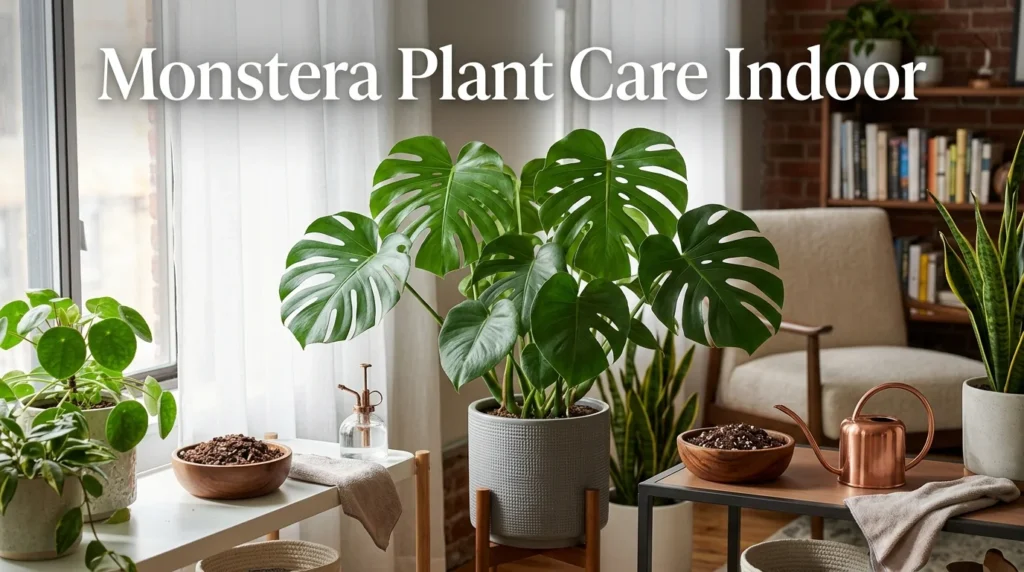
Mastering monstera plant care indoor spaces transforms juvenile tropical vines into magnificent centerpieces filled with dramatic leaf splits and fenestrations.
Successful monstera plant care indoor setups balance bright indirect light, chunky well-aerated potting media, vertical support, and targeted watering routines.
Proper monstera plant care indoor routines give your vines the needed humidity, aroid soil mix, and moss pole support to grow large fenestrated leaves.
This comprehensive master guide covers species selection, lighting levels, soil recipes, vertical training, propagation, and essential troubleshooting tips.
Popular Indoor Monstera Species Compared
Understanding the specific growth habits of different indoor Monstera varieties helps growers select the ideal space, potting setup, and vertical support system.
| Monstera Species | Common Name | Foliage Characteristics | Growth Habit | Best Support System | Care Difficulty |
| Monstera deliciosa | Swiss Cheese Plant | Broad, thick glossy leaves with deep edge splits and inner holes | Heavy climbing vine; sprawling footprint | Sturdy moss pole, coco coir pole, or wooden plank | Beginner Friendly |
| Monstera adansonii | Swiss Cheese Vine | Smaller, elliptical leaves riddled with enclosed oval fenestrations | Rapid climbing or trailing vine | Slim moss pole, wire trellis, or hanging basket | Beginner / Intermediate |
| Monstera thai constellation | Variegated Monstera | Cream/yellow speckled and blotched stable variegation on large leaves | Moderate climbing growth rate | Heavy-duty wooden or moss support pole | Intermediate |
| Monstera albo borsigiana | Albo Variegated Monstera | High-contrast pure white blocks and marbled patterns | Moderate to fast climber; smaller petioles | Moss pole kept consistently moist | Advanced |
| Monstera Peru (M. karstenianum) | Monstera Peru | Thick, puckered, iridescent dark green leather-like leaves (no holes) | Compact climbing vine | Trellis or moss pole | Beginner / Intermediate |
Environmental Requirements for Indoor Monstera Care
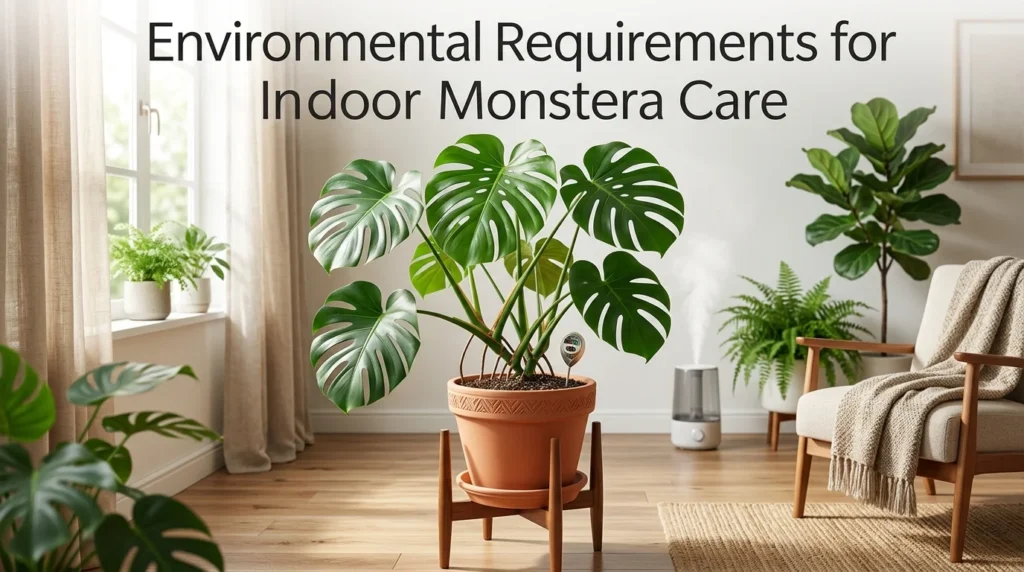
To encourage robust growth and large fenestrated leaves in a monstera plant care indoor program, recreate its tropical understory microclimate:
1. Light Intensity and Fenestration Chemistry
Light exposure directly controls leaf size and hole formation.
- Optimal Placement: Position your Monstera 2 to 4 feet back from a bright South- or West-facing window, or directly in front of an unobstructed East-facing window. Protect leaves from harsh midday sun.
- Direct Sunlight Limits: While Monsteras thrive in high light, intense, unshielded afternoon sun can scorch leaf tissue, leaving permanent yellow and brown bleach marks.
- Low Light Signs: In dim corners, Monsteras produce small, solid leaves without fenestrations, develop long stretched petioles (legginess), and risk root rot due to slow soil drying.
- Supplemental Lighting: Use a full-spectrum LED grow light supplying $150 – 300 \ \mu\text{mol/m}^2/\text{s}$ (PPFD) for 12 to 14 hours daily if natural light is inadequate.
2. Temperature and Air Circulation
- Ideal Temperature Range: Maintain indoor ambient temperatures between 65°F and 85°F (18°C to 29°C).
- Cold Protection: Keep Monsteras away from drafty exterior doors, air conditioning vents, and winter windows. Temperatures dropping below 50°F (10°C) cause cold shock, leaf blackening, and stunted growth.
- Ventilation: Gentle room airflow prevents stagnant air pockets around thick leaf clusters, reducing fungal spot development.
3. Humidity Management
- Target Relative Humidity: Monsteras appreciate relative humidity levels between 50% and 70% RH.
- Handling Dry Indoor Air: Standard winter heating drops humidity below 30% RH, causing leaf tips to turn crisp and brown. Boost humidity using a cool-mist room humidifier, grouping tropical plants together, or setting pots on pebble trays filled with water.
Substrate, Irrigation, and Nutrient Management
Monsteras are hemiepiphytes that naturally anchor to tree bark. Standard dense potting soils trap excessive water, smothering roots and triggering fatal decay.
The Ultimate Chunky Aroid Soil Blend
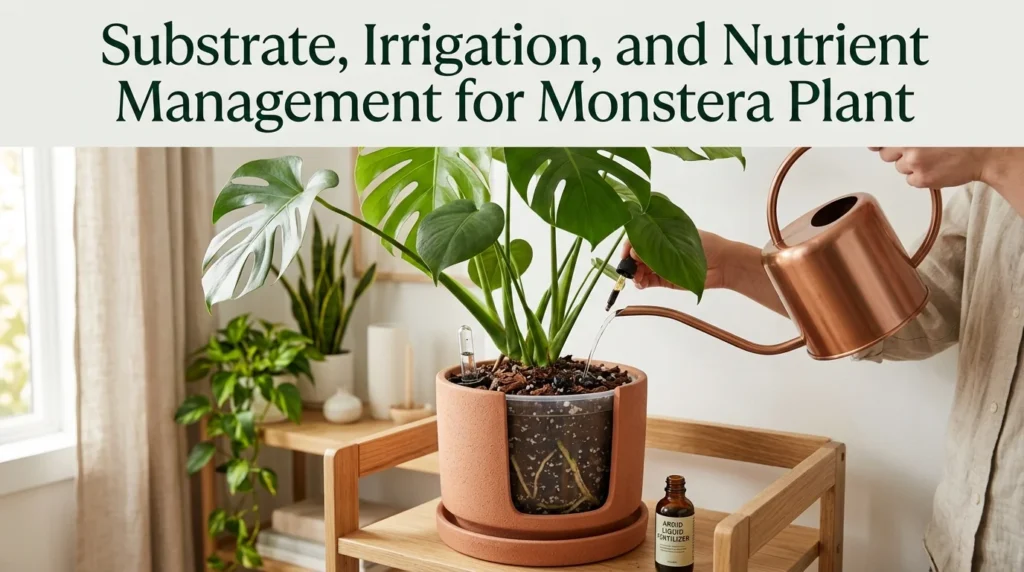
Provide a fast-draining, high-porosity potting media that allows oxygen to reach the root zone freely:
- 40% High-Quality Peat or Coco Coir (Moisture retention and structure)
- 30% Coarse Perlite or Pumice (Aeration and fast drainage)
- 20% Orchid Bark Chips (Coarse texture mimicking natural tree bark)
- 10% Horticultural Charcoal / Worm Castings (Toxin absorption and organic fertility)
Watering Protocol (The “Fifty Percent” Rule)
- Moisture Check: Allow the top 50% of the potting substrate to dry out completely before watering. Insert a finger or moisture meter into the soil to check dryness at depth.
- Thorough Soaking: Water deeply until excess flows out of the pot’s bottom drainage holes. Ensure the entire root mass gets saturated.
- Empty Saucers: Never allow the pot to sit in standing drainage water. Empty overflow trays within 20 minutes of watering to prevent anaerobic conditions.
Balanced Nutrient Schedule
Monsteras are heavy feeders during their active growing season (spring and summer).
- Fertilizer Ratio: Apply a balanced liquid houseplant fertilizer (such as 3-1-2 or 20-20-20) diluted to half-strength every 2 to 4 weeks from April through September.
- Micronutrients: Ensure your fertilizer includes Magnesium and Iron to prevent leaf chlorosis (yellowing between leaf veins).
- Winter Rest: Suspend fertilization completely during fall and winter when growth naturally slows.
Installing and Training a Monstera on a Moss Pole
Providing vertical support encourages a monstera plant care indoor setup to produce significantly larger, heavily fenestrated mature leaves:
1.Choose the Support Structure:Select a sturdy sphagnum moss pole, coco coir pole, or cedar wood plank.
Match pole thickness and height to the mature size of your plant. Sphagnum moss poles hold moisture, allowing aerial roots to grow directly inside the pole.
2.Identify the Rear Stem Pole Alignment:Locate the front (leaf side) and back (aerial root side) of the vine.
Monstera stems have a distinct front and back. Aerial roots emerge from the back of the central stem. Position the pole flush against the rear of the main vine.
3.Insert Support During Repotting:Anchor the pole deep into the container before filling with soil.
Place the base of the pole directly onto the bottom of the pot before adding your chunky aroid soil mix to ensure the structure remains stable under plant weight.
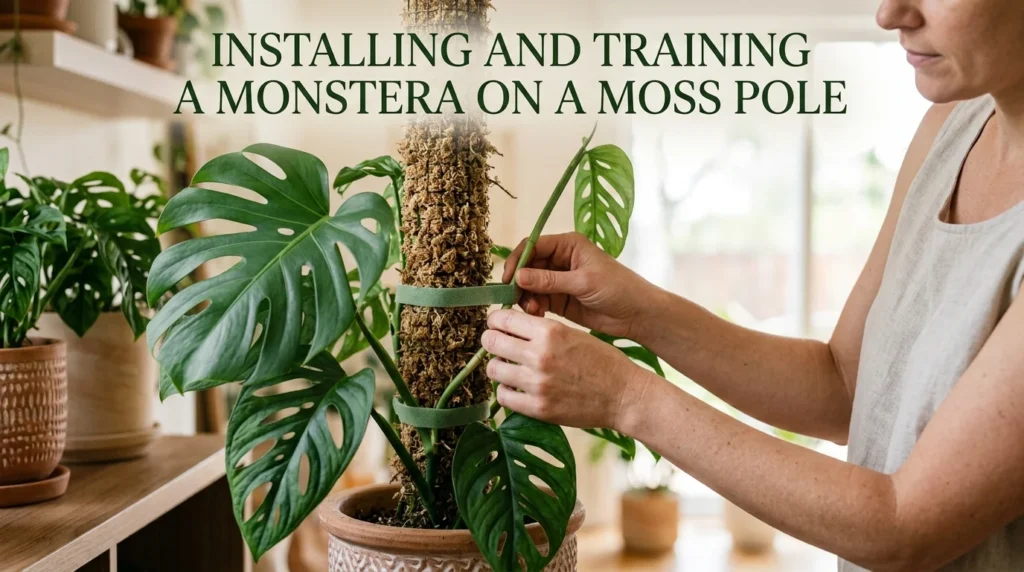
4.Secure Stems with Soft Plant Ties:Bind central thick stems to the pole using soft garden tape.
Attach the main woody vine to the pole using velcro plant ties or soft garden tape. Never tie leaf petioles (stems attached to leaves), as petioles need freedom to flex toward window light.
5.Guide Aerial Roots Into the Pole:Moisten sphagnum poles regularly to encourage root attachment.
Tuck emerging aerial roots into the moist moss matrix or direct long aerial roots down into the main potting substrate.
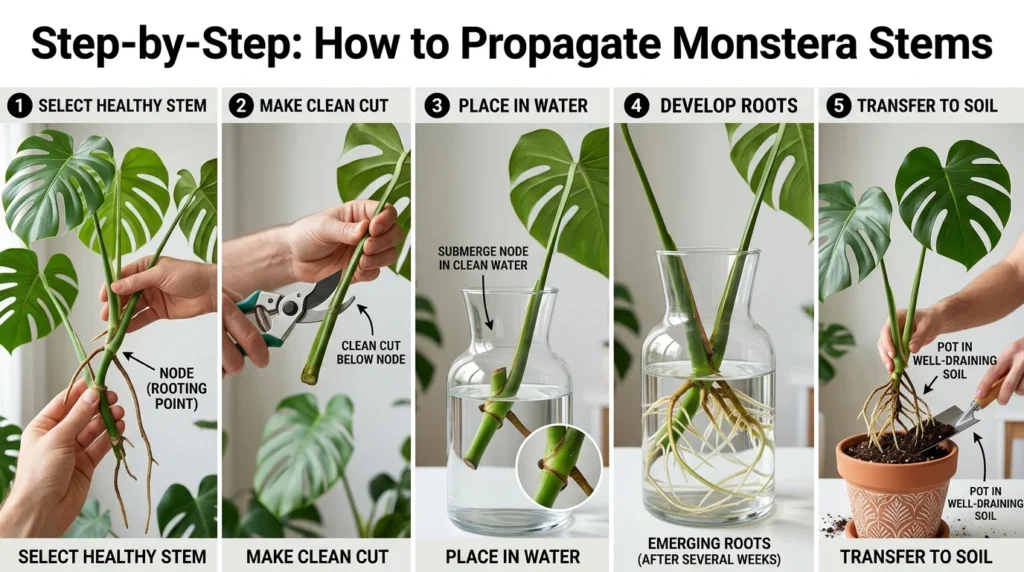
Step-by-Step: How to Propagate Monstera Stems
Propagating a monstera plant care indoor specimen is simple through stem node cuttings rooted in water or moist sphagnum moss:
- Locate a Healthy Node: Identify a stem section containing at least one healthy leaf, a prominent node (the raised ring on the stem), and ideally an aerial root.
- Make a Clean Cut: Using sterilized pruning shears, cut 1 inch below the node/aerial root junction.
- Root in Water or Moss: Submerge the node and aerial root in a jar of clean, room-temperature water or insert it into damp sphagnum moss. Keep the leaf above water.
- Provide Bright Light & Warmth: Place the cutting in bright indirect sunlight at 70°F to 80°F (21°C to 27°C). Change water weekly.
- Pot in Aroid Mix: Once secondary white feeder roots reach 2 to 3 inches long (typically 4 to 6 weeks), pot the cutting into a chunky aroid soil blend.
The GrowIndoorly Microclimate Setup for Monstera
Constructing an ideal indoor microclimate optimizes Monstera leaf expansion and structural health:
- Leaf Dusting and Cleaning: Dust accumulation blocks light absorption on large Monstera leaves. Wipe leaf surfaces with a damp microfiber cloth every 2 to 3 weeks to keep stomata clear for photosynthesis.
- Petiole Flex Space: Position Monstera pots with 1 to 2 feet of open wall space around the container. Allowing petioles to flex freely prevents structural stress and leaf crowding.
- Rotational Light Management: Rotate the pot 90 degrees every two weeks if grown without a pole to ensure balanced foliage distribution. If trained on a moss pole, face the front leaf canopy toward the main light source permanently.
Troubleshooting Indoor Monstera Pests and Diseases
Diagnose common problems affecting indoor Monstera plants with this practical reference guide:
| Problem | Cause | What to Check | Solution |
| Yellowing lower leaves, soft black stem bases | Overwatering; dense soil causing root rot | Soil moisture depth; check roots for brown, mushy decay | Allow soil to dry; prune rotted roots; repot into a chunky, well-aerated aroid soil mix |
| Brown, dry, crispy leaf edges and tips | Very low ambient air humidity or severe underwatering | Room humidity levels; soil dryness | Raise humidity above 50% using a humidifier; water thoroughly when top half of soil dries |
| Yellow bleached patches or white scorch marks on leaves | Direct, intense midday sun exposure | Distance from window glass; sun angles | Move plant 2–3 feet back from window or install sheer curtains to filter light |
| Leaves lack splits or holes (no fenestration) | Insufficient light intensity; young plant age | Daily hours of bright indirect light; plant maturity | Move plant to a brighter location or add full-spectrum grow lights; install a vertical moss pole |
| Sticky honeydew residues; tiny brown shells on stems | Scale insects or mealybugs (Coccidae) | Undersides of leaves and petiole joints for bugs | Wipe stems with 70% isopropyl alcohol; apply neem oil or systemic insecticidal soap weekly |
Conclusion
Mastering monstera plant care indoor environments requires balancing bright light, chunky soil, and strong vertical moss pole support. 🌿
Proper watering schedules prevent root rot while allowing healthy aerial roots to attach naturally to sturdy support structures.
Maintaining moderate room humidity and routine leaf cleaning maximizes photosynthesis for huge, vibrant fenestrated leaves. ✨
At GrowIndoorly.com, we provide practical expert advice to help your tropical vines thrive and transform your home spaces year-round.
Test Your Knowledge: Indoor Monstera Care Quiz
Question 1
Why is a chunky aroid soil blend containing perlite and orchid bark recommended for indoor Monstera plants?
- A) It turns the leaves pink.
- B) It mimics tree bark textures, provides high oxygen to roots, and prevents waterlogging.
- C) It makes the soil smell like flowers.
- D) It eliminates the need for light.
Question 2
What is the main cause of a mature Monstera deliciosa producing small, solid leaves without fenestrations (splits)?
- A) Insufficient light exposure.
- B) Giving the plant too much indirect light.
- C) Using a wooden moss pole.
- D) Pruning lower aerial roots.
Question 3
Where should you attach ties when training a Monstera onto a vertical support pole?
- A) Directly around the leaf petioles so leaves cannot move.
- B) Around the main woody stem, leaving leaf petioles free to flex toward light.
- C) Around individual leaf blades.
- D) Tie only the tips of the roots to the ceiling.
Question 4
How much of the potting soil should dry out before watering an indoor Monstera?
- A) Keep soil dripping wet 100% of the time.
- B) Allow the top 50% of the substrate to dry out between waterings.
- C) Let the entire pot turn to dry dust for six months.
- D) Water only when leaves fall off.
Question 5
Which plant tissue must be included when taking a stem cutting for successful Monstera propagation?
- A) Just a single leaf blade without any stem.
- B) A stem node (where leaves and aerial roots join the stem).
- C) A flower petal.
- D) The tip of a dry leaf.
(Answer Key: 1-B, 2-A, 3-B, 4-B, 5-B)
Frequently Asked Questions
Is Monstera deliciosa toxic to pets?
Yes. Monsteras contain insoluble calcium oxalate crystals. If chewed or ingested by cats or dogs, they cause oral irritation, burning of the mouth and tongue, excessive drooling, and vomiting. Keep plants out of reach of curious pets.
What should I do with long Monstera aerial roots?
You can tuck aerial roots into the potting soil, guide them into a moist sphagnum moss pole, or wrap them around the base support. Avoid cutting healthy aerial roots unless they block pathways, as they help supply water and nutrients to upper foliage.
Why are my Monstera leaves curling inward?
Leaf curling is typically a self-defense mechanism against moisture loss caused by underwatering, low humidity, severe heat stress, or root rot that prevents water uptake. Check soil moisture levels immediately.
How big do indoor Monstera plants get?
Indoors, Monstera deliciosa can reach 6 to 10 feet in height and 3 to 5 feet in width over several years. Regular pruning and pole training help control footprint and shape.
Why is my Monstera sweating (dropping water from leaf tips)?
This natural phenomenon is called guttation. When the soil is moist and humidity is high, roots absorb water faster than the plant transpires, forcing excess water droplets out through leaf tip pores (hydathodes). It is generally harmless.
How often should I repot my indoor Monstera?
Repot young Monsteras every 1 to 2 years in spring. Move up to a container 2 inches larger in diameter. Mature specimens in large pots can be top-dressed annually with fresh aroid soil instead of full repotting.
Can I grow an indoor Monstera without a moss pole?
Yes. Monsteras can grow as free-standing bush-like plants without support, but stems will sprawl horizontally, taking up considerable floor space, and upper leaves may develop smaller fenestrations over time.

Megan Foster is the founder and lead writer of GrowIndoorly.com, where she shares practical, easy-to-follow advice for growing healthy indoor plants. She is passionate about helping beginners and experienced plant lovers build thriving indoor gardens with confidence. Megan writes about houseplants, indoor herbs, succulents, hydroponics, grow lights, plant propagation, watering, soil care, and everyday plant maintenance.
She enjoys researching trusted gardening techniques and transforming them into simple, actionable guides that readers can easily apply at home. Her goal is to make indoor gardening more enjoyable and accessible by providing clear, reliable information that helps people keep their plants healthy throughout the year. Whether you’re caring for your first houseplant or expanding your indoor plant collection, Megan’s practical tips are designed to help you grow with confidence.


