
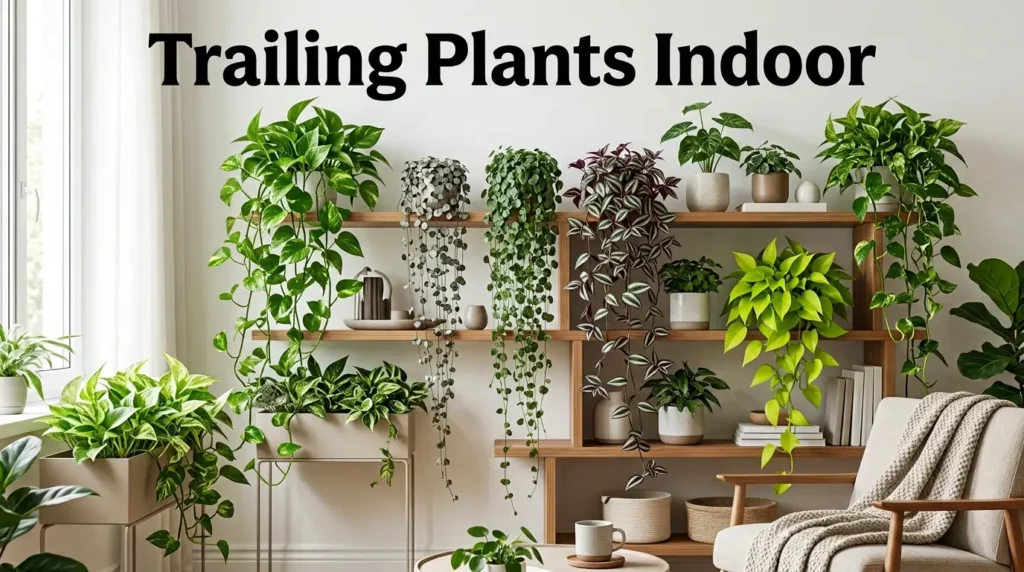
Growing trailing plants indoor spaces adds lush vertical interest, softens hard architectural edges, and turns high shelves or hanging baskets into cascading green waterfalls. Trailing and vining species such as pothos, heartleaf philodendrons, string of pearls, and trade-scantias are botanically adapted to trail across rainforest floors or spill down cliff sides. Replicating these cascading habits inside homes requires matching each species to its light threshold, maintaining fast-draining soil, preventing bald soil crowns, and providing proper hanging hardware.
Successfully managing trailing plants indoor environments comes down to balancing top-of-pot light with downward vine growth. A common mistake indoor gardeners make is placing hanging planters high near the ceiling where the top of the pot receives zero direct overhead light. Without adequate light reaching the root crown, the top stems go bare while the lower vines grow thin and leggy.
Proper trailing plants indoor routines focus on regular tip pruning, proper moisture management in elevated containers, and strategic placement near light sources. Whether you are cascading vining foliage off a high bookshelf or hanging heavy ceramic planters from ceiling joists, choosing species that fit your ambient humidity and light levels ensures vibrant foliage from root crown to vine tip.
This master guide covers top trailing species selection, lighting angles, elevated watering protocols, propagation, canopy thinning, and troubleshooting to keep your indoor vines full, healthy, and cascading year-round.
Top Trailing Plant Species Compared for Indoor Spaces
Selecting the right vining species depends on your available room light, humidity, and maintenance preference.
| Trailing Plant Species | Common Name | Foliage & Texture | Light Requirement | Watering Need | Care Level |
| Epipremnum aureum | Golden Pothos | Heart-shaped green leaves with yellow variegation | Low to bright indirect light | Top 50% dry | Beginner |
| Philodendron hederaceum | Heartleaf Philodendron | Smooth, deep green, pointed heart leaves | Moderate to bright indirect light | Top 50% dry | Beginner |
| Curio rowleyanus | String of Pearls | Spherical succulent beads along thin trailing stems | Bright direct to bright indirect sun | Dry out 75–100% | Intermediate |
| Tradescantia zebrina | Inchplant / Wandering Dude | Shimmering purple, silver, and green striped foliage | Bright indirect light | Top 25–50% dry | Beginner |
| Ceropegia woodii | String of Hearts | Delicately marbled heart-shaped succulent leaves | Bright indirect light with some sun | Dry out 75% | Intermediate |
| Hoya carnosa | Wax Plant | Thick, waxy succulent leaves with clusters of star flowers | Bright indirect light | Dry out 75% | Intermediate |
| Dischidia nummularia | String of Coins | Tiny, round, coin-shaped thick succulent leaves | Bright indirect, high humidity | Top 50% dry | Advanced |
Lighting for Elevated and Hanging Containers
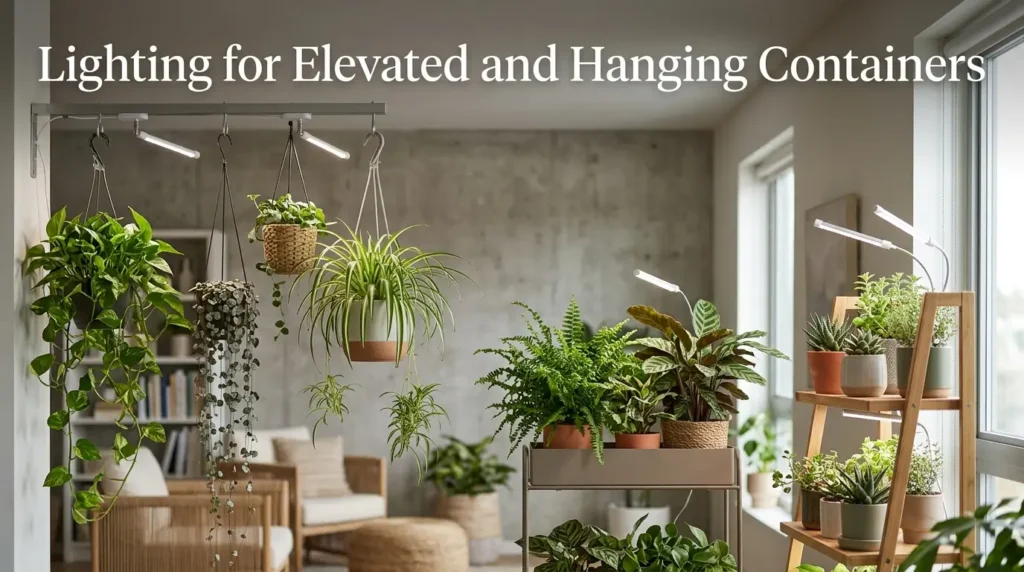
Lighting for trailing plants in elevated spots requires careful attention to pot angle and vine coverage:
1. The Overhead Crown Light Deficit
- The Problem: When hanging pots are mounted above window frames or on high shelves, the lower cascading vines catch light, but the soil surface is shaded by the pot’s rim.
- The Consequence: Shaded soil surfaces cause basal leaves to yellow and drop, leaving a bare, unappealing root crown while the lower vines remain green.
- The Fix: Position hanging planters so the top rim sits at or slightly below the top of the window frame. Alternatively, install a dedicated full-spectrum LED spotlight directed at the top of the pot.
2. Light Thresholds Across Trailing Species
- Thick-Leaved Succulent Trailers (String of Pearls, String of Hearts, Hoyas): Require high light intensity. Place them directly in front of South- or West-facing windows where the top of the pot receives 4 to 6 hours of bright indirect or filtered direct light.
- Foliage Trailers (Pothos, Philodendrons, Syngoniums): Highly adaptable to medium or bright indirect light near East- or North-facing windows.
- Variegated Varieties (Marble Queen Pothos, Tradescantia): Require brighter indirect light to maintain white and purple pigmentation. In low light, variegated foliage turns solid green.
Soil Mixes and Watering Elevated Planters
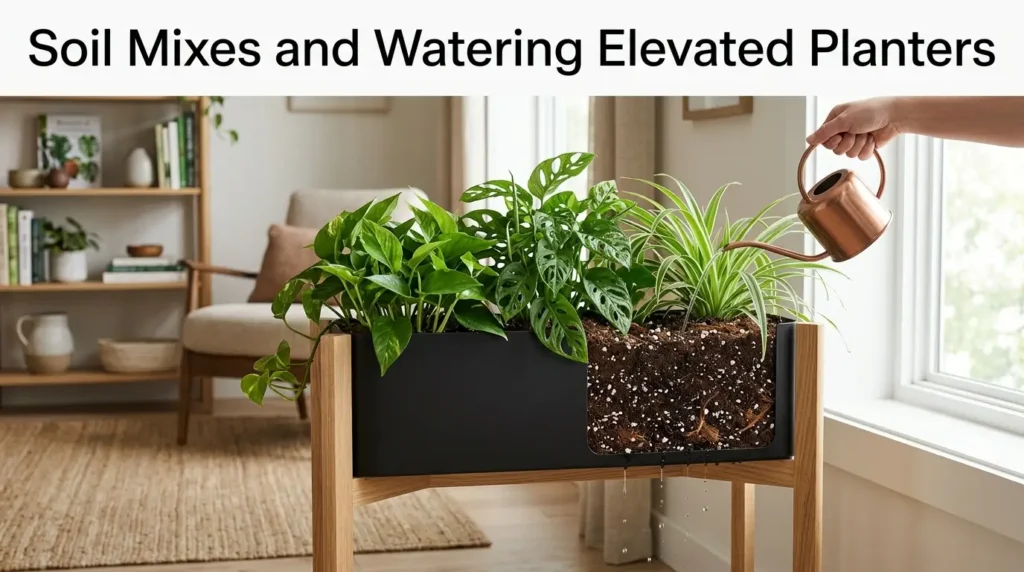
Elevated planters dry out differently than floor pots due to rising warm room air and increased air movement.
High-Aeration Trailing Soil Recipe
Trailing plants need lightweight, airy potting media that drains rapidly while retaining balanced moisture:
- 50% Quality Peat Moss or Coco Coir (Lightweight structure and moisture balance)
- 30% Perlite or Pumice (Enhances root zone aeration and keeps pots light)
- 20% Fine Orchid Bark or Rice Hulls (Prevents compaction around fine feeder roots)
Watering Hanging and High-Shelf Pots
- The Weight Test: Instead of guessing, lift the bottom of the hanging basket. A dry pot feels significantly lighter than a freshly watered container.
- Bottom Watering Option: For dense crowns (like String of Pearls or Tradescantia), set the inner nursery pot in a basin of room-temperature water for 20 minutes to let roots drink from below without rotting surface stems.
- Drainage Tray Safety: Always use hanging pots with attached, removable drainage saucers or use a double-pot setup (a plastic nursery pot nested inside a decorative cover pot) to prevent water from dripping onto floors and furniture.
Maintaining Fullness: Pruning, Pinching & Propagation
Without regular maintenance, long trailing vines naturally lose upper leaves over time, becoming long and sparse.
1.Pinch Back Vine Tips:Snip long stems just above a leaf node using sharp, clean shears.
Regularly trimming the tips of long vines breaks apical dominance, forcing the plant to activate dormant buds near the base and produce multiple new stems.
2.Take Stem Cuttings:Cut 4- to 6-inch vine segments containing at least two leaf nodes.
Select healthy trailing stems and make clean cuts below leaf nodes to create fresh propagation material.
3.Root Cuttings to Fill the Crown:Root cuttings in water or coil stems directly onto top soil.
Place stem cuttings in water until roots reach 2 inches long, then plant them back into the top of the original pot. For pothos or string of hearts, coil long vines directly onto the moist soil surface and pin them down using hairpin clips; roots will form at every node touching the soil.
4.Perform Annual Refresh:Remove yellowing lower leaves and trim leggy stems every spring.
Prune back tired growth by one-third every spring to encourage a wave of thick, fresh foliage.
Safe Mounting and Interior Styling Guidance
Hanging heavy indoor planters requires secure mounting hardware to protect ceiling drywall and flooring:
- Locating Ceiling Joists: Always anchor heavy hanging pots (over 5 lbs) into solid wooden ceiling joists using heavy-duty screw hooks.
- Drywall Anchors: If hanging from hollow drywall, use toggle bolts rated for at least double the weight of your wet planter.
- Shelf Styling: Place trailing plants on top of tall bookcases or wall-mounted shelves, allowing stems to frame books or furniture naturally.
- Macramé and Metal Hangers: Pair simple terracotta or ceramic pots with woven macramé plant hangers to add warm texture to modern interiors.
Troubleshooting Indoor Trailing Plant Problems
Use this practical diagnostic table to keep your indoor vines in top condition:
| Problem | Cause | What to Check | Solution |
| Bare soil crown with long, thin vines | Lack of top-of-pot light; age | Light angle hitting the top of the container | Lower the pot position relative to the window; coil rooted cuttings back into the top soil |
| Yellowing leaves starting from pot base | Overwatering; poor drainage | Soil wetness at root level; drainage holes | Allow top 50% of soil to dry; switch to a lightweight, airy soil blend |
| Shriveled beads or thin, dry leaf drop | Underwatering; extremely dry air | Moisture levels at center of root ball | Water thoroughly until saturated; soak bottom of nursery pot in water basin |
| Loss of leaf color or purple stripes | Low light levels | Daily light exposure | Move plant closer to a bright window or add a grow light fixture |
| Fine webbing under leaves; speckling | Spider mites (Tetranychidae) | Undersides of leaves for tiny moving specks | Wash vines under warm shower; apply neem oil or insecticidal soap weekly |
Test Your Knowledge: Trailing Plant Care Quiz
Question 1
Why do trailing plants hanging high near the ceiling often become bare at the top while remaining green below?
- A) Vines automatically shed top leaves as they grow.
- B) The top rim of the pot blocks light from reaching the soil surface and root crown.
- C) Elevated plants need high nitrogen fertilizer.
- D) Hanging pots draw water upward.
Question 2
What is the best way to encourage a pothos or heartleaf philodendron to grow fuller at the base?
- A) Stop watering completely for three months.
- B) Pinch back stem tips and coil rooted node cuttings back into the top soil.
- C) Cut off all the roots.
- D) Keep the plant in complete darkness.
Question 3
Which trailing plant species prefers its soil to dry out almost completely between waterings?
- A) Tradescantia zebrina.
- B) String of Pearls (Curio rowleyanus).
- C) Boston Fern.
- D) Peace Lily.
Question 4
Why should lightweight soil mixes containing perlite and peat be used for hanging pots?
- A) Dense soil gets too heavy when wet and restricts root oxygen in elevated pots.
- B) Heavy soil turns stems purple.
- C) Lightweight soil eliminates the need for sunlight.
- D) Heavy soil makes vines grow sideways.
Question 5
What safety precaution should be taken when mounting heavy hanging planters from ceilings?
- A) Use tape to stick hooks to drywall.
- B) Anchor screw hooks into solid wood ceiling joists or use heavy-duty toggle bolts.
- C) Hang pots directly from window curtains.
- D) Never water hanging pots.
(Answer Key: 1-B, 2-B, 3-B, 4-A, 5-B)
Frequently Asked Questions
What are the easiest trailing plants for beginners?
Golden Pothos (Epipremnum aureum) and Heartleaf Philodendron (Philodendron hederaceum) are the most forgiving trailing houseplants. They tolerate inconsistent watering, adapt to medium light, and propagate easily.
How do I water a hanging plant without making a mess on the floor?
Use a double-pot system: keep the plant in a plastic nursery pot with drainage holes set inside a decorative saucer-less cover pot. Alternatively, take the inner pot down, water thoroughly over a sink, let it drain completely, and return it to its hanging mount.
Can trailing plants grow in low light?
Pothos and Heartleaf Philodendron survive in low light, but growth slows down and stems may become leggy. Succulent trailers like String of Pearls will shrivel and die without bright light.
How do I stop my String of Pearls from rotting at the base?
Avoid watering from the top over the main bead crown. Bottom-water by setting the pot in water, ensure the soil contains 50% perlite or pumice, and provide direct sunlight to the top of the pot.
How fast do indoor trailing plants grow?
Under bright indirect light during spring and summer, fast growers like Tradescantia and Pothos can grow 12 to 18 inches of new vine per month. Succulent trailers grow more slowly.
Should I trim long vines on indoor trailing plants?
Yes. Trimming trailing vines is essential for long-term health. It stimulates new growth buds along the main stem, keeping the plant full and preventing thin, sparse vines.
Is String of Hearts safe for homes with pets?
Yes. Ceropegia woodii (String of Hearts) is non-toxic to dogs and cats. However, Pothos and Philodendrons contain calcium oxalates and should be kept out of reach of pets.

Megan Foster is the founder and lead writer of GrowIndoorly.com, where she shares practical, easy-to-follow advice for growing healthy indoor plants. She is passionate about helping beginners and experienced plant lovers build thriving indoor gardens with confidence. Megan writes about houseplants, indoor herbs, succulents, hydroponics, grow lights, plant propagation, watering, soil care, and everyday plant maintenance.
She enjoys researching trusted gardening techniques and transforming them into simple, actionable guides that readers can easily apply at home. Her goal is to make indoor gardening more enjoyable and accessible by providing clear, reliable information that helps people keep their plants healthy throughout the year. Whether you’re caring for your first houseplant or expanding your indoor plant collection, Megan’s practical tips are designed to help you grow with confidence.


