
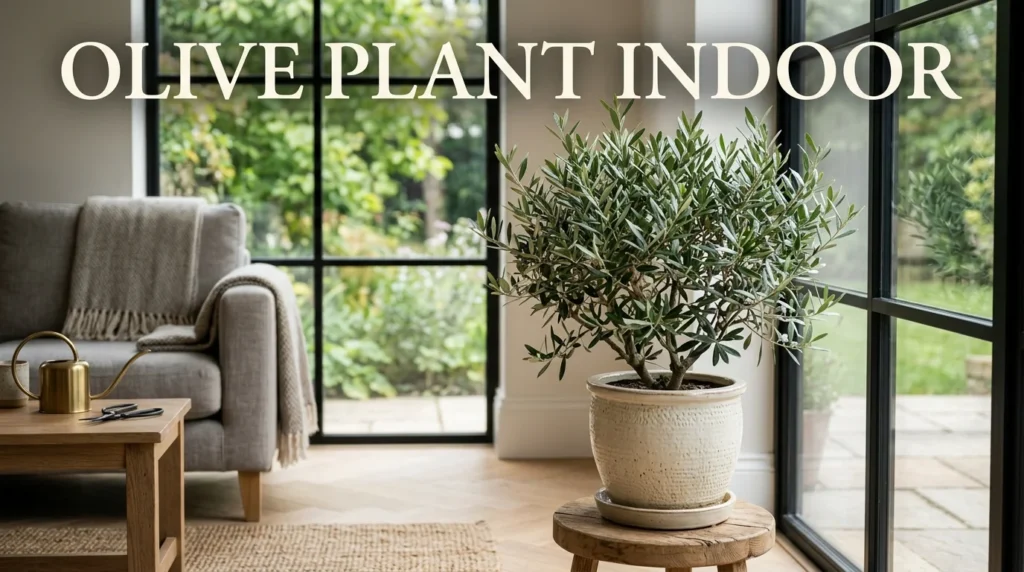
Cultivating an olive plant indoor space adds timeless Mediterranean elegance, slender silver-green foliage, and delicate woody architecture to contemporary living areas. Botanically belonging to the genus Olea most notably Olea europaea olive trees originate from the sun-baked, dry limestone slopes of the Mediterranean basin. While traditionally grown as orchard trees, compact dwarf cultivars adapt well to indoor containers when provided with direct sunlight, fast-draining gritty soil, and low ambient humidity.
Successfully keeping an olive plant indoor environment thriving requires bridging the gap between a tree’s high natural light demand and typical indoor residential conditions. Standard indoor living spaces often lack the intense solar radiation olive foliage needs for photosynthesis. Without adequate light intensity, proper root aeration, and porous pot drainage, indoor olive trees quickly suffer from leaf drop, weak leggy stems, and root decay.
Proper management for an olive plant indoor setup relies on disciplined environmental controls and accurate substrate selection. Placing containers directly near South-facing windows, utilizing breathable unglazed terracotta pots, and allowing the top half of the soil to dry out between waterings protects root systems from rot. Routine seasonal canopy shaping and spring outdoor moves further ensure long-term vitality and dense foliage growth.
This comprehensive master guide covers suitable cultivars, lighting requirements, gritty potting media recipes, irrigation protocols, annual pruning, and troubleshooting to ensure long-term plant health year-round.
Top Olive Cultivars for Indoor Containers
Choosing the right olive variety determines whether your plant remains a manageable indoor focal point or rapidly outgrows its container space.
| Olive Cultivar | Botanical Name | Growth Habit | Indoor Suitability | Key Characteristics |
| Arbequina | Olea europaea ‘Arbequina’ | Compact, bush-like, moderate grower | Best Choice | Self-fertile dwarf tree; adapts well to containers; dense silvery-green leaves. |
| Little Ollie | Olea europaea ‘Montra’ | Dwarf shrub; non-fruiting (fruitless) | Excellent | Naturally compact dwarf shrub (4–6 ft); lush foliage; ideal for purely ornamental use. |
| Mission | Olea europaea ‘Mission’ | Upright, slow to moderate growth | Good | Cold-tolerant classic variety; attractive grey-green leaves; responds well to pruning. |
| Picholine | Olea europaea ‘Picholine’ | Spreading branches, moderate size | Moderate | French origin; weeping canopy habit; needs frequent canopy shaping indoors. |
| Manzanilla | Olea europaea ‘Manzanilla’ | Low-spreading, heavy branching | Moderate | Highly productive outdoor fruiting tree, but requires aggressive pruning in pots. |
Environmental Requirements for Indoor Olive Trees
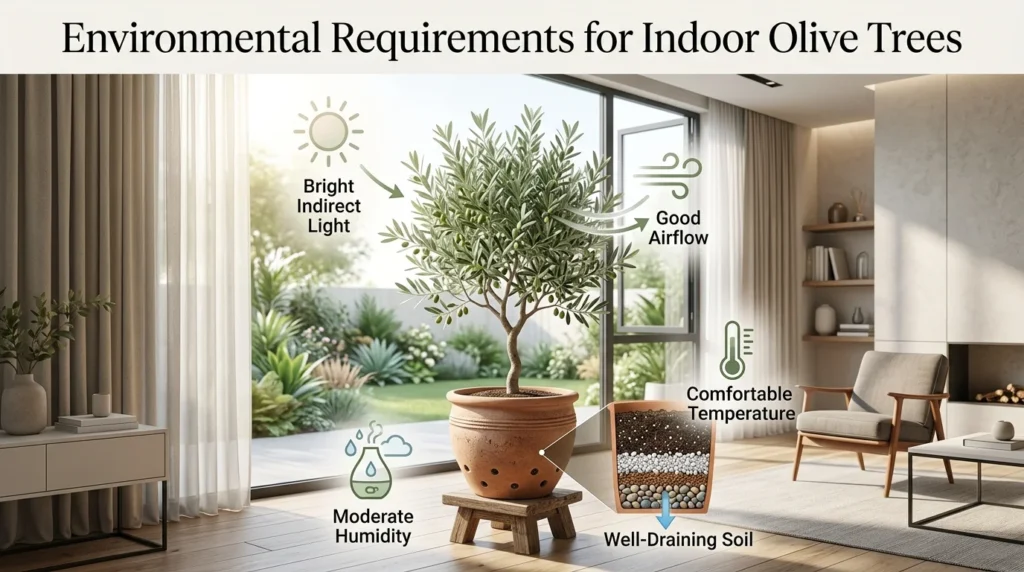
To maintain a healthy olive plant indoor setup, replicate its Mediterranean microclimate using these specific environmental parameters:
1. Sunlight and Artificial Lighting Thresholds
Light exposure is the single most critical factor for indoor olive survival.
- Direct Natural Sunlight: Position your olive tree directly in front of an unobstructed South-facing or West-facing window that provides at least 6 hours of direct sun daily.
- Supplemental Grow Lights: If natural sunlight falls short, install a full-spectrum LED grow light supplying a Photosynthetic Photon Flux Density (PPFD) of 300 to 500 $\mu\text{mol/m}^2/\text{s}$ positioned 12 to 18 inches above the canopy for 12 to 14 hours per day.
- Low Light Stress: Inadequate lighting causes premature drop of green leaves, thin stretched petioles, and complete growth cessation.
2. Temperature and Winter Rest Cycles
- Active Growing Season: Maintain room temperatures between 65°F and 80°F (18°C to 27°C) during spring and summer.
- Winter Chilling Requirement: For fruiting varieties to bloom, olives require a cool period in winter (vernalization) with temperatures between 45°F and 55°F (7°C to 13°C) for 60 to 80 days. Non-fruiting cultivars like ‘Little Ollie’ do not require winter chill to maintain foliage.
- Draft Sensitivity: Keep trees away from hot air vents and cold drafty doors.
3. Humidity Preferences
- Low Relative Humidity: Olives prefer dry indoor air (30% to 45% RH).
- Avoid Misting: Never mist olive leaves. High atmospheric humidity promotes fungal leaf spot and powdery mildew.
Substrate Formulation, Potting, and Irrigation
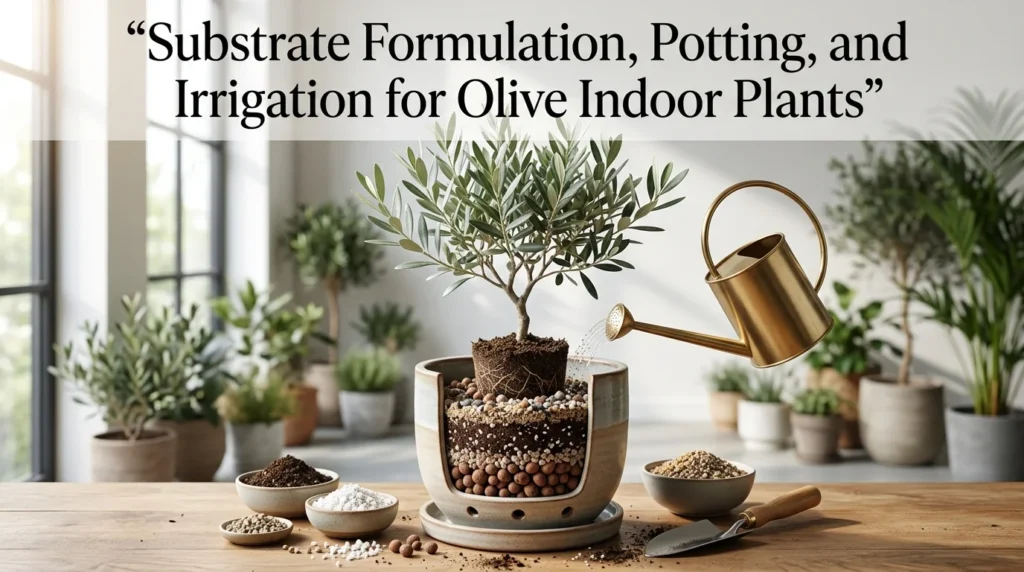
Olive roots require high oxygen levels and fast-draining media. Waterlogged soil causes rapid root loss.
Gritty Mediterranean Soil Recipe
Never use standard peat-heavy houseplant potting soil. Create a fast-draining, high-porosity blend:
- 40% High-Quality Potting Soil
- 30% Coarse Perlite or Pumice
- 20% Horticultural Crushed Granite or Poultry Grit
- 10% Coarse Builder’s Sand
Pot Selection
- Unglazed Terracotta: Always use unglazed terracotta or clay pots with generous drainage holes. Terracotta draws moisture out through its porous walls, speeding up root zone drying.
- Sizing: Choose a pot that is 2 to 3 inches wider than the root ball. Oversized pots hold excess water in unrooted soil zones.
Watering Protocol (The “Dry-Out” Rule)
- Drying Interval: Allow the top 50% of the potting substrate to dry out completely between waterings. Insert a finger or moisture meter deep into the root ball before watering.
- Thorough Soaking: Water deeply until water flows freely out of the bottom drainage holes, then discard all standing water from the drainage tray immediately.
- Winter Reduction: During winter, reduce watering frequency significantly, allowing the soil to dry almost entirely between light waterings.
Step-by-Step: How to Prune and Shape Indoor Olive Trees
Annual pruning maintains canopy density, controls tree height, and improves interior light penetration:
1.Sterilize Pruning Shears:Wipe blades with 70% isopropyl alcohol to avoid spreading pathogens.
Clean sharp bypass pruners before cutting wood.
2.Remove Weak and Dead Wood:Prune out broken, crossing, or inward-growing branches.
Cut dead or crossing branches back to the main trunk or parent stem to open up the center of the canopy to sunlight.
3.Clear Basal Suckers:Snip off suckers growing from the base or below graft unions.
Remove root suckers emerging from the soil line to direct energy into the main leader stem.
4.Shape Outer Canopy Growth:Trim back outer leggy shoots by one-third in early spring.
Shorten long branches just above an outward-facing node to encourage branching and a fuller foliage head.
The GrowIndoorly Microclimate Setup for Indoor Olives
Enhance growing conditions with these targeted microclimate safeguards:
- Terracotta Elevation: Place terracotta pots on plant rollers or trivets to allow air to circulate under the bottom drainage hole, keeping floor surfaces dry and speeding drainage.
- Gravel Top-Dressing: Add a 1/2-inch layer of light-colored pea gravel on top of the soil. This reflects light up into the lower foliage while preventing soil splatter during watering.
- Summer Outdoor Vacation: Move your potted olive tree outdoors to a sunny patio during late spring and summer. Outdoor sunlight, warmth, and natural wind build trunk thickness and store energy for wintering indoors.
Troubleshooting Indoor Olive Problems
Use this diagnostic reference table to identify and treat common indoor olive tree issues:
| Problem | Cause | What to Check | Solution |
| Sudden drop of green leaves | Insufficient sunlight; root shock from overwatering | Daily hours of direct sun; soil moisture at bottom of pot | Move to a brighter window or add a grow light; allow soil to dry between waterings |
| Leaves turning brown, crispy, and staying attached | Severe underwatering; dry root ball | Soil dryness depth; pot weight | Water deeply until soil is saturated; ensure soil mix absorbs water evenly |
| Sticky sap residue on leaves; small brown bumps on stems | Scale insects (Coccidae) | Undersides of leaves and young stems for oval shells | Wipe stems with alcohol-soaked cotton swabs; spray with insecticidal soap or neem oil |
| Yellowing leaves with soft brown roots | Root rot from heavy, soggy soil mix | Root firmness; soil odor | Repot into a gritty terracotta setup; prune away brown, soft rotted roots |
| Thin, leggy growth with long gaps between leaves | Low light levels | Distance from light source; window orientation | Increase light exposure using full-spectrum LED fixtures for 12–14 hours daily |
Conclusion
Cultivating an olive plant indoor setup succeeds when you provide full sunlight, fast-draining gritty soil, and breathable terracotta pots.
Allowing the top half of the soil mix to dry out protects delicate roots from rot while maintaining essential root zone aeration.
Positioning containers near sunny South-facing windows or adding supplemental LED lights ensures dense foliage and prevents leaf drop.
At GrowIndoorly.com, we help you bring sun-baked Mediterranean beauty into your living space with clear, science-backed care guidance.
Test Your Knowledge: Indoor Olive Care Quiz
Question 1
What is the minimum amount of direct sunlight an indoor olive tree requires daily near a window?
- A) 1 to 2 hours.
- B) 6 hours of direct sunlight.
- C) Zero hours; it thrives in shade.
- D) 2 hours of filtered light.
Question 2
Which olive cultivar is widely considered the best dwarf choice for indoor containers due to its compact habit?
- A) Olea europaea ‘Arbequina’.
- B) Commercial Spanish Giant.
- C) Mission Tree.
- D) Wild Alpine Olive.
Question 3
Why are unglazed terracotta pots recommended over plastic pots for growing olive trees?
- A) They make the plant leaves greener.
- B) They trap water inside the soil longer.
- C) Porous terracotta allows moisture to evaporate through pot walls, speeding up soil drying.
- D) They keep the soil acidic.
Question 4
How much of the potting substrate should dry out before watering an indoor olive tree?
- A) Never let the top dry out.
- B) Keep soil dripping wet at all times.
- C) Allow the top 50% of the soil to dry out completely.
- D) Water every single day regardless of dryness.
Question 5
What type of soil mix works best for indoor olive plants?
- A) Heavy garden clay with compost.
- B) 100% pure peat moss.
- C) Fast-draining gritty blend with potting soil, perlite, granite grit, and sand.
- D) Wet potting gel.
(Answer Key: 1-B, 2-A, 3-C, 4-C, 5-C)
Frequently Asked Questions
Can an indoor olive tree produce edible fruit?
While self-fertile varieties like ‘Arbequina’ can produce fruit, fruiting indoors is rare. It requires extremely high light levels, cross-pollination assistance, and a cool winter chilling period (45°F–55°F) to trigger flower buds.
Why is my indoor olive tree shedding green leaves?
Green leaf drop is almost always caused by a sudden reduction in light levels or overwatering. Moving a tree from a bright nursery to a dim indoor corner causes the plant to shed excess leaves it can no longer support.
Should I put my indoor olive tree outside during summer?
Yes. Moving your potted olive tree outdoors to a sunny patio during warm spring and summer months boosts growth, strengthens the trunk, and prepares the tree for winter indoors.
How big will an indoor olive tree get in a pot?
In containers, dwarf olive trees typically grow 4 to 6 feet tall. Annual pruning and pot size constraints keep the canopy compact and manageable.
How often should I fertilize my indoor olive plant?
Feed your olive tree once a month from spring through early autumn using a balanced water-soluble fertilizer containing micronutrients. Do not fertilize during late fall or winter.
Is the indoor olive plant safe for pets?
Yes. Olea europaea is non-toxic to dogs and cats.
How do I know if my indoor olive tree needs repotting?
Repot every 2 to 3 years in spring when roots begin crowding the drainage holes or when water drains straight through without absorbing into the root ball. Choose a pot 2 inches larger in diameter.

Megan Foster is the founder and lead writer of GrowIndoorly.com, where she shares practical, easy-to-follow advice for growing healthy indoor plants. She is passionate about helping beginners and experienced plant lovers build thriving indoor gardens with confidence. Megan writes about houseplants, indoor herbs, succulents, hydroponics, grow lights, plant propagation, watering, soil care, and everyday plant maintenance.
She enjoys researching trusted gardening techniques and transforming them into simple, actionable guides that readers can easily apply at home. Her goal is to make indoor gardening more enjoyable and accessible by providing clear, reliable information that helps people keep their plants healthy throughout the year. Whether you’re caring for your first houseplant or expanding your indoor plant collection, Megan’s practical tips are designed to help you grow with confidence.


