
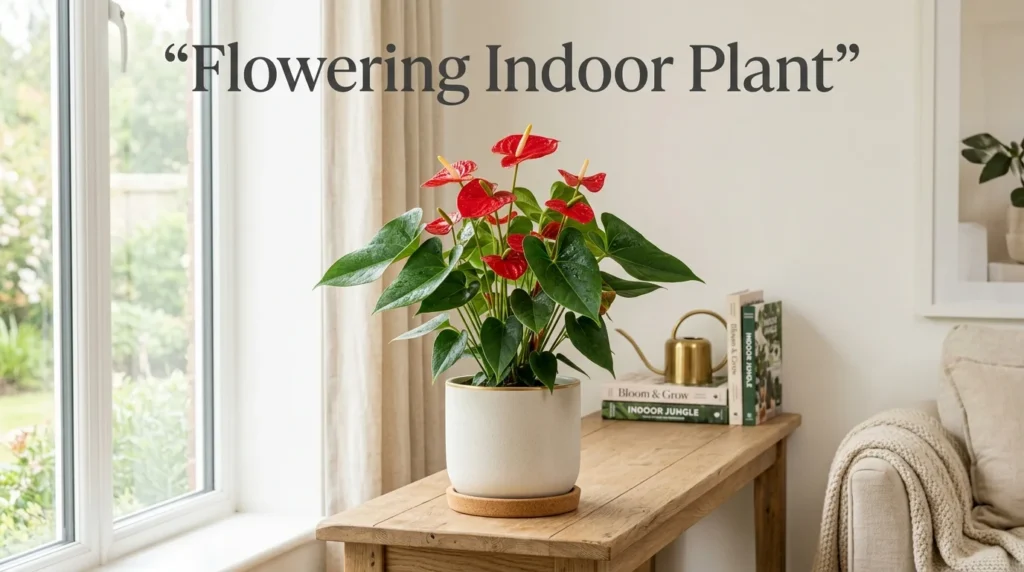
A flowering indoor plant adds vibrant color, subtle fragrance, and architectural beauty to interior spaces that green foliage alone cannot match. Popular indoor bloomers include Peace Lilies (Spathiphyllum), African Violets (Saintpaulia), Moth Orchids (Phalaenopsis), Flamingo Flowers (Anthurium), and Christmas Cacti (Schlumbergera). Unlike outdoor garden perennials that rely on full seasonal weather shifts, an indoor blooming plant requires precise light thresholds, proper nutrient balancing, and adequate humidity to trigger and sustain floral buds.
Successfully growing a flowering indoor plant requires understanding that flower production is an energy-intensive metabolic process. While foliage houseplants survive in modest indoor lighting, blooming varieties require higher light intensity, specific phosphorous-to-nitrogen ratios, and consistent temperature controls to initiate buds. When indoor bloomers fail to produce flowers, the underlying causes are almost always insufficient light energy, excessive high-nitrogen fertilizer, or improper moisture levels.
This master guide covers species selection across experience levels, light thresholds needed for bloom initiation, soil substrate formulas, high-phosphorus feeding schedules, deadheading techniques, pest control, and diagnostic troubleshooting to keep your indoor garden blooming year-round.
Top Flowering Indoor Plants Compared
Selecting the right flowering indoor plant depends on your available windowsill light, household humidity levels, and care commitment. If you are new to blooming houseplants, start with one forgiving beginner species and learn its rhythm before expanding your collection. Choose the plant to match your brightest available spot rather than trying to force a high-light bloomer into a dark corner.
| Plant Species | Common Name | Bloom Season & Duration | Light Requirement | Water Needs | Care Level |
| Spathiphyllum wallisii | Peace Lily | Spring/Summer (4–8 weeks) | Low to Bright Indirect | Top 50% dry; moisture lover | Beginner |
| Anthurium andraeanum | Flamingo Flower | Year-round under proper light | Medium to Bright Indirect | Top 25–50% dry | Beginner |
| Saintpaulia ionantha | African Violet | Year-round intermittent cycles | Bright Indirect (East window) | Evenly moist; bottom water | Intermediate |
| Phalaenopsis hybrids | Moth Orchid | Late Winter/Spring (2–3 months) | Bright Filtered Light | Bark media dry-out cycle | Intermediate |
| Schlumbergera truncata | Holiday/Christmas Cactus | Late Fall to Winter (3–6 weeks) | Bright Indirect; short days | Top 50% dry | Beginner |
| Cyclamen persicum | Florist Cyclamen | Fall through Spring cool months | Bright Indirect; cool temps | Keep evenly moist | Intermediate |
| Begonia x hiemalis | Rebuilder/Elatior Begonia | Winter through Spring | Bright Light; soft morning sun | Top 50% dry | Advanced |
Environmental Triggers for Indoor Bloom Production
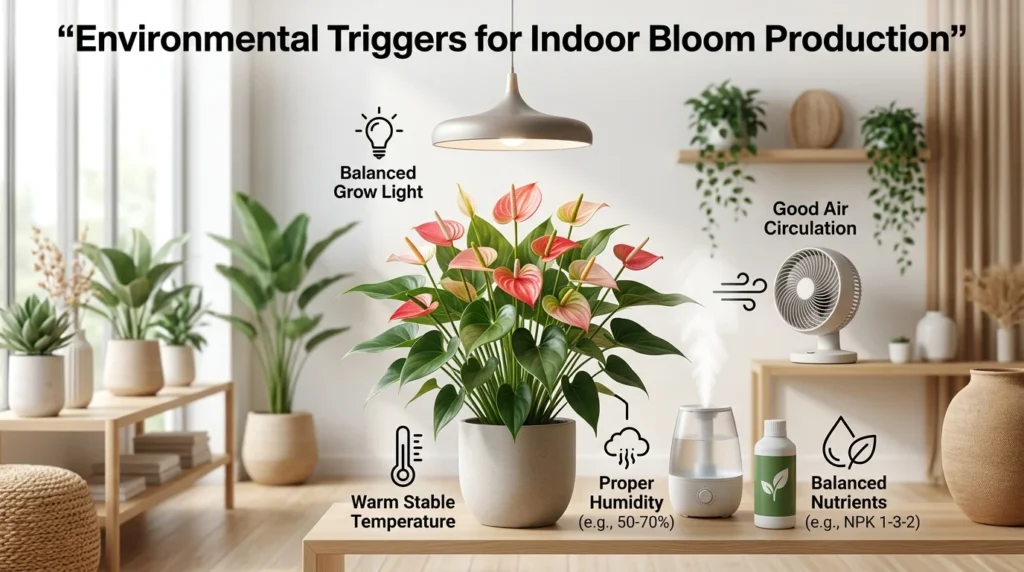
To force or encourage a flowering indoor plant to set new buds, growers must satisfy three main environmental triggers: light energy, temperature differential, and photoperiod (day length).
1. Light Energy and Photosynthesis
Floral development demands significant sugars synthesized through photosynthesis. If light is too low, the plant conserves energy by maintaining foliage while dropping floral buds (bud abscission). Rotate the pot regularly so all sides grow evenly, and keep the leaves dust-free so they capture as much light as possible. Tall, stretched stems with wide gaps between leaves are a classic signal that the plant is reaching for more light.
- Placement: Position flowering plants within 1 to 3 feet of an East-, West-, or indirect South-facing window.
- Target Intensity: Aim for 300 to 600 foot-candles (approx. $30 – 60 \ \mu\text{mol/m}^2/\text{s}$ PPFD) for heavy bloomers like Orchids and Anthuriums.
- Grow Light Setup: If natural sunlight is inadequate, use full-spectrum LED grow lamps set 10 to 14 inches above the plant canopy for 12 to 14 hours daily.
2. Temperature Shifts and Photoperiod
Certain blooming species rely on seasonal temperature or lighting cues to trigger flower bud differentiation:
- Short-Day Triggers (Photoperiodism): Plants like Schlumbergera (Christmas Cactus) and Kalanchoe require 12 to 14 hours of continuous dark nights for 4 to 6 weeks in autumn to set floral buds.
- Cool Night Drops: Orchids like Phalaenopsis often require a night-time temperature drop of 10°F (5°C to 6°C) below daytime averages (dropping to ~60°F or 15°C) for two to three weeks to stimulate flower spikes.
Substrates, Watering Protocols, and Bloom Feeding
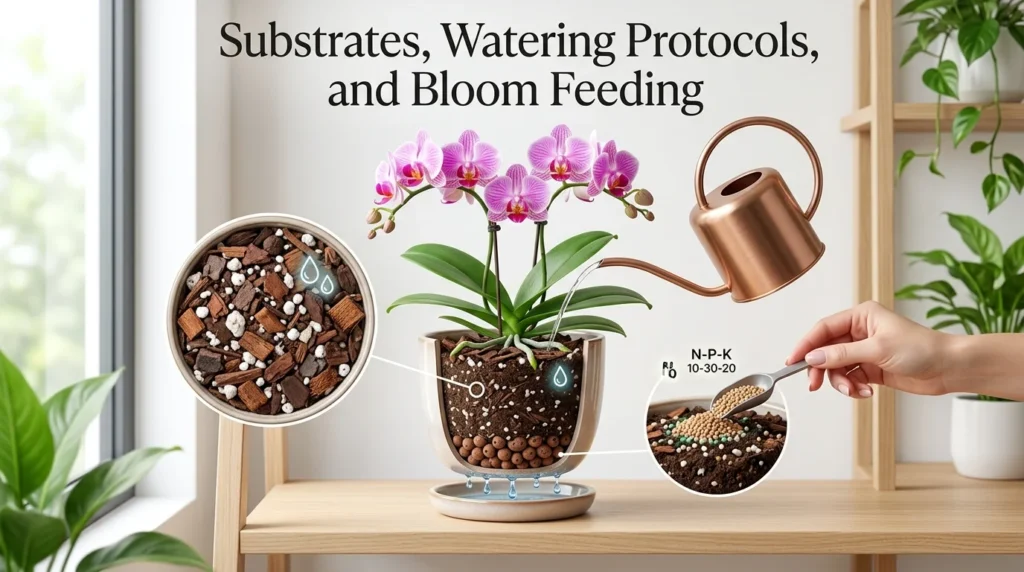
Because flowering roots are sensitive to both drought stress and stagnation, proper soil structure and nutrient management are critical.
Substrate Formulations
A dense, heavy potting mix smothers feeder roots, causing premature bud drop. Match substrate aeration to root anatomy:
- Standard Blooming Houseplant Blend: Combine 50% commercial potting soil, 30% coarse perlite or pumice, and 20% orchid bark chips for aeration.
- Epiphytic Orchids (Phalaenopsis): Use 100% medium-grade fir bark mixed with chunky sphagnum moss and charcoal. Never use soil.
- African Violets: Use a light, peat- or coco-based mix with 50% perlite to ensure rapid drainage while holding light surface moisture.
Irrigation Best Practices
- Consistency: Avoid letting plants oscillate between bone-dry conditions and waterlogged soil. Fluctuations trigger root shock and immediate bloom shedding.
- Bottom Watering: For sensitive foliage like African Violets and Cyclamen, place pots in a saucer filled with room-temperature water for 20 minutes, allowing roots to wick up water without wetting fuzzy leaves or crown tissue.
- Water Quality: Sensitive indoor bloomers react poorly to hard tap water containing high chlorine or mineral salts. Use room-temperature filtered, rain, or distilled water to prevent leaf tip burn.
High-Phosphorus Fertilizer Protocols
Nutrient ratios directly dictate whether a plant produces leaves or blooms. High nitrogen ($N$) stimulates lush green leaves at the expense of flowers, while high phosphorus ($P$) fuels floral differentiation and root expansion. Always apply fertilizer to already-moist soil rather than a dry root ball, and flush with plain water occasionally to prevent salt buildup. Brown, scorched leaf tips often mean feeding has been too heavy-handed.
- NPK Ratio Selection: Select a balanced or high-phosphorus bloom booster fertilizer (such as a 10-30-20 or 7-9-5 ratio).
- Application Schedule: Apply diluted at half-strength every 2 to 3 weeks during active growth and bud formation.
- Dormancy Pause: Cease fertilizing entirely once flowers open fully or when the plant enters post-bloom seasonal rest.
Step-by-Step: Deadheading, Pruning, and Reblooming Techniques
Managing fading flowers (deadheading) redirects metabolic energy away from seed production and back into fresh root, foliage, and floral growth.
1.Inspect the Floral Display:Identify spent, browning, or wilting flower stems.
Locate individual flowers that have finished blooming and are beginning to brown, drop petals, or form seed pods at the stem base.
2.Sterilize Tools:Use clean, bypass pruners sterilized with rubbing alcohol.
Wipe your shears or pruning scissors with 70% isopropyl alcohol to prevent transferring viral or fungal pathogens between stems.
3.Sever Spent Stalks:Snip flower stalks near the main base or leaf node.
Cut the flower stem cleanly near its point of origin at the base or just above the nearest healthy leaf junction. For Phalaenopsis orchids, cut back to the second node below the spent blooms to encourage a secondary spike.
4.Clean Soil Surface:Remove fallen petals and leaf debris from soil surface.
Clear out dead floral tissue that has fallen onto the topsoil to eliminate breeding grounds for Botrytis mold and fungus gnat larvae.
5.Provide Post-Bloom Care:Apply a light dose of balanced liquid fertilizer.
Feed the plant with a mild, half-strength balanced fertilizer to assist energy recovery as it transitions back to vegetative development.
Troubleshooting Indoor Flowering Plant Issues
Use this diagnostic reference table to identify and correct flowering problems quickly:
| Problem Observed | Primary Cause | What to Check | Corrective Action |
| Plant looks healthy and green but never blooms | Insufficient light intensity; excess nitrogen fertilizer | Distance from window; high-nitrogen fertilizer use | Relocate to brighter window or add LED grow lights; switch to high-phosphorus fertilizer formula. |
| Floral buds form but drop off before opening (Bud Blast) | Sudden draft, low humidity, or soil dryness | Proximity to AC vents; room humidity (<40%); dry root zone | Maintain consistent temperatures (65–75°F); increase humidity with a humidifier; keep soil evenly moist. |
| Flower petals develop gray fuzzy mold | Botrytis blight caused by excess moisture | Air circulation; wet petals from overhead watering | Trim affected blooms; improve room airflow with a fan; avoid getting water on flower petals. |
| Leaves turn yellow and soft; flowers wilt early | Root rot from overwatering / heavy soil | Soil moisture depth; drainage hole functionality | Reduce watering frequency; unpot to trim black soft roots; repot into a well-aerated, gritty mix. |
| White cottony patches on stem joints and blooms | Mealybug infestation (Pseudococcidae) | Leaf undersides, flower stems, and crowns | Spot-treat insects directly using cotton swabs dipped in 70% isopropyl alcohol; treat with insecticidal soap. |
Knowledge Check: Flowering Indoor Plant Quiz
Question 1
Which primary plant nutrient is most responsible for promoting flower and root development in indoor plants?
- A) Nitrogen (N)
- B) Phosphorus (P)
- C) Potassium (K)
- D) Sodium (Na)
Question 2
What happens when a flowering indoor plant is kept in light levels that are too dim?
- A) It blooms continuously year-round.
- B) It conserves energy, leading to bud drop or a complete failure to set flower buds.
- C) Its leaves turn silver immediately.
- D) It produces extra large seed pods.
Question 3
Why is deadheading (removing spent flowers) beneficial for an indoor plant?
- A) It stops root growth permanently.
- B) It prevents the plant from wasting energy on seed production, redirecting strength to new growth.
- C) It changes the flower color for the next season.
- D) It eliminates the need for watering.
Question 4
What environmental factor triggers flower bud production in a Christmas Cactus (Schlumbergera)?
- A) Continuous 24-hour bright light exposure.
- B) High nitrogen fertilizer applied daily.
- C) Uninterrupted long dark nights (12–14 hours) and cooler autumn temperatures.
- D) Keeping soil submerged under water.
Question 5
How should you water plants with delicate or fuzzy foliage, such as African Violets?
- A) Heavy misting over the top leaves every morning.
- B) Pouring boiling water into the pot.
- C) Bottom watering by setting the pot in a shallow tray of room-temperature water for 20 minutes.
- D) Keeping the pot in a bucket of ice water.
(Answer Key: 1-B, 2-B, 3-B, 4-C, 5-C)
Common Mistakes to Avoid with Flowering Indoor Plants
Most indoor blooming disappointments come from a few avoidable habits. Watch out for these:
- Feeding a high-nitrogen fertilizer that pushes leafy growth at the expense of flowers.
- Keeping a bloomer in a dim corner and expecting it to set buds.
- Letting the plant swing between bone-dry and waterlogged soil.
- Skipping the long dark nights or cool-night cues that short-day plants need to initiate buds.
- Deadheading too aggressively and removing healthy buds along with the spent flowers.
Frequently Asked Questions
Why did my indoor plant stop blooming after I brought it home from the nursery?
Commercial greenhouses provide optimal light, high humidity, and specialized feeding routines. Moving a plant into a drier, darker residential interior causes temporary acclimation shock, leading to flower drop. Provide bright indirect light and maintain consistent humidity to help it recover.
How do I get my Peace Lily to flower again?
Peace Lilies require bright indirect light to generate energy for spathe production. If kept in dim corners, they survive but rarely bloom. Move your Peace Lily within a few feet of an East window and feed with a high-phosphorus bloom booster during spring and summer.
Can I keep a flowering indoor plant in a room without windows?
Flowering plants cannot set buds or sustain blooms long-term in windowless rooms under standard residential light fixtures. However, you can grow them successfully using full-spectrum LED grow lights placed 10 to 14 inches above the plant running 12 to 14 hours daily.
Is Anthurium safe for households with pets?
No. Anthurium plants contain insoluble calcium oxalate crystals. If chewed by cats or dogs, they cause mouth irritation, burning, drooling, and difficulty swallowing. Keep Anthuriums out of reach of curious pets.
How long do Moth Orchid (Phalaenopsis) blooms typically last?
Individual Phalaenopsis orchid flowers can last between 6 and 12 weeks on the flower spike, making them one of the longest-lasting flowering indoor plants available.
Why are the leaves of my African Violet turning yellow and spotting?
Watering African Violets with cold water or getting water directly on fuzzy leaves under light causes cold shock and leaf spotting (ring spot). Always use room-temperature water and water from the bottom or below the foliage canopy.
Do flowering indoor plants need dormancy periods?
Yes, many blooming species require a natural period of reduced growth or rest during winter. During this time, reduce watering, hold off on fertilizer, and allow the plant to conserve energy before spring re-emergence.
Peace Lilies (Spathiphyllum) are a good starting choice: they tolerate low to moderate light, forgive watering mistakes, and bloom with reasonable care.
Christmas Cacti need 12 to 14 hours of continuous dark nights for 4 to 6 weeks in autumn to set floral buds.
Deadheading redirects metabolic energy away from seed production and back toward vegetative growth, root development, and new bloom formation.

Megan Foster is the founder and lead writer of GrowIndoorly.com, where she shares practical, easy-to-follow advice for growing healthy indoor plants. She is passionate about helping beginners and experienced plant lovers build thriving indoor gardens with confidence. Megan writes about houseplants, indoor herbs, succulents, hydroponics, grow lights, plant propagation, watering, soil care, and everyday plant maintenance.
She enjoys researching trusted gardening techniques and transforming them into simple, actionable guides that readers can easily apply at home. Her goal is to make indoor gardening more enjoyable and accessible by providing clear, reliable information that helps people keep their plants healthy throughout the year. Whether you’re caring for your first houseplant or expanding your indoor plant collection, Megan’s practical tips are designed to help you grow with confidence.


