
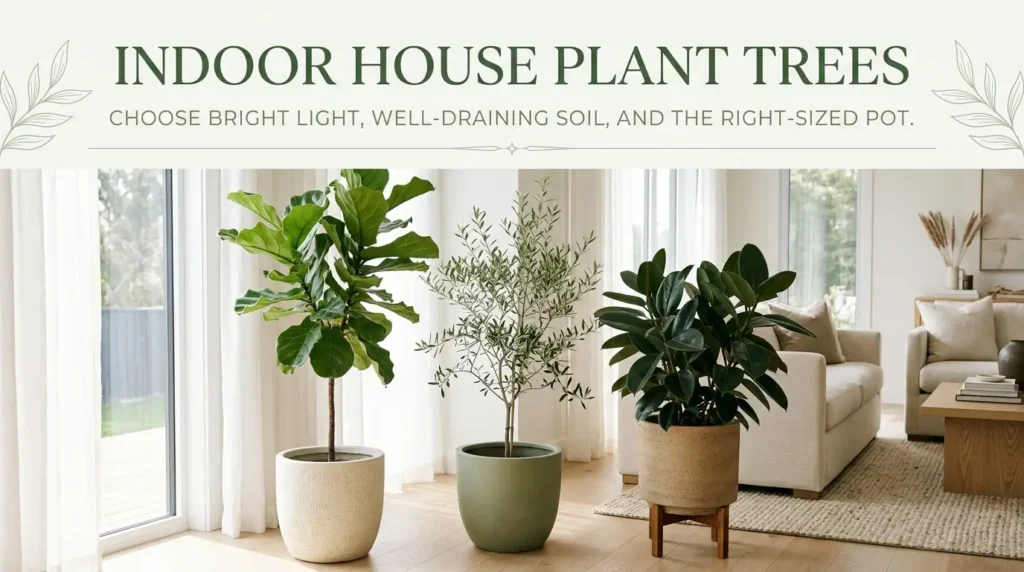
Indoor house plant trees bring height, natural beauty, and a calming atmosphere to indoor spaces. From the elegant fiddle-leaf fig to the adaptable rubber plant, indoor trees can transform empty corners into attractive green focal points. However, choosing the right tree involves more than appearance. Light availability, ceiling height, room temperature, watering habits, and mature plant size all influence how well a tree grows indoors.
The best indoor trees are those that suit your home’s conditions and your ability to care for them. Some thrive in bright, indirect light, while others tolerate moderate indoor light. Understanding these differences helps you select a healthy plant, prevent common care problems, and enjoy long-lasting greenery in your home.
This guide explains the best indoor tree varieties, their growing requirements, practical maintenance tips, and how to troubleshoot common problems.
What Are Indoor House Plant Trees?
Indoor house plant trees are woody or tree-like plants grown inside homes, apartments, offices, and other indoor spaces. They typically have upright stems or trunks, branching growth, and foliage that creates a taller silhouette than ordinary tabletop houseplants.
Some are naturally tree-shaped, while others develop a tree-like appearance through pruning and training.
Popular examples include:
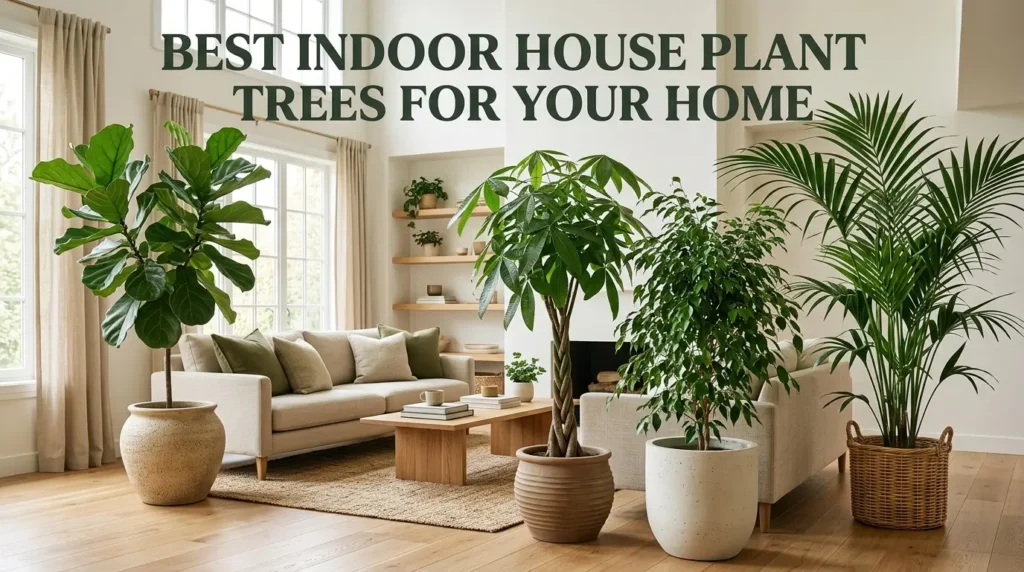
- Fiddle-leaf fig: Known for its large, violin-shaped leaves.
- Rubber plant: Features thick, glossy leaves and an upright growth habit.
- Areca palm: Adds a soft, tropical appearance with feathery fronds.
- Dracaena: Offers architectural foliage and varieties suitable for different interiors.
- Money tree: Recognized for its palmate leaves and often braided trunk.
- Indoor olive tree: Provides narrow, silvery-green foliage and a Mediterranean look.
- Weeping fig: Develops graceful branches and dense foliage when conditions are suitable.
Unlike small foliage plants, indoor trees can occupy substantial vertical space. Before purchasing one, consider both its current size and its potential mature height.
Best Indoor House Plant Trees for Your Home
The ideal indoor tree depends on your lighting, available space, and maintenance preferences. Some species are better suited to bright rooms, while others can tolerate less intense light.
1. Fiddle-Leaf Fig (Ficus lyrata)
A striking choice for spacious rooms, this tree has large, sculptural leaves that create a bold focal point. It performs best in bright, indirect light and benefits from consistent watering and minimal sudden environmental changes.
Best for: Bright living rooms and statement corners.
2. Rubber Plant (Ficus elastica)
Rubber plants have thick, glossy foliage and can develop a strong upright trunk. They generally adapt well to indoor growing when provided with bright, indirect light and well-draining potting mix.
Best for: Modern interiors and beginner-friendly tree displays.
3. Areca Palm (Dypsis lutescens)
This tropical palm produces multiple slender stems and arching fronds. It prefers bright, indirect light, evenly moist but well-drained soil, and moderate humidity.
Best for: Tropical styling and filling vertical spaces.
4. Dracaena (Dracaena fragrans and related species)
Dracaenas feature cane-like stems and long, decorative leaves. Many tolerate moderate indoor light better than light-demanding trees, although growth slows in dim locations.
Best for: Homes with moderate light and limited maintenance time.
5. Money Tree (Pachira aquatica)
Its distinctive braided trunk and hand-shaped leaves make it a popular indoor ornamental tree. It prefers bright, indirect light and a potting mix that drains freely.
Best for: Desks, bedrooms, and decorative indoor corners.
6. Indoor Olive Tree (Olea europaea)
Olive trees have narrow leaves and a refined, Mediterranean appearance. Unlike many foliage houseplants, they require several hours of strong light and are difficult to maintain long-term in dim rooms.
Best for: Very sunny rooms and bright conservatories.
7. Weeping Fig (Ficus benjamina)
This tree develops fine branches and dense foliage. It can look elegant indoors but may drop leaves when exposed to abrupt changes in light, temperature, or watering.
Best for: Stable indoor environments with consistent care.
Which Indoor Tree Is Best for Beginners?
For many beginners, a rubber plant or a suitable dracaena is a practical starting point. Both offer an attractive tree-like shape without demanding the intense light required by an olive tree.
Choose a money tree if you prefer a decorative trunk, or an areca palm if you want a softer, tropical appearance.
Remember that no tree thrives in complete darkness. Plants described as low-light tolerant still need enough light to maintain healthy growth.
How to Choose the Right Indoor Tree
Before bringing a tree home, evaluate the conditions where it will live. A suitable plant is more likely to remain healthy and require less corrective care.
1. Assess Your Available Light
Light is one of the most important factors in indoor tree growth. Windows facing different directions provide different amounts of light, and buildings, curtains, trees, and seasonal changes can reduce its intensity.
- Bright, direct sunlight: May suit olive trees and some sun-acclimated plants.
- Bright, indirect light: Often works well for rubber plants, money trees, and fiddle-leaf figs.
- Moderate indirect light: Can suit certain dracaenas, although growth may be slower.
- Very dim rooms: Generally unsuitable for long-term healthy growth of most indoor trees without supplemental lighting.
Observe the actual light reaching the leaves rather than judging a room by how bright it looks to people. If natural light is insufficient, a suitable full-spectrum grow light can supplement it.
2. Consider Ceiling Height and Floor Space
A young indoor tree may look compact in a nursery but eventually grow much taller and wider.
Before choosing a plant, consider:
- Its expected mature height indoors.
- The width of its canopy.
- The space required for watering and pruning.
- Whether it will obstruct windows, walkways, or furniture.
- Whether the pot and plant will be stable around children or pets.
Slow-growing or naturally compact varieties can be easier to manage in apartments. Larger species work best where they have room to develop without constant pruning.
3. Match the Tree to Your Routine
Some trees require more attention than others. Palms may need closer monitoring of moisture and humidity, while olive trees need substantial light. Rubber plants generally tolerate short periods of drying between waterings better than consistently wet soil.
Choose a plant whose needs fit your daily routine instead of relying on a fixed watering schedule.
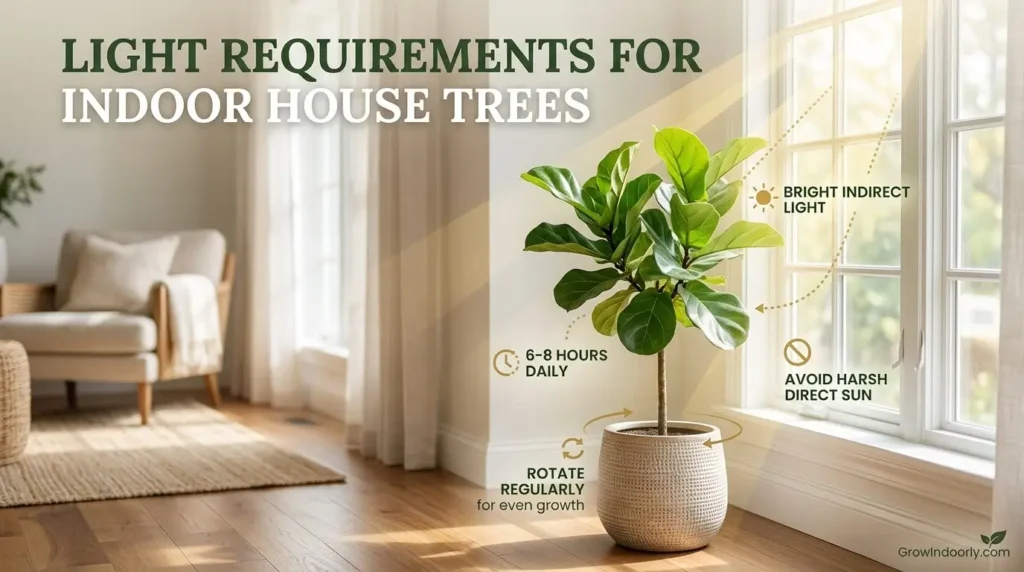
Light Requirements for Indoor House Trees
Indoor trees need light to photosynthesize, produce energy, and maintain healthy leaves. Insufficient light can cause weak growth, smaller leaves, long gaps between leaves, or gradual leaf loss.
Finding the Best Location
Place light-demanding trees near bright windows, adjusting their position according to the intensity of the sun. Bright, indirect light is often a good starting point for tropical foliage trees.
Direct sun through glass can be beneficial for some plants but may scorch foliage that has not adapted to it. Introduce stronger sunlight gradually.
Rotate the pot occasionally to encourage more even growth, provided the species tolerates changes in orientation.
Using Grow Lights
A full-spectrum LED grow light can help when natural light is inadequate, especially during darker seasons.
For better results:
- Select a grow light suitable for the size and light needs of your tree.
- Follow the manufacturer’s recommended distance and coverage.
- Provide a consistent daily lighting period, often around 10–14 hours depending on light intensity and species.
- Allow a regular dark period at night.
- Observe the leaves and new growth to assess whether the setup is working.
A timer can make supplemental lighting more consistent. Avoid assuming that a longer lighting period always compensates for weak light intensity.
Watering Indoor House Plant Trees Correctly
Overwatering is a common cause of trouble for indoor trees. Roots need oxygen as well as moisture, and soil that remains saturated can restrict oxygen availability and encourage root rot.
However, allowing a plant to become severely dry can also cause leaf curling, browning, and wilting.
How to Water Indoor Trees
Follow this process rather than watering every plant on the same day:
- Check the soil moisture with your finger or an appropriate moisture meter.
- Assess the moisture several centimeters below the surface, especially for larger pots.
- Water thoroughly when the plant’s needs and soil condition indicate that watering is due.
- Let excess water drain through the pot’s drainage holes.
- Empty standing water from the saucer or decorative outer pot.
The exact interval depends on the species, pot size, soil, temperature, and light level. A tree in bright light may use water faster than the same species in a cooler, dimmer room.
Signs of Watering Problems
| Symptom | Possible cause | What to do |
|---|---|---|
| Yellowing leaves and persistently wet soil | Overwatering or poor drainage | Check roots, drainage holes, and soil condition. |
| Dry, crispy leaf edges | Underwatering, low humidity, or salt buildup | Check moisture and review water quality and feeding. |
| Drooping leaves with dry soil | Water stress from insufficient moisture | Water thoroughly and reassess the root zone. |
| Wilting despite wet soil | Root damage or oxygen-starved roots | Inspect drainage and roots rather than adding more water. |
| Sudden leaf drop | Environmental stress or watering changes | Review recent changes in light, temperature, and moisture. |
Do not diagnose a problem from a single symptom. Yellow leaves, for example, can result from several different causes.
Best Soil and Potting Mix for Indoor Trees
Most indoor tree species grow best in a potting mix that holds enough moisture for roots while allowing excess water and air to move through it.
Ordinary garden soil is usually a poor choice for indoor containers because it can become compacted and drain poorly.
A practical starting mix for many tropical foliage trees is:
- Two parts quality indoor potting mix.
- One part perlite or pumice.
- One part fine orchid bark or another suitable coarse component.
This is a general starting point, not a universal formula. Some plants need adjustments. For example, palms may prefer a mix that retains somewhat more moisture, while olive trees generally benefit from a more freely draining medium.
Choose the Right Pot
Select a pot with drainage holes and a size appropriate for the root ball. Moving a small tree into a very large container can leave excess soil wet for too long.
Decorative cachepots are useful, but the growing pot should be removed for watering or emptied afterward so that the roots do not sit in standing water.
Temperature and Humidity for Healthy Indoor Trees
Many popular indoor trees are tropical or subtropical plants that grow comfortably at ordinary indoor temperatures.
For many tropical foliage species, approximately 18–27°C is a useful general range, although individual plants vary. Protect sensitive trees from cold drafts, air-conditioning vents, and sudden temperature changes.
Humidity requirements also differ. Tropical palms may benefit from moderate humidity, while rubber plants and many dracaenas can adapt to typical household conditions.
How to Improve Indoor Humidity
If a plant develops dry leaf tips and other evidence suggests low humidity, consider:
- Using a room humidifier.
- Grouping compatible plants together.
- Keeping plants away from direct blasts of hot or cold air.
- Monitoring humidity with a small hygrometer.
Misting leaves usually provides only a brief increase in local humidity and is not a reliable long-term solution. Consistently wet foliage can also encourage some diseases when airflow is poor.
Fertilizing Indoor House Trees
Indoor trees need nutrients to support foliage, roots, and new growth, but excessive fertilizer can damage roots and cause mineral salts to accumulate in the growing medium.
Use a balanced, water-soluble houseplant fertilizer according to its label. During active growth, many indoor trees benefit from periodic feeding, while growth often slows in winter or in low-light conditions.
Follow these guidelines:
- Apply fertilizer to appropriately moist soil rather than severely dry root balls.
- Reduce or pause feeding when growth slows significantly.
- Avoid combining several fertilizers without a clear reason.
- Flush the potting mix periodically when appropriate and ensure water drains freely.
- Investigate light, roots, and watering before assuming yellow leaves indicate a nutrient deficiency.
Brown leaf tips, for example, may be related to fertilizer salts, water quality, or dry conditions rather than a lack of nutrients.
Pruning, Cleaning, and Repotting Indoor Trees
Regular maintenance helps indoor trees retain an attractive shape and supports healthy growth.
Pruning and Shaping
Remove dead, damaged, or diseased branches with clean, sharp tools. Light pruning can help control height, improve the plant’s shape, and encourage branching in species that respond well to cutting.
Avoid removing too much healthy foliage at once. Leaves supply energy, so excessive pruning can slow recovery.
Some plants, including dracaenas and rubber plants, can be shaped by selectively cutting stems. The response depends on the species, season, and health of the plant.
Cleaning Leaves
Dust can accumulate on large indoor leaves and interfere with their appearance. Wipe smooth leaves gently with a soft, damp cloth.
Avoid using leaf-shine products unless the plant’s needs and product instructions specifically support their use. Naturally clean foliage is generally sufficient. For plants with textured or hairy leaves, skip the damp cloth and use a soft, dry brush instead, since moisture can linger on uneven foliage. Clean leaves not only look better but also receive light more effectively, so making leaf cleaning a regular habit supports healthier growth.
When to Repot
Repot when roots are densely crowded, the plant dries out unusually quickly despite appropriate care, or growth is restricted by the existing container.
Choose a pot only modestly larger than the current root ball and refresh the potting mix as needed. Repotting is not automatically necessary every year; the plant’s roots and growth rate should guide the decision. The best time to repot is usually at the start of the active growing season, when the plant can recover more quickly. If a tree has simply outgrown its container but you want to keep it the same size, you can trim away some of the outer roots and refresh the potting mix instead of moving to a larger pot.
Common Indoor Tree Problems and Their Solutions
Even a suitable indoor tree can develop problems when its environment changes or its care becomes inconsistent.
- Cause: Overwatering, poor drainage, insufficient light, or normal aging.
- Check: Soil moisture, drainage holes, root condition, and the pattern of yellowing.
- Solution: Correct the underlying problem rather than automatically adding fertilizer.
- Cause: Irregular watering, low humidity, fertilizer salts, or water-quality issues.
- Check: Moisture levels, recent feeding, and whether the damage affects old or new leaves.
- Solution: Stabilize care, adjust feeding, and address humidity or water quality if needed.
Problem: Long, weak growth
- Cause: Insufficient light is a common reason.
- Check: Distance from windows, shading, and the amount of light reaching the canopy.
- Solution: Move the tree gradually to a brighter location or add supplemental lighting.
Problem: Fine webbing, sticky leaves, or visible insects
- Cause: Possible spider mites, scale insects, aphids, or other pests.
- Check: Leaf undersides, stems, and new growth.
- Solution: Isolate the affected plant, remove pests where practical, and use a suitable treatment according to its label.
Problem: Sudden leaf drop
- Cause: Environmental changes, cold drafts, watering stress, or root problems.
- Check: Recent relocation, temperature changes, and soil moisture.
- Solution: Stabilize the environment and correct watering or root issues. Avoid repeatedly moving the plant.
Indoor Tree Styling Ideas for Beautiful Green Spaces
Indoor trees can make a room feel more connected to nature while adding height and texture to its design. Their appearance is most effective when the plant’s care requirements remain the priority.
Create a Natural Focal Point
Place a larger tree beside a bright window or in an open corner where its canopy has room to spread. A fiddle-leaf fig or rubber plant can work well as a focal point in a living room.
Combine Different Leaf Shapes
Pair a tree with smaller houseplants to create contrast. Broad rubber plant leaves, narrow dracaena foliage, and feathery palm fronds can complement each other without making the space look repetitive.
Match Containers to Your Interior
Neutral ceramic pots, terracotta containers, and simple planters can suit different decorating styles. Make sure the container remains practical, stable, and compatible with the plant’s drainage requirements.
Use Indoor Trees in Small Spaces
Choose compact species, manageable varieties, or plants that can be maintained through selective pruning. Avoid purchasing a tree solely because it looks small in a shop.
Also consider floor strength and the combined weight of a mature plant, its container, and wet soil when selecting a location for a large specimen.
Safety Considerations for Indoor House Trees
If you share your home with children or pets, check the toxicity of a plant before purchasing it.
Some popular indoor trees can be harmful if chewed or swallowed. Rubber plants contain an irritating milky sap, while some dracaenas are toxic to cats and dogs. Fiddle-leaf figs can also cause irritation following contact with their sap.
Place potentially harmful plants out of reach, wear gloves when handling irritating sap, and clean pruning tools after use. If a pet ingests a potentially toxic plant, contact a veterinarian for advice.
Common Mistakes to Avoid with Indoor Trees
Most indoor tree problems come from a few common habits. Avoiding these mistakes early can save you months of corrective care.
- Placing the tree too far from a window and assuming a bright-looking room provides enough light.
- Watering on a fixed calendar schedule instead of checking the soil moisture first.
- Leaving the tree standing in water inside a decorative outer pot.
- Moving the plant to a new spot every few weeks, which stops it from settling in.
- Skipping regular checks of leaf undersides, where pests often hide first.
Frequently Asked Questions
1. What are the best indoor house plant trees for beginners?
Rubber plants, suitable dracaenas, and money trees are practical options for many beginners. Choose according to your room’s light, available space, and watering routine.
2. Which indoor tree grows well in low light?
Certain dracaenas tolerate moderate or relatively low indoor light better than many other tree-like plants. However, no ordinary indoor tree grows well indefinitely in complete darkness, and low light generally slows growth.
3. How often should I water an indoor tree?
There is no universal schedule. Check soil moisture and water when the species and growing conditions indicate it is needed. Always account for drainage, pot size, light, and temperature.
4. Can indoor trees grow in bedrooms?
Yes. Many suitable indoor trees can grow in bedrooms if light, space, temperature, and watering requirements are met. Consider plant toxicity if pets or young children have access to the room.
5. Do indoor house trees need direct sunlight?
Not all of them. Many tropical foliage trees prefer bright, indirect light, while olive trees generally need strong direct sunlight for healthy long-term growth.
6. Why are the leaves on my indoor tree turning brown?
Brown leaves or tips can result from inconsistent watering, dry air, fertilizer salts, poor water quality, or excessive direct sunlight. Check the plant’s conditions before changing several aspects of its care.
7. When should I repot an indoor tree?
Repot when roots become crowded, the growing medium deteriorates, or the plant’s growth is restricted. Choose a container slightly larger than the root ball with adequate drainage.
8. Can indoor trees improve the appearance of a small apartment?
Yes. A compact tree can add height, texture, and a natural focal point without requiring a garden. Select a species that suits your available light and can be maintained at a manageable size.
9. Are indoor house trees safe for pets?
Some are, and others are not. Check the exact species for pet toxicity before buying it, and keep potentially harmful plants away from animals that may chew their leaves or stems.
Conclusion
Indoor house plant trees offer an appealing way to bring greenery, height, and natural texture into your home. The most successful choice is not necessarily the largest or most fashionable tree, but the one that matches your available light, space, and care routine.
Start with a suitable species, provide well-draining soil, water according to actual moisture needs, and monitor the plant for changes in its leaves and growth. With consistent care and realistic expectations, an indoor tree can become a beautiful and lasting part of your living space.
Unlike many foliage houseplants, indoor olive trees require several hours of strong light and are difficult to maintain long-term in dim rooms. They are best suited to very sunny rooms and bright conservatories.
If a plant develops dry leaf tips and low humidity is suspected, use a room humidifier, group compatible plants together, keep plants away from direct blasts of hot or cold air, and monitor humidity with a small hygrometer. Misting leaves usually provides only a brief increase in local humidity and is not a reliable long-term solution.
A practical starting mix for many tropical foliage trees is two parts quality indoor potting mix, one part perlite or pumice, and one part fine orchid bark or another suitable coarse component. Ordinary garden soil is usually a poor choice for indoor containers because it can become compacted and drain poorly.

Megan Foster is the founder and lead writer of GrowIndoorly.com, where she shares practical, easy-to-follow advice for growing healthy indoor plants. She is passionate about helping beginners and experienced plant lovers build thriving indoor gardens with confidence. Megan writes about houseplants, indoor herbs, succulents, hydroponics, grow lights, plant propagation, watering, soil care, and everyday plant maintenance.
She enjoys researching trusted gardening techniques and transforming them into simple, actionable guides that readers can easily apply at home. Her goal is to make indoor gardening more enjoyable and accessible by providing clear, reliable information that helps people keep their plants healthy throughout the year. Whether you’re caring for your first houseplant or expanding your indoor plant collection, Megan’s practical tips are designed to help you grow with confidence.


