

A rosemary plant indoors can look healthy for weeks and then suddenly develop brown tips, weak growth, or dropping leaves. Usually, the problem is not the herb itself but a mismatch between indoor conditions and what rosemary naturally prefers.
Growing a rosemary plant indoors is different from growing tropical houseplants. Rosemary likes strong light, excellent drainage, moderate watering, and good airflow. A warm, dim corner with constantly damp soil is one of the fastest ways to weaken it.
The good news is that rosemary is manageable once you understand its basic needs. With the right pot, soil, grow light, watering routine, and placement, you can keep a productive herb garden on a sunny windowsill or indoor growing shelf.
This guide explains how to choose rosemary, provide proper lighting, water correctly, manage soil and temperature, prune for bushier growth, troubleshoot common problems, and keep your rosemary plant indoors healthy through the seasons.
Understanding Rosemary as an Indoor Herb
Rosemary (Salvia rosmarinus) is a woody, aromatic herb traditionally associated with Mediterranean climates. It naturally grows in bright conditions and is adapted to relatively dry, well-drained soil.
That background explains many indoor-care problems.
Unlike plants that tolerate consistently moist potting mix, rosemary prefers its roots to receive both water and plenty of air. Its narrow, needle-like leaves also reflect its adaptation to sunny, relatively dry environments.
When you bring rosemary indoors, you are essentially trying to recreate three important outdoor conditions:
- Strong light
- Fast drainage
- Good air circulation
Temperature is important too, but beginners often focus on warmth while overlooking light. A warm room with inadequate light can produce weak, stretched growth even if watering is perfect.

Why Grow Rosemary Indoors?
Growing rosemary indoors is useful for more than having an attractive herb nearby.
Fresh herbs for cooking
An indoor rosemary plant gives you convenient access to fresh sprigs for roasted vegetables, potatoes, breads, soups, sauces, and other dishes.
You can harvest small amounts regularly rather than buying a large bunch that may go unused.
A fragrant indoor plant
Rosemary releases a pleasant herbal fragrance, especially when you brush against the foliage or harvest a sprig.
A compact edible garden
If you have limited outdoor space, a sunny windowsill, plant shelf, or indoor growing system can provide a practical place for culinary herbs.
A useful learning plant
Rosemary teaches several important indoor-gardening lessons: light matters, drainage matters, and more water is not always better.
These principles apply to many other herbs and houseplants.
Choosing the Right Rosemary Plant
Start with a healthy plant rather than trying to rescue a severely stressed one.
Look for:
- Firm green foliage
- Multiple healthy stems
- Compact growth
- No widespread yellowing
- No visible insects
- No moldy or sour-smelling soil
- Roots that are firm rather than black and mushy
Avoid plants sitting in water at the garden center or grocery store for long periods.
You may also see different rosemary cultivars with upright or trailing growth habits. For an indoor windowsill, a compact upright variety is often easier to manage because it takes up less horizontal space.
If purchasing a rosemary plant for cooking, make sure it is intended for culinary use and follow the label’s guidance regarding pesticide treatments.
Where Should You Put Rosemary Indoors?
Location is one of the biggest factors in indoor rosemary care.
A bright south-facing window can be an excellent choice in the Northern Hemisphere, although the actual amount of usable sunlight depends on your building, season, window glass, nearby structures, and latitude.
East- or west-facing windows can also work when they provide several hours of strong light.
Watch your plant, not just the window direction
A window’s compass direction does not guarantee sufficient light.
Signs that your rosemary needs more light include:
- Long spaces between leaves
- Thin or weak stems
- Pale new growth
- Slow growth
- A plant leaning strongly toward the window
If natural light is weak, supplement it with a grow light.
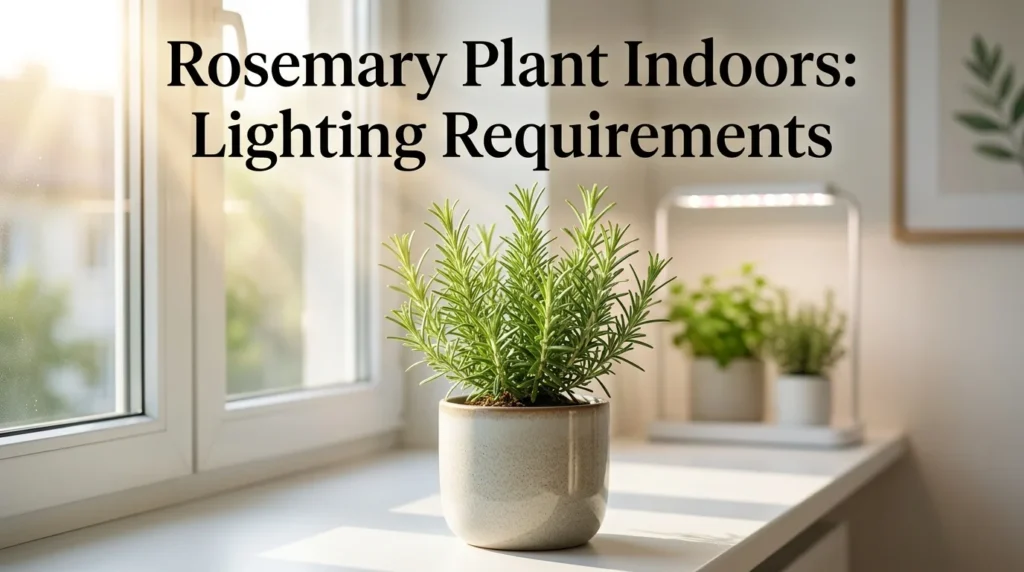
Rosemary Plant Indoors: Lighting Requirements
Light is often the deciding factor between thriving rosemary and struggling rosemary.
Rosemary generally needs much stronger light than many popular low-light houseplants.
Place the plant as close to a bright window as practical without exposing it to conditions that cause excessive heat or leaf scorching.
If natural sunlight is inadequate, use an LED grow light designed for plants.
How long should a grow light run?
A practical starting point is around 12–16 hours of supplemental light per day, depending on the strength of the fixture and how much natural light the plant receives.
The exact distance between the plant and grow light depends on the fixture. Always follow the manufacturer’s recommendations rather than assuming every LED has the same intensity.
A timer makes the routine much easier.
Give rosemary darkness too
Plants benefit from a consistent light-and-dark cycle. Leaving a grow light running continuously is unnecessary and can interfere with a predictable daily rhythm.
A timer also prevents the common problem of forgetting to switch the light off.
What Soil Is Best for Indoor Rosemary?
Rosemary needs a growing medium that drains quickly.
Avoid using heavy garden soil by itself in an indoor container. It can compact, drain poorly, and stay wet around the roots.
A quality potting mix amended with materials that improve drainage can work well.
Useful ingredients may include:
- Potting mix
- Perlite
- Coarse horticultural material
- Other appropriate drainage-improving amendments
The goal is not to create soil that dries instantly. You want a balance where water can move through the pot while enough moisture remains available for the roots.
Choosing the Right Pot
A container should have drainage holes.
This is not optional for indoor rosemary.
A decorative cachepot can be used around the growing pot, but excess water should not be allowed to remain trapped underneath the plant.
Choose a container only moderately larger than the root system. Moving a small rosemary plant into a huge pot can make moisture management harder because the extra soil stays wet for longer.
Terracotta pots can be particularly useful because they allow some moisture to evaporate through the container walls. However, the pot material does not replace proper watering and drainage.
How to Water Rosemary Indoors
Watering is where many beginners accidentally cause problems.
Do not water rosemary automatically every few days simply because your calendar says it is time.
Instead, check the growing medium.
Allow the upper portion of the soil to dry between thorough waterings. Then water deeply enough that excess water flows from the drainage holes.
After watering, empty water collected in a saucer or outer container.
A simple watering test
Push your finger into the upper layer of soil and assess the moisture.
You can also lift the container. A recently watered pot usually feels noticeably heavier than a pot that has dried considerably.
The correct watering frequency changes throughout the year.
Your rosemary may need more frequent watering when:
- Light levels are high
- Temperatures are warmer
- The plant is actively growing
- The container is small
- Air movement increases evaporation
It may need less water when:
- Light levels drop
- Growth slows
- Indoor temperatures are cooler
- Humidity is higher
- The plant has recently been moved
The important principle is water according to plant and soil conditions, not according to a fixed schedule.

Temperature and Humidity
Rosemary generally prefers comfortable indoor temperatures rather than extreme heat.
Keep it away from:
- Hot radiators
- Heating vents
- Strong air-conditioning blasts
- Very cold drafts
- Sudden temperature changes
Humidity deserves some clarification.
Rosemary does not need the highly humid environment preferred by many tropical houseplants. Increasing humidity simply because you think every houseplant needs it can sometimes create unnecessary problems.
Good airflow is more important than creating a miniature tropical environment.
A small fan can improve air movement around a crowded indoor growing area, but avoid blasting the plant with strong continuous airflow.
Fertilizing Indoor Rosemary
Rosemary is not a heavy feeder.
If you use a quality potting mix, the plant may need little fertilizer initially. As nutrients are gradually used or washed from the growing medium, light feeding during active growth can help.
Use a balanced fertilizer according to its label instructions rather than applying concentrated fertilizer frequently.
Overfertilizing can cause excessive soft growth and may contribute to salt buildup in the container.
A good indoor-gardening rule is simple: fertilizer supplements good growing conditions; it does not compensate for poor lighting, bad drainage, or incorrect watering.
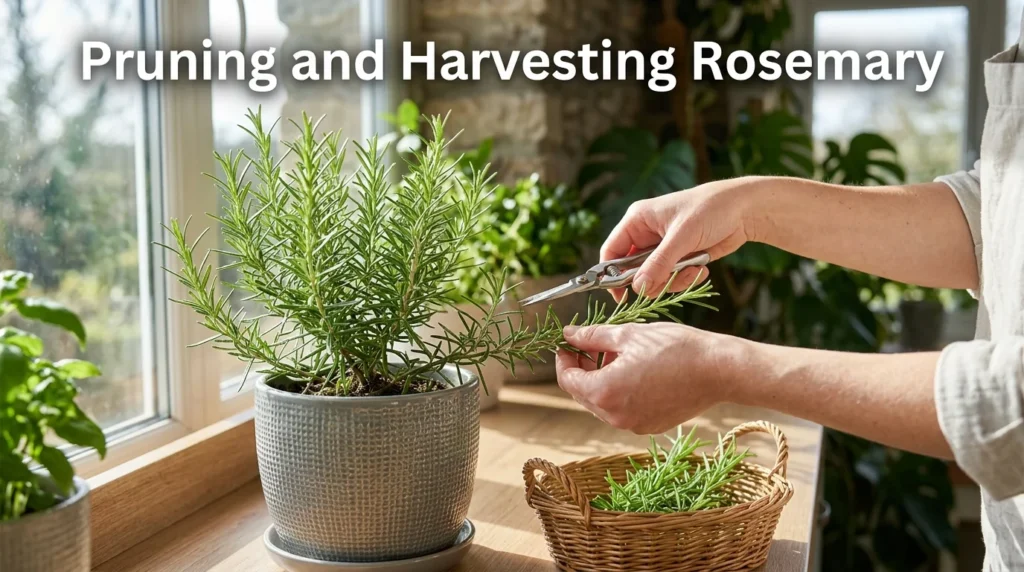
Pruning and Harvesting Rosemary
Regular harvesting can help keep rosemary manageable indoors.
Instead of repeatedly cutting into the oldest woody sections, harvest tender leafy stems where practical.
Use clean, sharp scissors or pruning shears.
How to encourage bushier growth
Pinching or trimming growing tips encourages branching in many young rosemary plants.
Avoid removing a large percentage of the plant at once, especially when it is already stressed.
For cooking, harvest only what you need and use the opportunity to shape the plant gradually.
Can you prune woody rosemary?
Yes, but be careful.
Very old woody stems may not respond as readily to aggressive cutting as younger green growth. If the plant is badly overgrown, gradual pruning is safer than removing most of its foliage in one session.
Seasonal Care for Indoor Rosemary
Indoor conditions still change throughout the year.
Spring
As light levels increase, rosemary may begin producing more active growth.
This is a good time to:
- Check the root system
- Refresh the potting mix if needed
- Begin or increase light feeding
- Prune lightly
- Adjust watering as growth increases
Summer
Summer may provide excellent natural light, but hot windows can become surprisingly intense.
Watch for excessive heat, rapid drying, or leaf scorch.
If the plant sits directly beside hot glass, move it slightly back while maintaining strong light.
Autumn
As daylight decreases, indoor rosemary may slow down.
Reduce fertilizer if active growth declines and monitor soil moisture more carefully.
Do not continue watering at the same frequency simply because you used that schedule during summer.
Winter
Winter can be challenging because homes may have lower light, heating, and dry air.
A grow light can make a major difference.
Keep the plant away from heating vents and avoid keeping the soil constantly wet when growth is slow.
Common Rosemary Problems and Solutions
Rosemary leaves are turning brown
Brown leaves can have several causes.
Possible reasons include:
- Underwatering
- Root problems
- Excessive fertilizer
- Very dry conditions
- Sudden environmental changes
- Poor lighting
Check the soil and roots before changing several things at once.
If the soil is extremely dry and the plant is wilted, lack of water may be involved. If the soil remains wet for long periods and the roots are unhealthy, excessive moisture is more likely.
Rosemary leaves are turning yellow
Yellowing often deserves an inspection of the roots and growing medium.
If the soil stays wet for too long, roots may become stressed.
Other possibilities include insufficient light, nutrient issues, natural aging of older foliage, or environmental stress.
Do not automatically add fertilizer when leaves turn yellow. First determine what is actually causing the problem.
Rosemary is dropping leaves
Sudden leaf drop can follow environmental stress.
Check:
- Light intensity
- Soil moisture
- Drainage
- Temperature
- Recent changes in location
- Signs of insects or disease
Avoid moving a struggling plant from one extreme environment to another repeatedly.
Rosemary is growing tall and thin
This is commonly a lighting problem.
If stems are stretching toward a window, provide stronger light or add a suitable grow light.
Pruning can improve the shape, but pruning alone will not solve a serious lack of light.
The soil stays wet
This is a warning sign.
Check whether:
- The container has drainage holes
- The pot is excessively large
- The soil is too dense
- The plant is receiving too little light
- You are watering too frequently
Improving drainage and adjusting watering is usually more useful than simply adding another product to the soil.
Pests to Watch For
Indoor rosemary can occasionally attract common plant pests.
Inspect the stems, leaf undersides, and new growth for signs of insects.
Possible pests include:
- Aphids
- Spider mites
- Whiteflies
- Scale insects
Early detection makes management much easier.
If you notice insects, isolate the affected plant from other houseplants when practical and identify the pest before choosing a treatment.
Avoid spraying random household chemicals on edible herbs.
Always follow the product label and observe any required harvest interval if a pesticide is used.
Can Rosemary Grow Under a Grow Light?
Yes. Rosemary can be grown successfully indoors under artificial lighting when the light provides adequate intensity and the plant receives a consistent daily cycle.
An LED grow light is often a practical choice because it can provide supplemental light without requiring a sunny windowsill.
For a small indoor herb setup, position the light according to the manufacturer’s recommended distance and monitor plant response.
If growth remains weak despite long lighting hours, do not assume that simply increasing the hours will solve the problem. The light may be too weak or too far away.
Light intensity matters as well as duration.
Can You Grow Rosemary Hydroponically?
Rosemary can be propagated and grown in controlled soilless systems, but it is not necessarily the easiest herb for a beginner to grow hydroponically.
Hydroponic systems provide roots with water, nutrients, oxygen, and support without conventional soil.
If you want to experiment, a small indoor hydroponic garden can be an interesting project. However, the system needs appropriate nutrient management, lighting, water quality, and root-zone oxygenation.
For most beginners who simply want fresh rosemary for cooking, a well-drained container with a quality growing medium is considerably simpler.
A Simple Indoor Rosemary Care Routine
A practical weekly routine can prevent many problems.
Once or twice a week
Inspect:
- Soil moisture
- Leaf color
- New growth
- Stem condition
- Pest activity
- Drainage
Do not automatically water just because it is your inspection day.
Every few weeks
Check:
- Whether the plant is leaning toward the light
- Whether growth is becoming leggy
- Whether fertilizer is actually needed
- Whether the container drains freely
Every few months
Consider:
- Light adjustments
- Gentle shaping
- Root and soil inspection
- Cleaning dust from nearby surfaces
- Checking the grow-light timer
This routine takes only a few minutes but can catch problems before they become severe.
Beginner Mistakes to Avoid
1. Treating rosemary like a tropical houseplant
Frequent watering and high humidity are not automatically beneficial.
2. Putting it in a dark kitchen corner
Convenience does not replace adequate light.
3. Using a pot without drainage
Decorative containers without drainage can trap water around the roots.
4. Watering on a fixed calendar
Indoor conditions change. Check the soil instead.
5. Using a huge container
Too much soil around a small root system can remain wet for too long.
6. Overfertilizing
More fertilizer does not mean faster, healthier growth.
7. Ignoring airflow
Crowded plants and stagnant air can contribute to pest and disease problems.
8. Trying to fix everything at once
When rosemary starts declining, change one or two obvious problems first. Making five major changes simultaneously makes it difficult to determine what helped.
Expert Tips for Better Indoor Rosemary Growth
Experienced indoor gardeners tend to focus on consistency rather than complicated routines.
Match watering to light. A rosemary plant receiving strong light may use water much faster than one sitting in a dim room.
Look at new growth. New leaves and stems often tell you more about current conditions than a few older leaves.
Rotate the container. If light comes primarily from one direction, occasionally turning the pot can help maintain more balanced growth.
Keep the foliage clean. Dust can accumulate indoors. A gentle cleaning can help keep leaves free of debris while also giving you an opportunity to inspect for pests.
Don’t chase humidity numbers. Focus first on light, drainage, watering, and airflow.
Use a grow light strategically. Supplemental lighting is especially useful when winter daylight or window exposure is inadequate.
Harvest gradually. Regular light harvesting can provide kitchen herbs while helping maintain a compact plant.
Conclusion
Growing rosemary indoors becomes much easier when you stop treating it like a typical moisture-loving houseplant. The key is to recreate the conditions this Mediterranean herb naturally prefers: strong light, excellent drainage, moderate watering, good airflow, and steady temperatures.
Start with a healthy plant and place it in the brightest suitable location you have. Use a container with drainage holes and a well-draining growing medium. Check soil moisture instead of following a rigid watering calendar, and use an LED grow light when natural light is not enough.
Pay attention to changes in new growth, leaf color, and soil moisture. These small observations often reveal problems before your rosemary becomes seriously stressed.
At GrowIndoorly.com, our goal is to make indoor gardening practical rather than intimidating. Whether you’re growing herbs on a windowsill, using a dedicated grow-light shelf, or experimenting with hydroponics, understanding what your plants actually need is the foundation for success.
With consistent care and a little observation, a productive rosemary plant can become one of the most rewarding herbs in your indoor garden.
Knowledge Check: Test Your Rosemary Care Skills
Before you finish, see if you can answer these questions without looking back.
Question 1
What is usually more important for healthy indoor rosemary: very high humidity or strong light?
Answer: Strong light. Rosemary is adapted to bright conditions, and insufficient light commonly causes weak, stretched growth.
Question 2
Should you water rosemary on the same schedule every three or four days?
Answer: No. Check the growing medium and the plant’s conditions first. Watering needs change with light, temperature, season, and container size.
Question 3
Why are drainage holes important?
Answer: They allow excess water to escape and help prevent the root zone from remaining excessively wet.
Question 4
Your rosemary is tall, thin, and leaning toward the window. What should you investigate first?
Answer: Light. The plant may need stronger natural light or supplemental grow lighting.
Question 5
Does adding fertilizer fix poor lighting?
Answer: No. Fertilizer cannot compensate for inadequate light, poor drainage, or incorrect watering.
Question 6
Why might a large pot cause problems for a small rosemary plant?
Answer: The extra growing medium can hold moisture for a long time, increasing the risk of an overly wet root zone.
Frequently Asked Questions
How much sunlight does rosemary need indoors?
Rosemary generally performs best with strong light. A bright, sunny window can work well, while a grow light can supplement or replace insufficient natural light.
How often should I water rosemary indoors?
There is no single correct schedule. Allow the growing medium to dry between thorough waterings, then water deeply and let excess water drain away.
Why is my indoor rosemary dying?
Common causes include insufficient light, excessive watering, poor drainage, root stress, temperature problems, pests, or sudden environmental changes. Inspect the growing conditions before assuming the plant needs more fertilizer.
Can rosemary grow indoors all year?
Yes. Rosemary can be maintained indoors year-round when it receives adequate light, appropriate watering, good drainage, and reasonable temperatures.
Should I mist my rosemary plant?
Regular misting is generally unnecessary. Focus instead on good airflow, strong light, proper drainage, and appropriate watering.
Can rosemary survive in a low-light room?
It may survive temporarily, but long-term growth is usually much better with strong light. If natural light is inadequate, supplemental grow lighting is a better solution.
What is the best pot for indoor rosemary?
Choose a pot with drainage holes that is appropriately sized for the root system. Terracotta can be useful because it dries somewhat faster than many nonporous containers.
Can I grow rosemary in an indoor hydroponic system?
Yes, rosemary can be grown in soilless systems, but hydroponic cultivation requires more careful management of nutrients, water, oxygen, and lighting. Container growing is usually easier for beginners.

Megan Foster is the founder and lead writer of GrowIndoorly.com, where she shares practical, easy-to-follow advice for growing healthy indoor plants. She is passionate about helping beginners and experienced plant lovers build thriving indoor gardens with confidence. Megan writes about houseplants, indoor herbs, succulents, hydroponics, grow lights, plant propagation, watering, soil care, and everyday plant maintenance.
She enjoys researching trusted gardening techniques and transforming them into simple, actionable guides that readers can easily apply at home. Her goal is to make indoor gardening more enjoyable and accessible by providing clear, reliable information that helps people keep their plants healthy throughout the year. Whether you’re caring for your first houseplant or expanding your indoor plant collection, Megan’s practical tips are designed to help you grow with confidence.


