
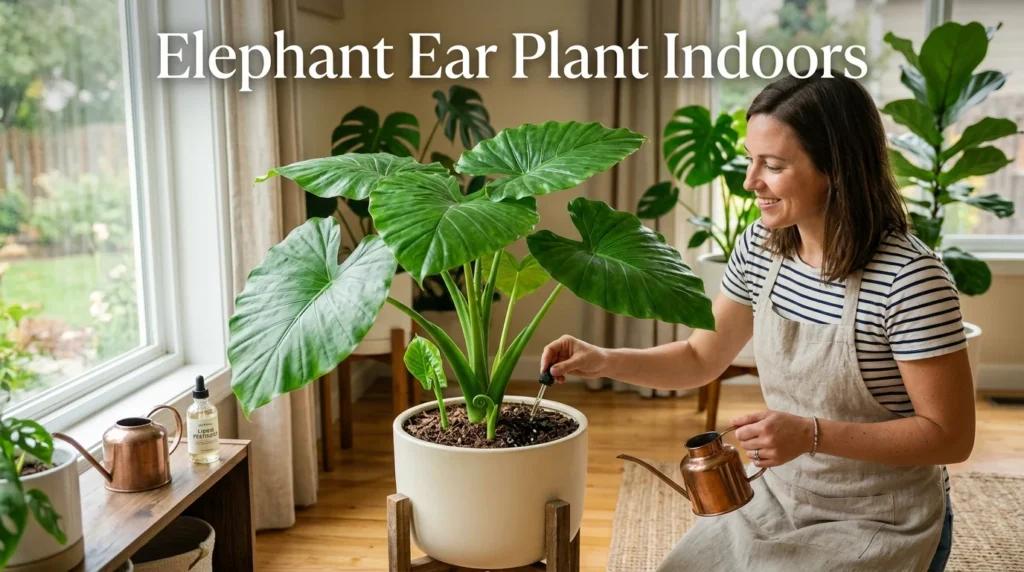
Growing an elephant ear plant indoors transforms residential spaces into dramatic, tropical sanctuaries with giant, architectural foliage. “Elephant ear” is a common umbrella term primarily referring to tropical plants in the Alocasia, Colocasia, Xanthosoma, and Caladium genera.
To keep an elephant ear plant indoors thriving year-round, growers must carefully simulate warm understory conditions. Unlike forgiving, low-light houseplants, indoor elephant ears require high relative humidity (above 50–60%), bright filtered light, rich yet fast-draining aroid soil, and warm temperatures.
Successfully maintaining an elephant ear plant indoors also involves managing seasonal shifts, pest prevention, and corm propagation. During autumn and winter, reduced daylight hours and low indoor humidity can trigger winter dormancy, causing the plant to drop leaves and retreat into its underground tuber.
This comprehensive master guide covers genus and cultivar selection, precise lighting limits, custom aroid soil mixes, irrigation protocols, humidity management, spider mite prevention, corm propagation, and diagnostic troubleshooting for long-term indoor success.
Key Genera Compared for Indoor Growing
While all elephant ears share large, dramatic foliage, understanding the differences between Alocasia, Colocasia, and Xanthosoma helps growers choose the right species for their indoor environment. If you are new to elephant ears, start with a forgiving type that matches your brightest, most humid spot rather than the most dramatic cultivar. Beginners do best with plants whose light and moisture needs align with what their home already offers, since forcing a high-humidity species into dry air creates constant problems.
| Genus / Type | Leaf Orientation | Light Needs | Water & Humidity Preference | Best Indoor Location | Care Difficulty |
| Alocasia (e.g., A. macrorrhizos, A. Polly, A. Frydek) | Leaves point upward or horizontally; peltate attachments | Bright indirect light; sensitive to harsh sun | Consistent moisture; high humidity (>60%); fast drainage | Near East or shielded South/West windows | Intermediate to Advanced |
| Colocasia (e.g., C. esculenta ‘Black Magic’, ‘Illustris’) | Leaves point downward; petiole attaches inside leaf blade | Bright indirect light to gentle direct sun | High moisture tolerance; loves warm, bog-like moisture | Sunny sunrooms, balconies, or window nooks | Intermediate |
| Xanthosoma (e.g., X. sagittifolium, ‘Lime Zinger’) | Leaves point downward or outward; deep sagitate lobes | Bright indirect light | Prefers moist, warm soil; high humidity | Spacious living rooms with bright light | Intermediate |
| Caladium (e.g., C. bicolor) | Flat, heart-shaped variegated leaves | Medium to bright indirect light | Moderate moisture; strict winter tuber dormancy | Bright desks, plant cabinets, or plant shelves | Beginner / Intermediate |
Environmental Requirements for Elephant Ears Indoors
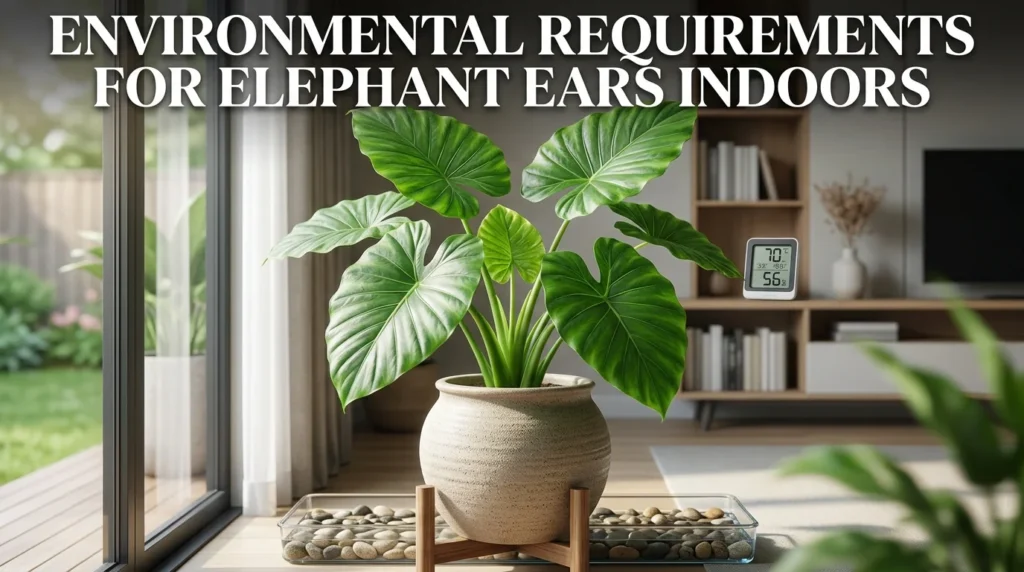
Replicating tropical understory conditions is essential when maintaining an elephant ear plant indoors. Think of light, warmth, and humidity as one connected system rather than separate tasks. A plant that gets enough light but sits in cold, dry air will still struggle, and warm humid air cannot compensate for deep shade. Once your plant settles into a suitable spot, avoid moving it around, since sudden changes often trigger leaf drop.
1. Light Intensity and Placement
- Optimal Light: Place your plant 2 to 4 feet back from a bright South- or West-facing window, or directly in front of an unobstructed East-facing window. Full-spectrum ambient light fuels rapid leaf expansion.
- Direct Sun Risks: Unfiltered, intense midday sunlight burns thin leaf blades, causing scorched brown patches and faded foliage colors.
- Low Light Stress: Dim lighting prevents large leaf formation, causes leaf stems (petioles) to stretch and collapse, and increases the risk of root rot from slow soil drying.
- Supplemental Lighting: Use a dedicated LED grow lamp supplying $150 – 250 \ \mu\text{mol/m}^2/\text{s}$ (PPFD) for 12 to 14 hours daily if natural windows fall short.
2. Temperature and Thermal Stability
- Ideal Temperature Range: Maintain indoor temperatures between 65°F and 85°F (18°C to 29°C).
- Cold Damage: Elephant ears are extremely cold-sensitive. Exposure to temperatures below 55°F (13°C) can shock the plant, causing foliage to collapse and forcing the corm into unwanted dormancy. Keep pots clear of drafty windows, exterior doors, and air conditioning vents.
3. High Humidity Management
- Target Humidity: Elephant ears thrive best at 55% to 75% relative humidity (RH).
- Dry Air Signs: Low indoor humidity (below 40% RH) common during winter heating causes dry, brown leaf margins, crisp tips, and leaf splitting during unfurling.
- Boosting Humidity: Use a dedicated cool-mist room humidifier, group tropical plants together to create a microclimate, or place the pot on a pebble tray filled with water. Avoid heavy leaf misting, as standing water droplets invite bacterial leaf spot.
Substrate Formulation, Irrigation, and Feeding
Proper soil structure and moisture control form the foundation of indoor elephant ear care.
The Aerated Aroid Soil Recipe
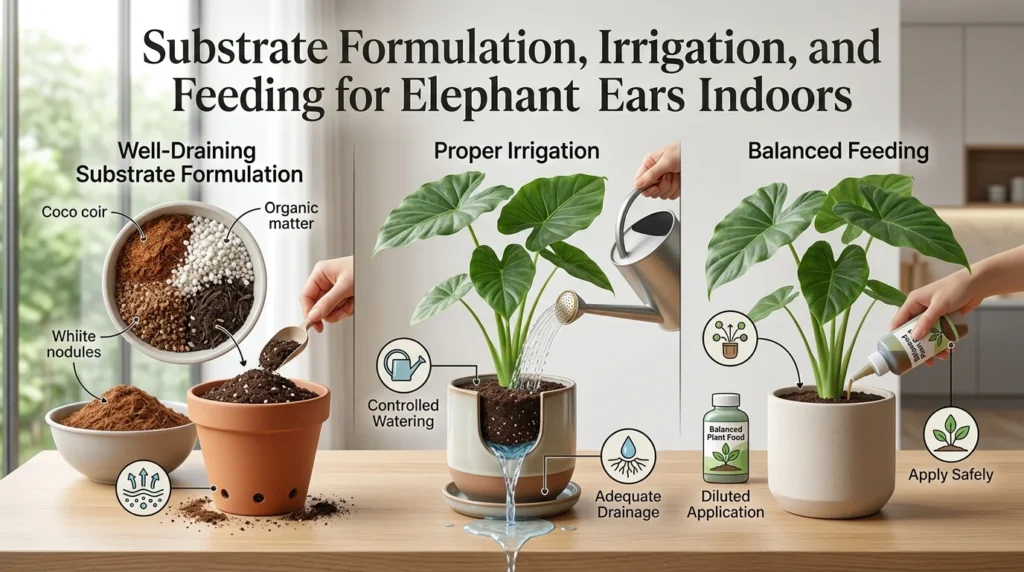
Standard dense potting soil retains excess water, suffocating roots and rotting underground corms. Create an airy, highly porous, yet moisture-retentive blend:
- 30% High-Quality Peat Moss or Coco Coir (Moisture retention and organic base)
- 30% Coarse Perlite or Pumice (Aeration and rapid drainage)
- 30% Orchid Bark Chips (Structure and oxygen pockets)
- 10% Worm Castings or Horticultural Charcoal (Nutrient delivery and sweetening)
Moisture Protocol (The “Top Third” Rule)
- When to Water: Water when the top 25–30% (about 1 to 2 inches) of the potting media feels dry to the touch. Do not allow the root zone to dry out completely, but never leave the soil waterlogged.
- Watering Technique: Apply room-temperature, filtered, or dechlorinated water evenly until it drains from the pot’s bottom holes. Warm tap water reduces root shock.
- Drainage Safety: Empty drainage saucers within 15 minutes of watering. Roots sitting in stagnant water rapidly develop fatal fungal decay.
Balanced Nutrient Schedule
Elephant ears are heavy feeders during active growth (spring through early autumn). Always apply fertilizer to moist soil, never to a dry root ball, to avoid burning the roots. Every few weeks, flush the pot with plain water to rinse away accumulated salts. If leaf tips turn brown despite correct watering, overfeeding is the likely cause, so scale the dose back before the next application.
- Fertilizer Ratio: Apply a balanced liquid houseplant fertilizer (such as 10-10-10 or 20-20-20) diluted to half-strength every 2 to 3 weeks from April through September.
- Micro-Nutrient Support: Ensure your plant food includes Calcium and Magnesium to prevent petiole weakness and leaf yellowing.
- Winter Pause: Stop fertilizing entirely during fall and winter when growth naturally slows down or pauses.
Step-by-Step: Managing Winter Dormancy vs. Root Rot
Indoor growers frequently confuse natural winter dormancy with root rot. When light levels and temperatures drop in autumn, elephant ears may drop leaves sequentially until only the tuber remains.
+-----------------------------------------------------------------------+
|                    DORMANCY VS. ROOT ROT DIAGNOSIS                    |
|                                                                       |
| [ Foliage Yellows ] --> Check Corm Texture:                           |
|                         * FIRM Corm = Natural Winter Dormancy         |
|                         * SOFT/MUSHY Corm = Fungal Root Rot           |
+-----------------------------------------------------------------------+
1.Inspect the Underground Corm:Firm corms mean natural rest; soft corms indicate rot.
Gently remove topsoil around the base. If the corm is firm and solid, the plant is entering natural dormancy. If it is soft, brown, and foul-smelling, rot is present.
2.Prune Fading Leaves:Allow old foliage to yellow and dry naturally.
Do not prematurely chop yellowing leaves during dormancy entry; the plant absorbs vital nutrients back into the underground corm before leaf shedding.
3.Reduce Watering Frequency:Water sparingly—only once every 4 to 6 weeks.
During winter rest, a leafless corm consumes almost no water. Keep the soil slightly barely damp to prevent total corm shriveling without triggering rot.
4.Maintain Warmth & Light:Keep in a warm spot above 65°F (18°C).
Place resting containers in a warm room with gentle light to await spring revival.
5.Resume Care Upon Re-emergence:Increase water and heat as new shoots emerge in spring.
When new green spikes poke through the soil surface in spring, relocate to bright indirect sun and resume regular watering and light feeding routines.
Propagation: Harvesting Corms and Division
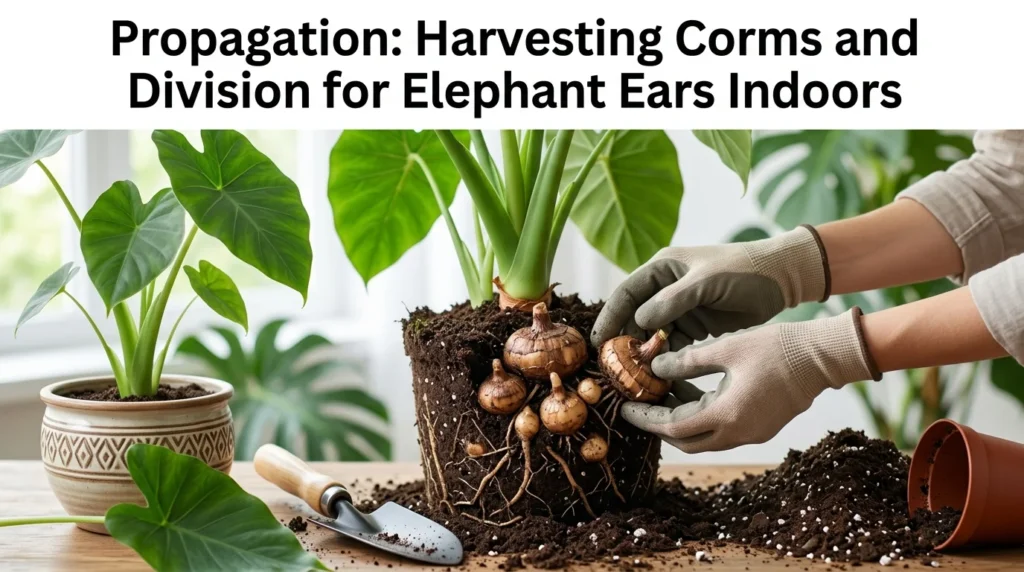
Expanding your indoor elephant ear collection is easy through corm harvesting and tuber division during spring repotting:
- Unpot the Parent Plant: Carefully remove the plant from its container during spring repotting and shake off loose soil mix.
- Locate Offset Corms: Search the main root mass for small, solid, pea- to walnut-sized offset corms attached to the main tuber or growing along runner roots.
- Separate or Slice Offsets: Gently snap off mature corms or use a sterile knife to cut them cleanly away from the parent plant.
- Pot Up Small Corms: Plant isolated corms upright in small 3- to 4-inch pots filled with damp aroid soil mix or pure sphagnum moss. Position the growing tip facing up, covered by 1 inch of substrate.
- Provide Warmth & Moisture: Cover the pot with a clear plastic dome or bag to maintain high humidity (above 80% RH) and place in bright light at 75°F to 80°F (24°C to 27°C). New shoots will emerge within 3 to 6 weeks.
Troubleshooting Indoor Elephant Ear Pests & Problems
Elephant ears have soft, sap-rich leaves that can attract common houseplant pests. Use this practical diagnostic matrix to address issues quickly:
| Problem | Cause | What to Check | Solution |
| Fine webbing under leaves; speckled yellow dots | Spider mites (Tetranychidae) | Undersides of leaves, petiole junctions | Wash leaves with warm water; apply neem oil or insecticidal soap every 5 days for 3 weeks; increase ambient room humidity |
| Yellowing leaves starting from bottom up | Overwatering; dense waterlogged soil; natural aging | Soil moisture at root level; root firmness | Adjust watering to let top third dry; trim oldest outer leaf if only one leaf is fading naturally |
| Brown, crispy, dry leaf margins and tips | Low air humidity; mineral buildup from tap water | Room humidity (<40% RH); tap water quality | Raise humidity above 50% using a humidifier; flush soil with distilled or rainwater |
| Drooping, weeping petioles; bent stems | Insufficient light; underwatering; cold drafts | Sunlight hours; soil dryness; room temperature | Relocate to brighter light; water thoroughly if soil is dry; ensure room temperature stays above 65°F |
| Bacterial water drops on leaf tips (Guttation) | Normal transpiration process | Water droplets forming on leaf tips overnight | Harmless natural process; place towels under leaves to protect wooden furniture |
Test Your Knowledge: Indoor Elephant Ear Care Quiz
Question 1
What is the primary light requirement for growing an elephant ear plant indoors successfully?
- A) Direct, scorching afternoon sun all day.
- B) Bright indirect light or filtered sunlight.
- C) Total shade in a windowless room.
- D) Low-intensity artificial night lighting.
Question 2
How should you adjust your watering schedule if your indoor elephant ear enters winter dormancy?
- A) Double the amount of water applied daily.
- B) Stop watering entirely and throw the plant away.
- C) Reduce watering dramatically, keeping soil barely damp to prevent corm shriveling.
- D) Add high-nitrogen fertilizer twice a week.
Question 3
Which soil mix composition works best for indoor Alocasia and Colocasia species?
- A) Pure dense garden clay soil.
- B) Pure beach sand without organic matter.
- C) An airy, porous blend of peat/coco coir, perlite, orchid bark, and worm castings.
- D) Unbroken rock gravel.
Question 4
What is the most common pest problem associated with low humidity on indoor elephant ears?
- A) Earthworms.
- B) Spider mites.
- C) Caterpillars.
- D) Snails.
Question 5
Why do mature elephant ear leaves often drop water droplets from their tips in the morning?
- A) The plant is dying of root rot.
- B) It is a natural process called guttation, where roots push out excess water under high moisture conditions.
- C) Spider mites are spraying liquid.
- D) The plant is absorbing air pollution.
(Answer Key: 1-B, 2-C, 3-C, 4-B, 5-B)
Common Mistakes to Avoid with Indoor Elephant Ears
Most indoor elephant ear setbacks come from a few avoidable habits. Watch out for these:
- Using dense, waterlogged potting soil that suffocates roots and rots corms.
- Placing the plant in a dim corner and expecting large, dramatic leaves.
- Letting cold drafts or air conditioning chill the plant below its comfort zone.
- Watering a dormant, leafless corm as if it were actively growing.
- Ignoring the undersides of leaves where spider mites establish first.
Frequently Asked Questions
Is an elephant ear plant indoor safe for homes with pets?
No. All members of the elephant ear family (Alocasia, Colocasia, Xanthosoma, and Caladium) contain insoluble calcium oxalate crystals. If chewed or swallowed by cats or dogs, they cause severe oral pain, swollen lips/tongue, excessive drooling, and vomiting. Keep these plants well out of reach of curious pets.
Why does my indoor elephant ear only keep 3 or 4 leaves at a time?
This is very common in young or pot-bound elephant ears. As a new leaf emerges, the oldest outer leaf yellowing and dying off indicates that the plant is reallocating energy and nutrients. To support more leaves, upgrade to a larger pot, provide brighter light, and feed consistently during active growth.
Can I grow an elephant ear plant indoors from a grocery store corm?
Yes! You can plant edible taro roots (Colocasia esculenta) purchased from Asian or Latin grocery markets. Plant the corm upright in rich, fast-draining potting media, keep it warm (above 75°F), keep the soil moist, and provide bright light to sprout foliage.
Why are the leaf stems bending over and snapping?
Weak, floppy leaf stems (petioles) are caused by insufficient light (etiolation), severe underwatering, or sudden cold drafts. Ensure the plant receives adequate indirect sun, use a soft stake if necessary, and keep temperatures consistently warm.
Should I trim off yellow lower leaves?
Yes. Once an outer leaf turns completely yellow or brown, slice the petiole cleanly near the base using a sterile knife or shears. This keeps the plant clean and prevents pests from hiding in decaying plant matter.
How big do elephant ear plants get indoors?
Indoors, height and leaf size depend on the species and container size. Larger cultivars like Alocasia macrorrhizos or Xanthosoma can reach 4 to 6 feet tall with leaves 2 feet long, whereas dwarf cultivars like Alocasia Polly stay compact at 1 to 2 feet tall.
Can I move my indoor elephant ear outside for the summer?
Yes. Moving your plant outdoors during warm summer months (when night temperatures stay above 60°F) promotes rapid growth. Place it in a shaded or protected patio spot with indirect light to prevent sun scold, and bring it back inside before autumn temperatures drop below 55°F.
Alocasia leaves point upward or horizontally with peltate attachments and need bright indirect light, while Colocasia leaves point downward with the petiole attaching inside the leaf blade and tolerate more moisture, even bog-like conditions.
Check the corm: a firm, solid corm means natural winter dormancy, while a soft or mushy corm indicates fungal root rot.
Water sparingly — only once every 4 to 6 weeks during winter rest, keeping the soil slightly barely damp to prevent the corm from shriveling.

Megan Foster is the founder and lead writer of GrowIndoorly.com, where she shares practical, easy-to-follow advice for growing healthy indoor plants. She is passionate about helping beginners and experienced plant lovers build thriving indoor gardens with confidence. Megan writes about houseplants, indoor herbs, succulents, hydroponics, grow lights, plant propagation, watering, soil care, and everyday plant maintenance.
She enjoys researching trusted gardening techniques and transforming them into simple, actionable guides that readers can easily apply at home. Her goal is to make indoor gardening more enjoyable and accessible by providing clear, reliable information that helps people keep their plants healthy throughout the year. Whether you’re caring for your first houseplant or expanding your indoor plant collection, Megan’s practical tips are designed to help you grow with confidence.


